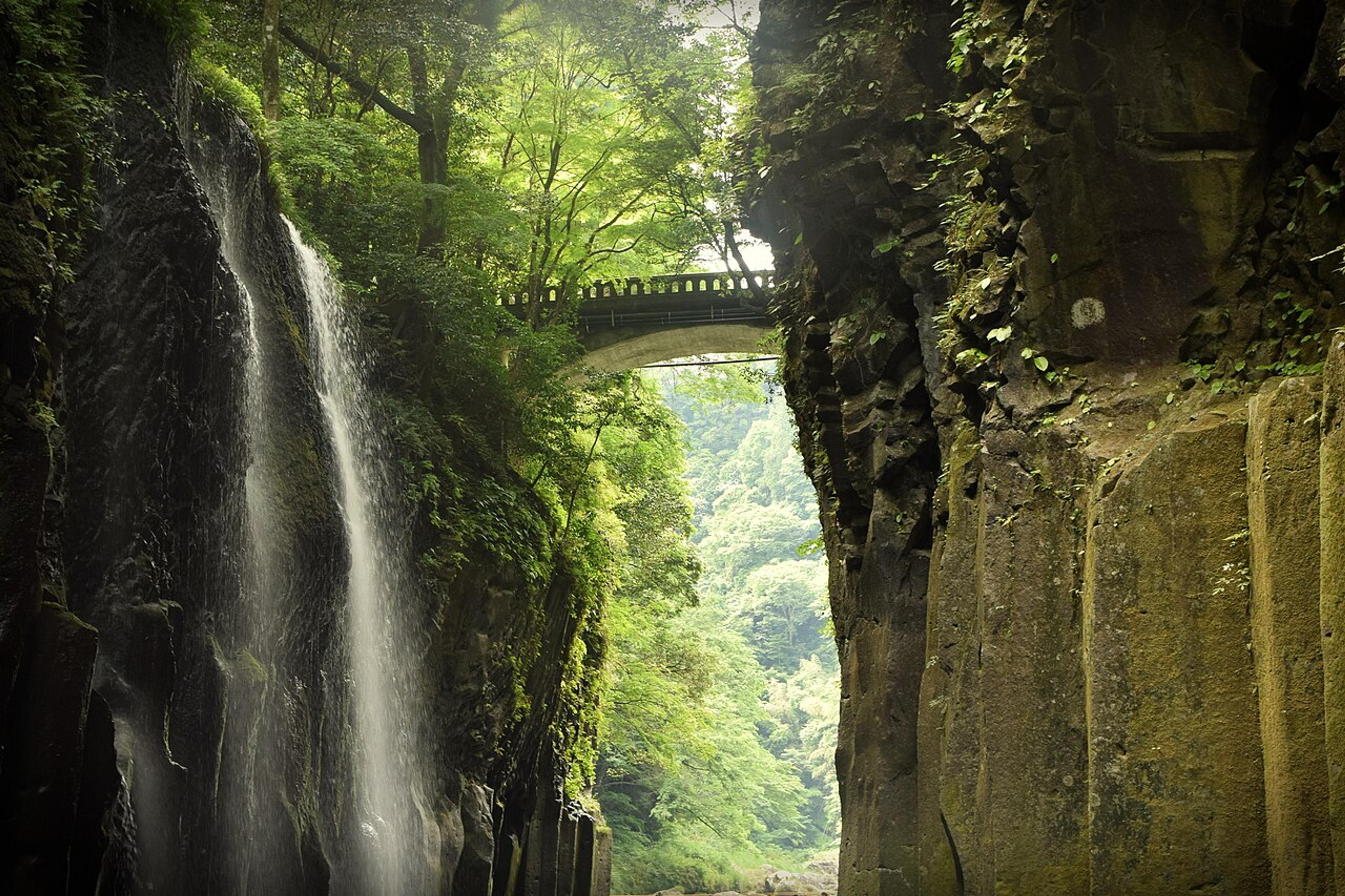
Kyushu delivers a volcanic gorge from Japanese mythology, a curated onsen village with 7 spring types, and Yakushima's ancient forests.
Koku Travel · February 15, 2026
12 places in this guide
Kyushu is Japan's third-largest island and its most geologically active. The caldera of Mount Aso, the largest active volcano in Japan, sits at the island's center, and volcanic heat powers the densest concentration of hot springs in the country. But beyond the onsen, Kyushu holds mythological landscapes, hidden Christian heritage, and some of the oldest forests on Earth. Most visitors stick to Fukuoka, Beppu, and maybe Nagasaki. The five places below sit outside that triangle.
Takachiho Gorge
A ravine in Miyazaki prefecture where basalt columns, formed by eruptions of nearby Mount Aso roughly 120,000 years ago, rise up to 100 meters on both sides of the Gokase River. The columnar jointing creates walls that look almost architectural, like stacked organ pipes. The 17-meter Manai-no-Taki waterfall cascades into emerald water, and visitors paddle rowboats directly beneath it. The boat wait can reach two hours on autumn weekends, arrive early or visit on a weekday.
In Japanese mythology, Takachiho is where Ninigi-no-Mikoto, grandson of sun goddess Amaterasu, descended from heaven to rule the earth. The nearby Amano Iwato Shrine marks the cave where Amaterasu hid in anger, plunging the world into darkness. A priest-guided walk to the cave viewing point (free, available during shrine hours) reveals a moss-covered rock face across a sacred river gorge. At night, the Takachiho Shrine hosts traditional kagura dance performances, masked dances depicting the gods luring Amaterasu from her cave. Takachiho is about 90 minutes by bus from Kumamoto, with no rail access.
Kurokawa Onsen
A mountain hot spring village at 700 meters elevation in Kumamoto prefecture, Kurokawa is the antithesis of large-scale onsen resorts. Thirty ryokan, each with a unique spring source, line a narrow valley of the Tanoharu River, connected by footpaths through forest. The village has deliberately preserved its character, wooden buildings, earthen walls, bamboo fencing, no neon, no concrete. In the 1980s, the ryokan owners collectively agreed to limit signage and maintain natural landscaping, creating the cohesive aesthetic that defines the village today.
A rotenburo meguri pass (1,300 yen) grants access to three open-air baths of your choice across different ryokan. Kurokawa features 7 of Japan's 10 classified hot spring water types, sulfur, iron, sodium chloride, simple thermal, and more, which means you can experience dramatically different mineral compositions, temperatures, and colors within a 10-minute walk. In winter, the bamboo-sphere illuminations along the river add a warm glow to the snow-dusted forest. Access is by bus from Aso or Kurokawa IC, about 60 minutes from Kumamoto.
Sakitsu Village
A UNESCO World Heritage fishing village on the Amakusa Islands in western Kumamoto. For 250 years during Japan's Christian ban (1614-1873), the villagers of Sakitsu secretly practiced their faith, praying to hidden icons disguised as Buddhist figures, baptizing in secret, passing beliefs orally across generations without a single priest. When French missionaries arrived in 1865, the Hidden Christians of the region revealed themselves, one of the most remarkable survivals of religious practice in history.
The Gothic-style Sakitsu Church (rebuilt in 1934 by French missionary Father Halbout) stands on the site where authorities once forced villagers to trample on fumie, images of Christ, to prove they were not Christian. It is the only church in Japan with tatami mat flooring, a fusion of faith and culture that captures the community's identity. The village is tiny, a handful of fishing boats, a narrow harbor, the church. The drive from Kumamoto takes about 2.5 hours via the five Amakusa bridges, which island-hop across the Yatsushiro Sea.
Yakushima
A round volcanic island 60 kilometers south of the Kyushu mainland, Yakushima holds some of the oldest trees on Earth. The island was designated a UNESCO Natural World Heritage Site in 1993 for its ancient cedar forests, which contain trees over 1,000 years old, locally called yakusugi. The Jomon Sugi, estimated at 2,170 to 7,200 years old, is the most famous, an 8 to 10 hour round-trip hike through primordial forest to reach it. The trail starts at the Arakawa trailhead, requiring a pre-booked shuttle bus from March through November.
But Yakushima's lesser-known trails are equally rewarding. Shiratani Unsuikyo's moss forest (the direct inspiration for Princess Mononoke, confirmed by Miyazaki himself) has waterfalls and short loop trails accessible in 2 to 4 hours. The Hananoego high-altitude peat bog at 1,600 meters resembles a manicured Japanese garden formed entirely by nature. The Seibu Rindo forest road along the western coast offers encounters with wild Yakushima deer and macaques, both endemic subspecies smaller than their mainland relatives. The island receives over 4,000mm of rainfall annually, locals say "it rains 35 days a month." Ferries run from Kagoshima (4 hours standard, 2 hours high-speed), and JAC operates 30-minute flights.
Arita
The birthplace of Japanese porcelain, Arita is a small town in Saga prefecture where Korean potter Yi Sam-pyeong discovered kaolin clay in 1616 at Izumiyama quarry. The ceramic tradition that followed, first Arita-yaki, then exported to Europe as Imari ware through the Dutch East India Company, changed European decorative arts and influenced Meissen, Delft, and Wedgwood. At its peak, Arita porcelain was more valuable than gold by weight in European courts.
Today, historic kilns and workshops line the streets. The Kyushu Ceramic Museum holds a comprehensive collection tracing 400 years of production. A distinctive blue porcelain torii gate marks the entrance to Tozan Shrine, surrounded by porcelain-walled fences. The Kakiemon and Imaemon kilns, both designated as Intangible Cultural Properties, still operate using traditional techniques passed through 14 generations. The annual Golden Week pottery fair (late April to early May) draws 800,000 visitors to browse stalls from hundreds of potters. Arita Station is on the JR Sasebo Line, about 90 minutes from Hakata.
Getting Around
The Kyushu Shinkansen connects Hakata (Fukuoka) to Kagoshima-Chuo in 80 minutes, with stops at Kumamoto and Shin-Yatsushiro. Takachiho, Kurokawa, and Sakitsu all require buses or a car, the mountainous interior of Kyushu has limited rail coverage. Yakushima requires a ferry or flight from Kagoshima. Arita is accessible by JR. A JR Kyushu Rail Pass (3 or 5 days) covers the trains; supplement with a car rental for the interior destinations. The climate is mild year-round, with autumn (October to November) offering the best balance of weather and foliage. Kyushu's two discount airlines, Solaseed Air and Peach, connect Fukuoka and Kagoshima to the rest of Japan cheaply.
Featured in this guide
Places to Visit

Turn this guide into a trip
We'll prioritize these 12 places when building your itinerary.