Cross Japan's largest national park on foot, Asahidake to Kurodake, through alpine flower fields, volcanic fumaroles, and a mountain hut system built for solitude.
Yuku Japan · February 16, 2026
9 places in this guide
The Roof of Hokkaido
Daisetsuzan National Park covers 2,268 square kilometers of central Hokkaido, larger than all of Tokyo's 23 wards combined and Japan's biggest national park by a wide margin. The name means 'Great Snowy Mountains,' and the description is literal: the peaks hold snow into July, the alpine zone starts at just 1,500 meters (compared to 2,500 meters on Honshu), and the treeline drops low enough that vast stretches of the park are open tundra-like terrain more reminiscent of Scandinavia than Japan.
The park's central massif contains Hokkaido's highest peaks, Asahidake (2,291m), Hokkaido's tallest, and Kurodake (1,984m), connected by a ridge traverse that is one of the finest multi-day hikes in Japan. The Grand Traverse from Asahidake to Kurodake covers roughly 17 kilometers of alpine terrain, passing through volcanic fumarole fields, alpine flower meadows, snowfields, and rocky ridgelines with views that extend to the Sea of Okhotsk on clear days.
Asahidake: The Starting Point
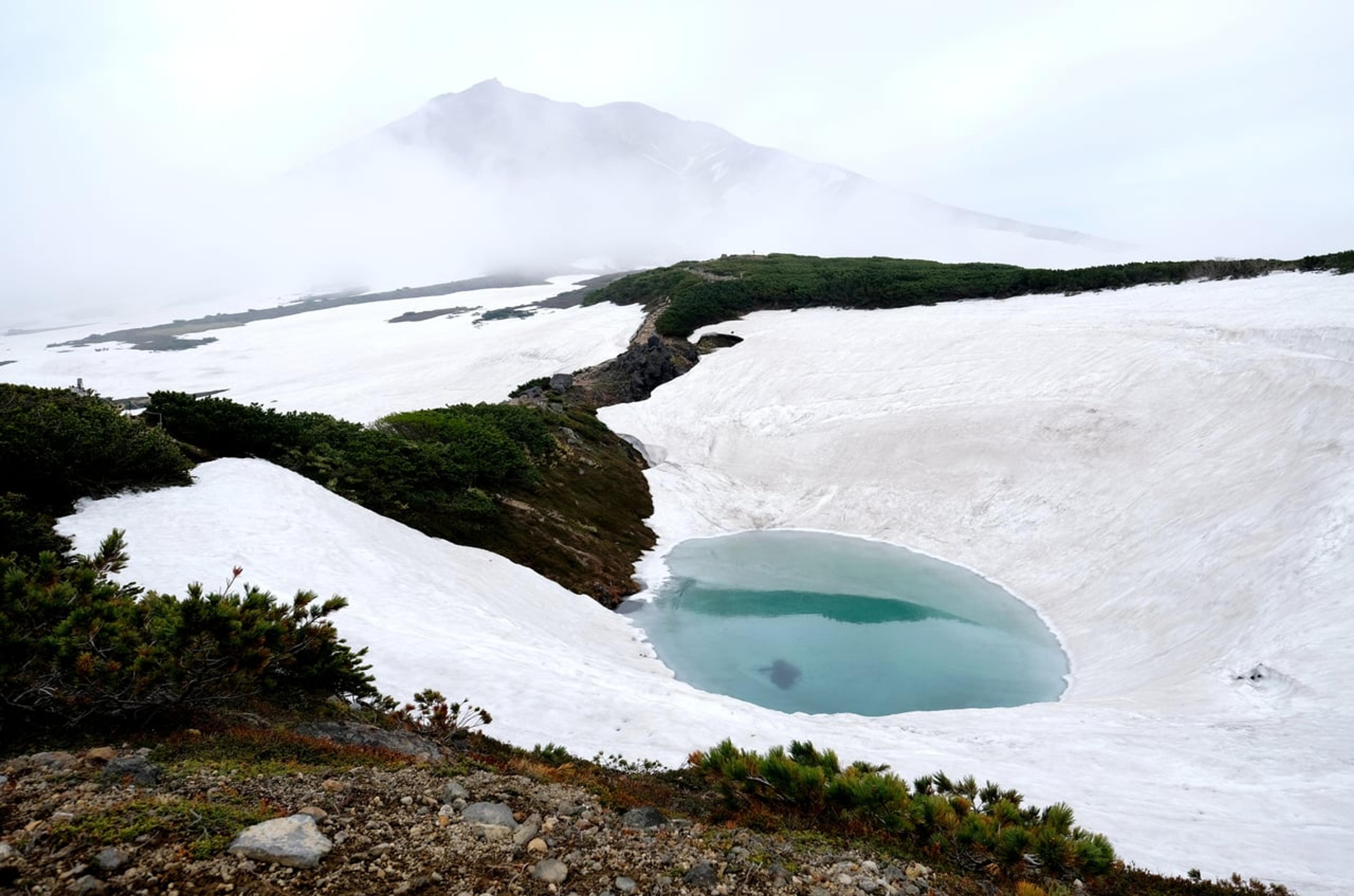
Most hikers begin at Asahidake Ropeway (¥2,200 return), which lifts you from the forested base at 1,100 meters to the Sugatami station at 1,600 meters. From the upper station, a boardwalk loops through the Sugatami Pond area, where volcanic fumaroles vent sulfurous steam from the hillside and the reflection of Asahidake shimmers in the pond's surface. The boardwalk is accessible to all fitness levels and gives a taste of the alpine landscape.
The summit climb from the ropeway station is a 2.5-hour ascent through increasingly bare volcanic terrain. The trail passes Sugatami Pond, crosses a snowfield (present into August most years), and ascends a series of switchbacks through loose volcanic rock to the summit crater rim. The crater itself is active, fumaroles steam within it, and the sulfur smell is sharp at the top. The summit view encompasses the entire Daisetsuzan range, the patchwork of Hokkaido's agricultural plains below, and on the clearest days, the distant cone of Rishiri Island 300 kilometers to the north.
Asahidake's weather changes rapidly. Cloud can engulf the upper mountain within minutes, reducing visibility to near zero on the exposed ridge. Carry a GPS device or download the trail on a phone app, the trail markers are cairns that become invisible in fog. Turn back if conditions deteriorate; the ridge is no place to navigate blind.
The Traverse: Asahidake to Kurodake
The ridge traverse from Asahidake's summit to Kurodake runs roughly northeast along the park's central spine. The route descends from Asahidake into the Nakadake col, then climbs over Mamiyagadake and Hokuchindake before dropping to the Kurodake Ishimuro mountain hut and ascending Kurodake's summit. The total distance is approximately 17 kilometers with 1,200 meters of cumulative elevation gain. Most hikers complete it in two days, overnighting at the Kurodake Ishimuro hut.
The terrain is extraordinary. Between peaks, the ridgeline passes through alpine flower fields that peak in mid-July, a riot of purple alpine gentian, white Hokkaido anemone, yellow cinquefoil, and the delicate pink of moss campion. The flower season is compressed into roughly four weeks, and during peak bloom, the tundra-like landscape transforms into a garden that extends to every horizon. Snow lingers in the col between peaks well into August, and hikers cross snowfields with ice axes (available for rent at the ropeway station, ¥500/day) for safety.
Alpine flower peak is typically July 10-August 5. Snow conditions on the traverse are safest from mid-July through September. The autumn color season (mid-September) turns the lower slopes crimson and gold while the alpine zone is already bare. The ropeway operates from mid-June through mid-October.
Mountain Huts and Logistics
The Kurodake Ishimuro hut (石室) sits at 1,900 meters on the col below Kurodake's summit. The hut is unstaffed, first-come-first-served, and free, a stone shelter with wooden sleeping platforms, a dirt floor, and space for roughly 60 people. Bring your own sleeping bag, stove, food, and water. Water sources along the traverse are limited to snowmelt pools (treat before drinking) and a reliable spring near the hut.
For those wanting more comfort, the staffed Asahidake Sugatami-so Lodge (¥8,500 with two meals) sits near the ropeway upper station and serves as a base for the summit day hike. On the Kurodake end, the Sounkyo Gorge onsen town at the mountain's base has ryokan and hotels from ¥6,000 per night. The Kurodake ropeway (¥2,600 return) and chairlift (¥800) descend from near the summit to Sounkyo, providing a convenient exit from the traverse.
Carry at least 2 liters of water per person for the traverse, the ridge is exposed and dehydration is the most common issue. The hut has no water supply; fill up at the spring 200 meters northwest of the shelter, marked with a small cairn. A lightweight tarp or bivy sack is insurance against the hut being full, in peak flower season, it occasionally overflows.
Beyond the Main Traverse
The Grand Traverse is the headline route, but Daisetsuzan rewards extended stays. The Tomuraushi circuit, starting from the southern end of the park, is a three-to-four-day loop through even more remote terrain, with volcanic hot springs at the Tomuraushi campsite where you can sink into a hand-dug pool after a day on the trail. The Tokachi-Furano ridge to the south offers equally spectacular flower fields with fewer hikers.
For day hikers, the Kurodake summit from the ropeway and chairlift is achievable in four hours round trip and offers a taste of the alpine landscape without the commitment of the full traverse. The Sugatami Pond loop from the Asahidake ropeway is a gentle 1.5-hour walk through fumarole fields, one of the most accessible volcanic landscapes in Japan, fully boardwalked and suitable for all ages.
The Daisetsuzan traverse is one of Japan's cheapest multi-day hikes. The mountain hut is free. Ropeway tickets total ¥4,800 (Asahidake up + Kurodake down). Budget ¥3,000 for two days of lightweight trail food. Total cost for a two-day traverse: under ¥10,000 per person, excluding transport to the trailheads.
Featured in this guide
Places to Visit


Turn this guide into a trip
We'll prioritize these 9 places when building your itinerary.