Walking the Kumano Kodo
Itinerary · tanabe · 9 min
Walk the Nakahechi route of the Kumano Kodo, Japan's other great pilgrimage. Centuries-old trails through cedar forests to Kumano Hongu Taisha, Nachi Falls, and Yunomine Onsen.
Yuku Japan · February 16, 2026
9 places in this guide
The Other Camino
The Kumano Kodo is one of only two pilgrimage routes in the world designated as a UNESCO World Heritage Site, the other being the Camino de Santiago in Spain. For over a thousand years, pilgrims have walked these mountain trails through the Kii Peninsula to reach the three Kumano Grand Shrines, a cluster of sacred sites embedded in some of the densest forest in Japan. Emperors walked this path. Monks walked it. Farmers and fishermen walked it. Today the trails remain largely unchanged, narrow packed-earth corridors winding through towering cryptomeria cedar, paved in places with the original cobblestones laid down eight centuries ago.
The Nakahechi route is the most accessible and popular path, running roughly 38 kilometers from Takijiri-oji (the traditional trailhead near Tanabe) to Kumano Hongu Taisha over three to four days. The terrain is moderate, steep in sections but never technical, and the infrastructure is excellent. Luggage forwarding services (¥2,000-3,000 per bag per day) shuttle your bags between accommodations, meaning you walk with only a daypack. The Tanabe City Kumano Tourism Bureau provides detailed English maps, GPS files, and will book your entire route including lodging and luggage transfers.
Start at the Tanabe City Kumano Tourism Bureau office (8:30 AM-5 PM daily, inside Tanabe Station) to collect physical trail maps and your pilgrimage credential book (dual-pilgrim passport if you have also walked the Camino). The staff speak English and can confirm trail conditions, which matter after heavy rain, some sections close temporarily when rivers rise.
Takijiri-oji to Takahara
The trail begins at Takijiri-oji, a small shrine at the confluence of two rivers that marks the spiritual boundary of the Kumano sacred lands. A purification ritual traditionally happened here, pilgrims washed in the river before entering the mountains. The first ascent is the steepest of the entire route: 350 meters of elevation gain in 3.8 kilometers, climbing through dense forest on a trail that narrows to barely a shoulder width. The canopy overhead blocks most sunlight, and the air is thick with the scent of cedar and damp earth.
Takahara, the first overnight stop, is a tiny farming hamlet perched on a ridge at 300 meters elevation. The settlement has no shops, no restaurants, and fewer than fifty residents. What it has is one of the most striking locations on the entire route, a narrow shelf of terraced fields and old farmhouses above a sea of forest, with mountain ridges layered to the horizon. The lodging options are a handful of minshuku (family-run guesthouses) where dinner is a multi-course meal of local mountain vegetables, river fish, and wild boar stew. Expect to pay ¥8,000-10,000 per person including dinner and breakfast.
Along the trail you will pass oji, subsidiary shrines that served as rest stops and prayer points for medieval pilgrims. There are ninety-nine oji on the Nakahechi route. Most are now small stone markers in the forest, easy to miss, but each one represents a point where pilgrims stopped, prayed, and continued. Pausing at the oji connects you to a thousand years of footsteps on the same path.
The Heart of the Mountains
The second and third days traverse the mountain interior. The trail rolls through a rhythm of ascent and descent, following ridgelines where gaps in the canopy open sudden views across forested valleys. The path passes through Chikatsuyu (a small village with a public onsen bath at ¥300) and Nonaka, where the Tsugizakura-oji campsite sits among ancient cedar trees estimated at 800 years old. The trees here are enormous, trunks three meters in diameter, bark furrowed deep enough to insert your hand.
The approach to Kumano Hongu Taisha on the final day is the pilgrimage's emotional crescendo. The trail descends through increasingly large cedar forest until you reach the massive torii gate at the shrine entrance. Kumano Hongu Taisha is the head shrine of the three Kumano Grand Shrines and one of the most important Shinto sites in Japan. The current buildings date from the 1890s (the original was destroyed by flooding in 1889), but the sacred precincts have been worshipped at for over two millennia. The yatagarasu, a three-legged crow that guided the mythological first emperor, is the shrine's symbol, visible on banners and stamps throughout the complex.
The Kumano Kodo bus network (operated by Ryujin Bus and Meiko Bus) connects all major trailheads and towns along the route. A single ride costs ¥300-1,000 depending on distance. If you need to skip a section due to weather or fatigue, buses run multiple times daily between Tanabe, Chikatsuyu, Hongu, and Shingu. The Kumano area bus pass (¥3,000 for three days) is worth it if you plan to use buses more than twice.
Nachi Falls and Kumano Nachi Taisha
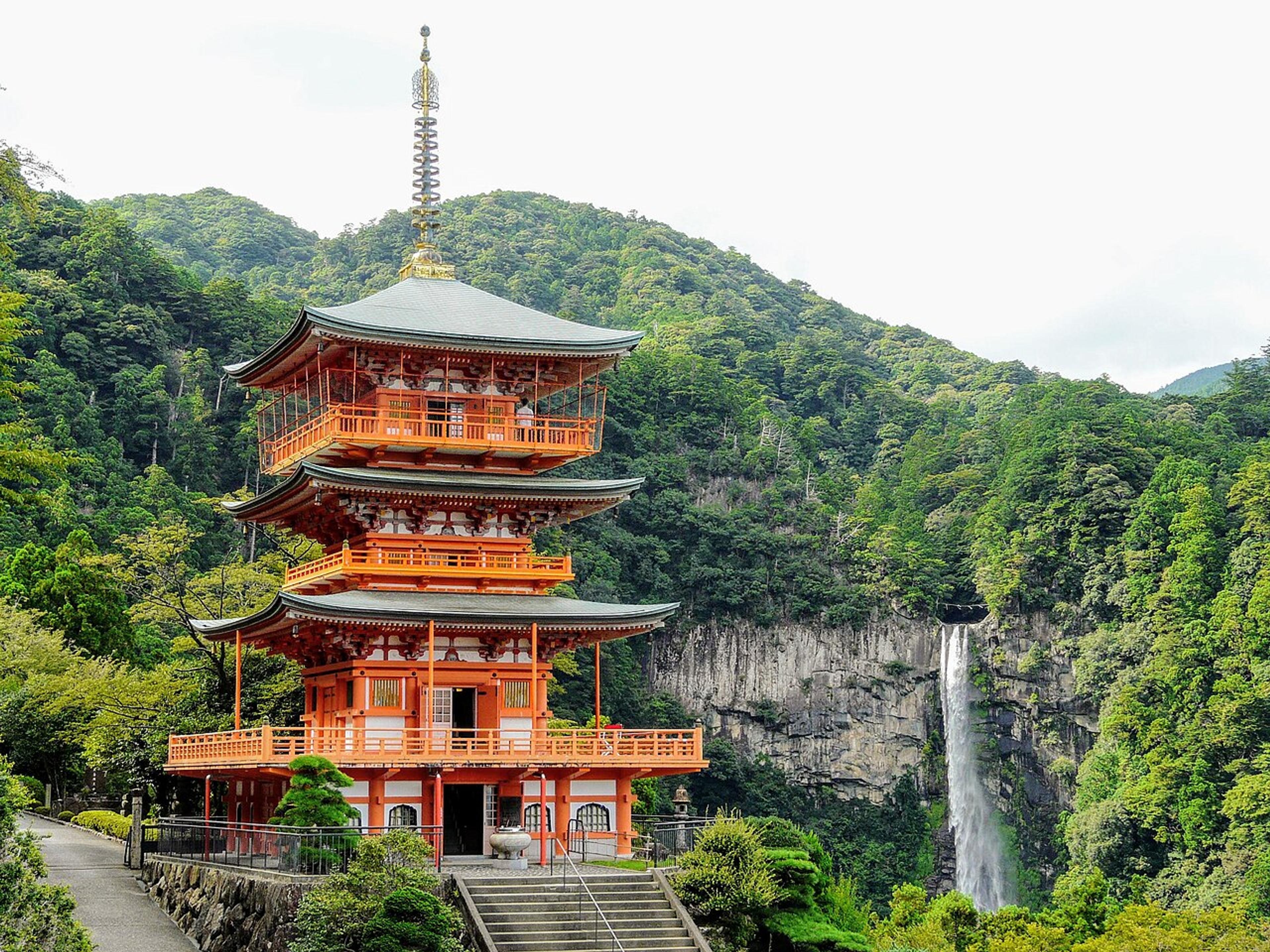
From Hongu, a bus ride east reaches the coast at Shingu, and from there another bus climbs to Nachi Falls, the tallest single-drop waterfall in Japan at 133 meters. The falls are sacred, considered the embodiment of a deity, and the adjacent Kumano Nachi Taisha shrine and Seiganto-ji temple form one of the most photographed sacred landscapes in Japan: the vermilion pagoda framing the white cascade of the falls behind it. The viewing platform (¥300) at the base of the falls puts you close enough to feel the mist on your face.
The Daimon-zaka, a 600-meter stone staircase flanked by 800-year-old cedar trees, is the traditional pilgrimage approach to Nachi. The steps are wide and worn smooth, climbing through forest so dense the stairway feels like a green tunnel. At the top, the path emerges at the shrine complex with the falls thundering below. The Nachi Fire Festival (July 14) is one of Japan's most dramatic matsuri, twelve portable shrines are carried down the Daimon-zaka stairway accompanied by bearers swinging enormous flaming torches to 'purify' the path.
The Daimon-zaka steps are steep and can be slippery after rain. Wear proper hiking shoes, not sandals or smooth-soled sneakers. The descent is harder on the knees than the ascent. In summer, the humidity in the cedar corridor is intense, bring water and take breaks on the stone benches placed along the stairway.
Yunomine Onsen: The Living Spring
Yunomine Onsen is a tiny hot spring village tucked into a narrow valley near Kumano Hongu Taisha. The village has been in continuous use as a spa for over 1,800 years, making it one of the oldest hot spring settlements in Japan. The centerpiece is Tsuboyu, a natural rock pool enclosed in a small wooden hut on the bank of the river, fed by a spring that changes color up to seven times per day depending on mineral concentrations and temperature. Tsuboyu is the only UNESCO World Heritage hot spring you can actually bathe in.
Bathing at Tsuboyu is reserved in 30-minute slots (¥800 per person) at the village public bath office. The pool fits two people at most. The water is scalding, around 90°C at the source, cooled to about 43°C in the pool by mixing with river water. The experience is intimate and slightly surreal: sitting in a stone pool inside a wooden shack, steam rising through gaps in the boards, the sound of the river inches away. After the bath, the village's public cooking spring (tokoji) lets you boil eggs, vegetables, or tofu in the mineral water, locals leave their dinner simmering in net bags while they bathe.
Spring (April-May) and autumn (October-November) offer the best conditions for the Kumano Kodo, mild temperatures, manageable humidity, and fewer crowds than summer. Winter walking is possible but some mountain lodgings close December through February. The rainy season (mid-June to mid-July) makes trail sections muddy and occasionally impassable. Pilgrimage stamps are available year-round at all major shrines and oji.
Featured in this guide
Places to Visit

Turn this guide into a trip
We'll prioritize these 9 places when building your itinerary.