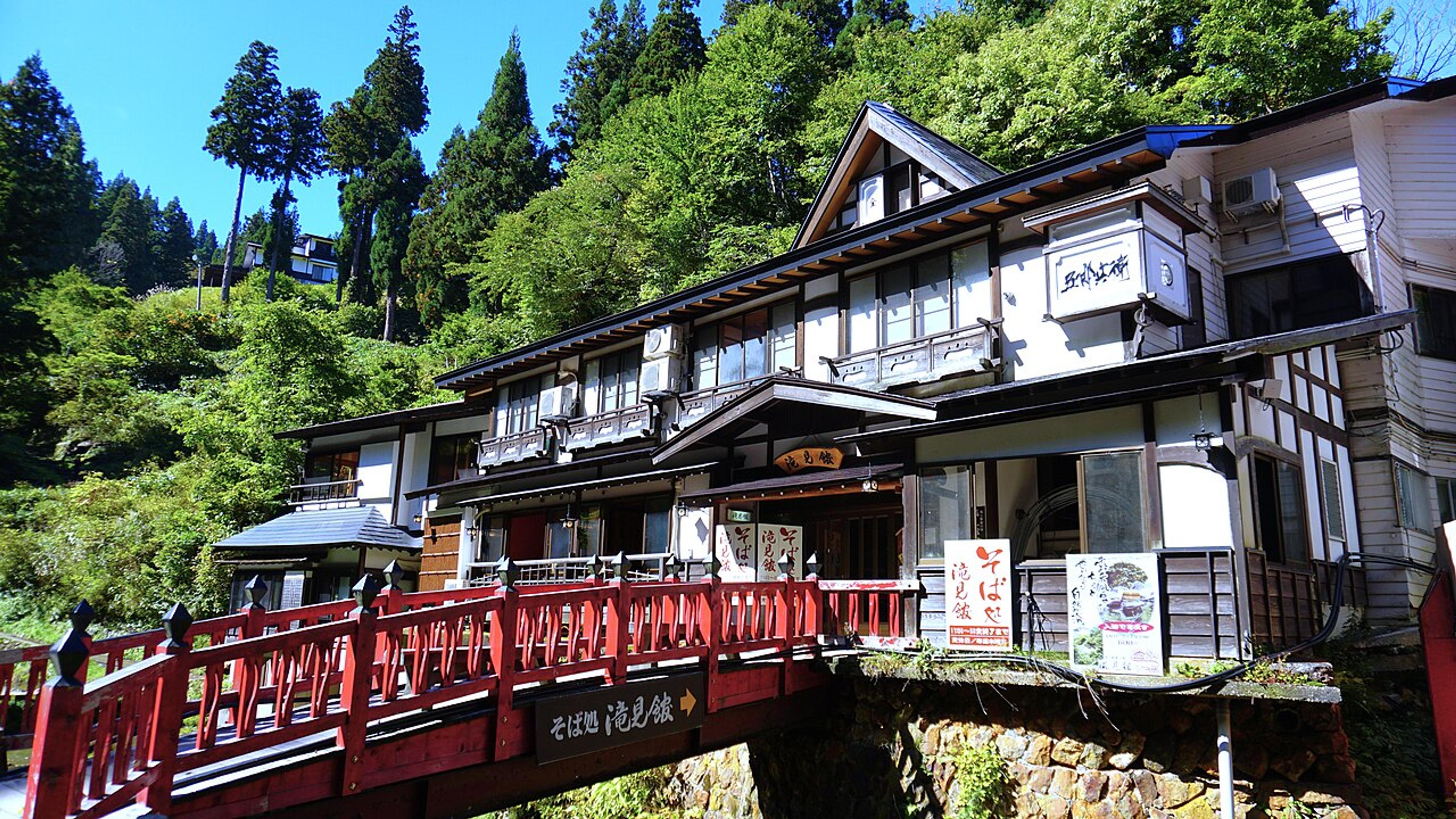
Tohoku's hot springs are Japan's most evocative: Ginzan Onsen's lamplit streets, Nyuto's rustic mountain baths, and Zao's snow-monster landscape.
Koku Travel · February 15, 2026
12 places in this guide
The Onsen Heartland
Every region of Japan has hot springs, but Tohoku's are different. The combination of volcanic geology, heavy snowfall, rural isolation, and wooden architecture creates onsen towns that feel like they exist outside of time. The baths are often rustic, sometimes little more than a stone pool fed by a pipe from a hillside spring. The buildings are wooden and weathered. The atmosphere is one of slow, deliberate retreat from the modern world.
This trail connects three of Tohoku's most exceptional onsen destinations, each offering a different register of the hot spring experience: Ginzan for atmosphere, Nyuto for wildness, and Zao for spectacle.
Ginzan Onsen
Ginzan Onsen occupies a narrow valley in the mountains of Yamagata Prefecture. A hot spring stream runs down the center, flanked by three-story wooden ryokan built during the Taisho era (1912-1926). The buildings are remarkably uniform, dark wood facades, balconied upper floors, steam rising from every surface. At dusk, gas lamps light the street, and the entire scene becomes a living woodblock print.
The town is genuinely small, about 300 meters from end to end, and most visitors come as day-trippers, leaving by early evening. Staying overnight is the transformative choice. After the buses leave, Ginzan belongs to its guests. The gas lamps glow brighter against the dark sky. The stream sounds louder. The outdoor baths, perched above the stream, fill with sulfurous water that turns your skin silky and your muscles to liquid.
In winter, when snow banks reach head height and the rooftops carry a meter of white, Ginzan achieves its final form. The combination of warm lamplight, cold air, rising steam, and deep snow creates a sensory experience that is genuinely difficult to describe and impossible to forget.
Ginzan's ryokan accept a very limited number of guests (the entire town has perhaps 200 beds). Book two to three months ahead for winter weekends. Day visitors can use the public foot baths (ashiyu) along the stream and the Shirogane-no-Yu public bathhouse (¥500).
Nyuto Onsen
Nyuto Onsenkyo is a cluster of seven hot spring inns deep in the beech forests of the Towada-Hachimantai National Park in Akita Prefecture. Each inn maintains its own spring source, and the water chemistry varies, from milky white sulfur baths to clear, iron-rich pools that turn brown on exposure to air. The oldest inn, Tsurunoyu, has been operating since 1638.
Tsurunoyu is the icon of Nyuto and a candidate for the most evocative onsen in Japan. The main outdoor bath (rotenburo) is a large, naturally-formed pool surrounded by rocks and forest, its milky-white water heated to about 42°C by a spring that bubbles up directly from the pool floor. The bath is mixed-gender (konyoku), which surprises many modern Japanese visitors, but the milky water and the etiquette of the setting make it less exposing than it sounds.
The other six inns at Nyuto each offer distinct character. Ganiba Onsen has baths built directly into the stream bed. Ogama Onsen is the newest and most comfortable, with private rooms and modern facilities. Kuroyu Onsen has a spring so hot (98°C at the source) that it must be cooled by mixing with mountain stream water.
Nyuto maintains the tradition of meguri tegata, a wooden passport purchased at any of the seven inns that entitles you to bathe at all seven. Completing all seven baths earns you a commemorative towel. The meguri is the best way to experience the full range of Nyuto's waters, and the walk between inns through the snowy beech forest is itself a highlight.
Zao Onsen and the Snow Monsters
Zao Onsen sits at the base of Mount Zao, a volcanic massif straddling the border of Yamagata and Miyagi Prefectures. The onsen town is a functional ski resort village, not as evocative as Ginzan or as wild as Nyuto, but the mountain above it hosts one of the most extraordinary natural phenomena in Japan.
In winter, the combination of freezing wind, snow, and rime ice transforms the trees on Zao's upper slopes into 'snow monsters' (juhyo). The Maries' fir trees become completely encased in ice and snow, forming towering white sculptures that barely resemble trees at all. The shapes are organic and strange, hulking forms that appear to march across the mountain in frozen procession.
The snow monsters are best viewed from the Zao Ropeway gondola or by snowshoeing among them on the upper plateau. At night, the resort illuminates the juhyo field with colored lights, creating a surreal landscape of glowing ice figures against the dark mountain sky.
Snow monsters form from late December through February, with peak development in mid-January to mid-February. Warm winters can reduce their size or prevent formation entirely. After viewing the juhyo, descend to Zao Onsen's public baths, the Zao Onsen Dai-rotenburo is a huge outdoor bath with strong sulfur water that turns the skin of regular bathers faintly green.
Connecting the Trail
The three destinations can be linked in a five-to-six-day circuit. Start at Zao (accessible from Yamagata Station by bus), continue to Ginzan (one hour by car from Obanazawa, which is connected to Yamagata by train), and finish at Nyuto (accessible from Tazawako Station on the Akita Shinkansen). The route moves west to north through some of Tohoku's finest mountain terrain.
Ryokan stays with dinner and breakfast (one night, two meals, ippaku nishoku) run ¥12,000-20,000 at Ginzan, ¥8,000-15,000 at Nyuto, and ¥8,000-12,000 at Zao. These rates include multi-course kaiseki dinners using local ingredients. For the quality of food and experience, Tohoku onsen ryokan represent extraordinary value compared to equivalent stays in Hakone or Arima.
Featured in this guide
Places to Visit
Turn this guide into a trip
We'll prioritize these 12 places when building your itinerary.