Okinawan cuisine is Japan's most distinctive: soba unlike any ramen, braised pork that melts, taco rice born from military bases, and Naha's legendary Makishi Market.
Koku Travel · February 16, 2026
12 places in this guide
A Kitchen That Belongs to No One Else
Okinawan food is not Japanese food. It shares some ingredients and some techniques, but the flavor profile, the core dishes, and the culinary philosophy are distinct, shaped by the Ryukyu Kingdom's centuries of trade with China, Southeast Asia, and Korea, and more recently by 27 years of American military occupation. The result is a cuisine that confuses categories: pork-heavy but also longevity-promoting, comfort food but also health food, island food with global DNA.
This trail runs through Naha and beyond, covering the dishes that define Okinawan eating. Come hungry. The portions are generous, the flavors are bold, and the prices are astonishingly low by Japanese standards.
Okinawa Soba: Not What You Think
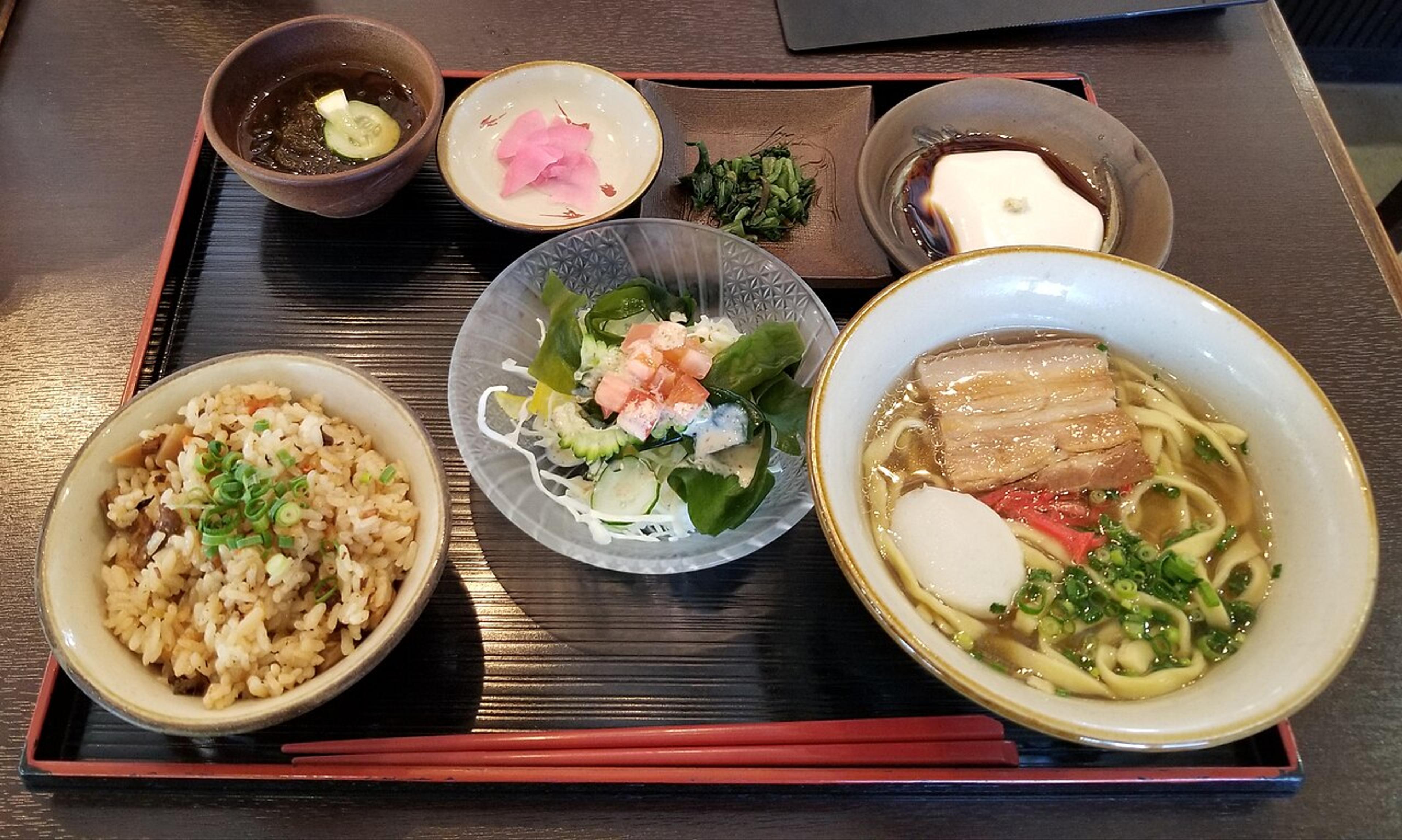
Okinawa soba bears almost no resemblance to mainland Japanese ramen or soba. The noodles are thick, flat, and made from wheat flour with lye water (kansui), closer to Chinese egg noodles than to buckwheat soba. The broth is a clear, light pork and bonito dashi, delicate rather than rich. Toppings are simple: slices of soki (bone-in pork spare ribs braised until falling-apart tender), kamaboko fish cake, pickled ginger, and a scattering of green onions.
Every Okinawan has a favorite soba shop, and opinions are fierce. Kishimoto Shokudo in Motobu (open since 1905) is widely cited as the standard-bearer, their hand-cut noodles have a chewy, irregular texture that machine noodles cannot replicate. In Naha, Suba Machigwa on Heiwa-dori serves a classic bowl for ¥600 in a no-frills, counter-only setting. The soba at Hamaya in Naha's Tsuboya district includes all three pork cuts, soki, sanmainiku (three-layer pork belly), and tebichi (pig's trotters), for ¥850.
Add koregusu to your soba, a condiment of island chili peppers steeped in awamori. It sits on every soba shop counter in a small bottle. A few drops add a clean, sharp heat that cuts through the pork richness without overwhelming the delicate broth. Start with two drops. The heat builds.
Rafute and the Pork Kingdom
Pork is the foundation of Okinawan cuisine. The island saying goes: 'We eat everything from the pig except the squeal.' Rafute, thick cubes of pork belly braised for hours in awamori, soy sauce, and brown sugar until the fat renders to a trembling, translucent jelly and the meat dissolves at the touch of a chopstick, is the pinnacle of this pork obsession. The dish has Chinese origins, adapted through centuries of Ryukyuan court cooking.
Mimiga (sliced pig's ear, crunchy and vinegared), nakami (tripe soup, mild and restorative), tebichi (braised pig's trotters, collagen-rich), and chiraga (smoked pig's face, sliced thin like salumi) fill out the pork repertoire. At Naha's Makishi Market, the ground-floor butchers display every conceivable pig part, and the upstairs restaurants will cook your market purchases for a small fee, typically ¥500 per dish for preparation.
Pork arrived in Okinawa through centuries of trade with China, where pork cookery is the foundation of cuisine. The Ryukyuan court adapted Chinese techniques to local ingredients, creating dishes like rafute (from Chinese dongpo rou) and tebichi (from Chinese braised trotters). Understanding this lineage deepens appreciation, Okinawan food is a living record of Pacific Rim cultural exchange.
Taco Rice: Okinawa's American Legacy
Taco rice was invented in Kin Town, near the Camp Hansen Marine base, in 1984. Matsuzo Gibo, owner of the restaurant King Tacos, created the dish as affordable comfort food for American servicemen, seasoned ground beef, lettuce, tomato, and cheese served over hot rice instead of in a taco shell. The dish became an instant hit with locals and is now served in school cafeterias, convenience stores, and restaurants across the island.
King Tacos (¥500 for a standard plate) remains the pilgrimage site, its cinder-block storefront in Kin Town packed at all hours. The original recipe uses a simple but intensely seasoned beef, cumin, chili, garlic, piled on Japanese short-grain rice that absorbs the meat juices. A fried egg on top (¥100 extra) is the accepted upgrade. In Naha, Jetta Burger in Makishi offers a refined version with locally sourced beef, while Taco Rice Cafe Kijimuna on Kokusai-dori serves a tourist-friendly version with salsa and sour cream.
Taco rice is the best food value on the island. A full plate at King Tacos costs ¥500 and is large enough to split. Even in Naha, taco rice plates rarely exceed ¥700. For the cheapest possible Okinawan meal, visit any Lawson or FamilyMart convenience store, their onigiri section includes taco rice filling, and their bento cases stock a ¥398 taco rice that is surprisingly good.
Makishi Market: Naha's Kitchen
Makishi Public Market (Makishi Kosetsu Ichiba) is Naha's culinary heart. The ground floor is a wet market where fishmongers, butchers, and vegetable sellers display the full range of Okinawan ingredients: fluorescent-colored reef fish, whole pigs' heads, sea grapes (umi-budo, tiny green spheres that pop with brine on the tongue), island tofu (shimadofu, denser and firmer than mainland tofu), and tropical fruits including shikuwasa (Okinawan citrus), passion fruit, and dragon fruit.
The market reopened in 2023 after a three-year reconstruction. The new building is cleaner and more tourist-friendly than the beloved old warren, but the vendors are the same families, the products are the same, and the upstairs restaurants still follow the same system: buy your fish or meat downstairs, carry it upstairs, and a cook will prepare it, sashimi, grilled, deep-fried, or champuru-style (stir-fried with tofu and vegetables), for ¥500-800 per dish. A full market lunch for two, including fish, pork, beer, and cooking fees, runs about ¥3,000.
Visit Makishi Market between 9 AM and 11 AM for the freshest selection and the least crowded conditions. The fishmongers are happy to explain what you are looking at, point at anything unfamiliar and ask 'Kore wa nan desu ka?' (What is this?). Sea grapes (umi-budo) and island tofu (shimadofu) are must-tries that are nearly impossible to find fresh outside Okinawa.
Awamori and Beniimo: The Finishing Touches
Awamori, Okinawa's indigenous spirit, deserves more than a passing mention alongside food. The spirit is distilled from long-grain Thai indica rice using a black koji mold unique to the islands, producing a drink that ranges from clean and vodka-like (young awamori, 30% ABV) to complex, caramel-noted, and whisky-adjacent (aged kusu, 40-43% ABV). The best food pairing is with rafute, the fat-cutting sharpness of young awamori complements the rich pork, while aged kusu matches the sweet-soy depth of the braising liquid.
For dessert, follow the beniimo. The purple sweet potato (beniimo) is Okinawa's most iconic ingredient after pork, its vivid violet color turns up in tarts, ice cream, cheesecake, mochi, and soft-serve across the island. The Okashi Goten chain produces the best-known beniimo tart (¥1,000 for a box of six), but the freshest versions are found at small bakeries in Yomitan and Chatan. The flavor is subtle, mildly sweet, nutty, with a starchy density that makes it more satisfying than it looks.
Beniimo harvest peaks from September through January, and tarts made from fresh-harvest potatoes have noticeably better flavor and color than those made from stored stock. Awamori has no season, it is produced and consumed year-round, but many distilleries release limited-edition bottlings during the November Awamori Festival in Naha, where over 40 distilleries set up tasting booths along Kokusai-dori.
Featured in this guide
Places to Visit
Turn this guide into a trip
We'll prioritize these 12 places when building your itinerary.