Kunisaki Peninsula: A Buddhist-Shinto Kingdom in Stone
Deep Dive · kunisaki · 9 min
The Kunisaki Peninsula hides an entire Buddhist civilization: Rokugo Manzan's 28 temples, Japan's oldest wooden hall, and Usa Jingu's Shinto-Buddhist fusion.
Yuku Japan · February 16, 2026
3 places in this guide
A Kingdom Carved in Stone
The Kunisaki Peninsula juts into the Seto Inland Sea from the northeast corner of Oita Prefecture, a rough circle of volcanic ridges radiating from the central peak of Mount Futago (721 meters). In the valleys between those ridges, beginning in the 8th century, monks established a network of 28 temples collectively known as Rokugo Manzan, the Six Districts of Mount Satisfaction. For over a thousand years, they practiced a faith found nowhere else in Japan: a fusion of esoteric Tendai Buddhism, mountain asceticism, and the Shinto traditions of nearby Usa Jingu, the head shrine of the Hachiman deity.
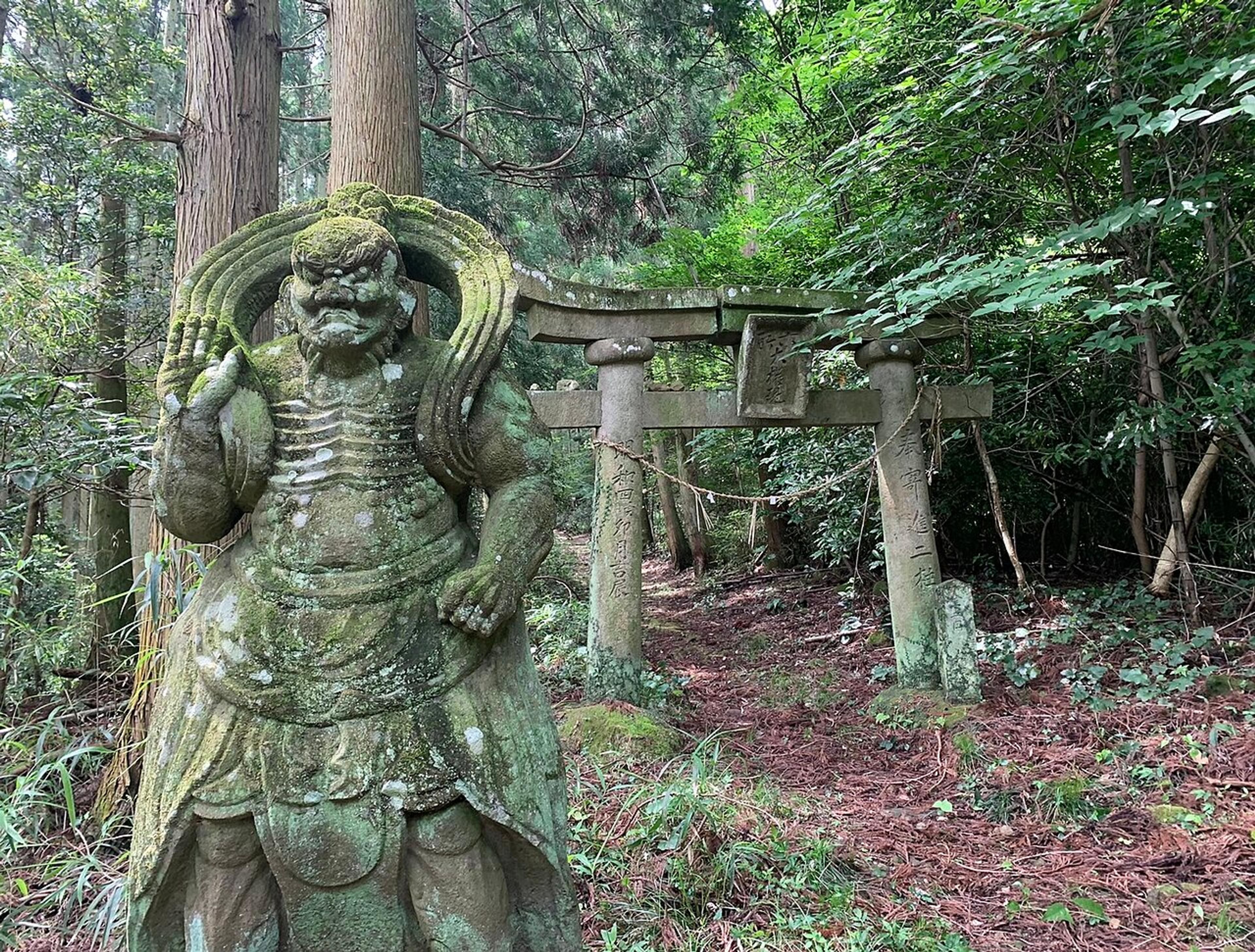
Today the peninsula is sparsely populated, its narrow roads winding through bamboo groves and cedar forests past moss-covered stone markers that once guided pilgrims. Most of the 28 temples survive, though some are little more than a clearing in the forest with a stone Buddha and a weathered torii. The few visitors who come find a landscape saturated with spiritual architecture, stone carvings peer from cliff faces, half-hidden halls nestle into volcanic overhangs, and the forest trails between temples follow paths worn by a millennium of walking meditation.
Rokugo Manzan Temple Circuit
The Rokugo Manzan temples are scattered across all six valleys of the peninsula, but the essential circuit covers four or five in a day by car. Futagoji, the spiritual center, sits near the summit of Mount Futago and functions as the headquarters of the Rokugo Manzan tradition. The approach climbs through a forest of giant cedar trees flanked by stone nio guardian statues, not the polished wooden figures seen in Nara or Kamakura, but rough-hewn volcanic rock guardians weathered into ghostly abstraction. The main hall contains a secret Buddha (hibutsu) revealed to the public only once every six years.
Taizo-ji, lower on the mountain's northern slope, preserves a collection of stone magaibutsu (cliff-carved Buddhas) dating to the Heian period. The largest figure, carved directly into a volcanic rock face, stands over three meters tall and retains traces of the original pigment, faint red and gold visible in the creases of the robe. The trail to the magaibutsu passes through dense forest where stone lanterns and small prayer niches appear every few meters, each one a miniature act of devotion accumulated over centuries.
The Rokugo Manzan practice of shugenjo (mountain asceticism) survives in the annual Shusho Onie fire festival at Iwatoji temple every New Year. Monks wearing fearsome wooden masks perform fire rituals and torch dances that date to the 10th century. The festival is designated an Important Intangible Folk Cultural Property and draws practitioners from across Japan.
Fukiji: The Oldest Wooden Hall in Kyushu
Fukiji temple, tucked into a quiet valley on the peninsula's eastern slope, houses the oldest wooden structure in Kyushu, a compact Amida hall built in the late Heian period, around 1012 CE. The hall is remarkably simple: a single room with a pyramidal roof, unpainted cypress wood darkened to near-black by a thousand years of incense smoke and weather. Inside, a seated Amida Buddha occupies the center, flanked by attendant figures, with faded paintings of celestial beings still visible on the wooden walls.
What makes Fukiji extraordinary is not its size but its survival. While temples across Japan were destroyed by war, fire, earthquake, and political upheaval, this small hall in an obscure valley on a remote peninsula endured. The construction technique, interlocking wooden joints without nails, a style shared with Horyuji in Nara, speaks to a level of craftsmanship that made permanence possible. The surrounding garden, with its lotus pond and ancient camphor tree, is maintained by a single resident priest who also serves as guide and groundskeeper.
Fukiji is open daily from 8:30 AM to 4:30 PM. Admission is ¥300. The resident priest gives informal explanations in Japanese (no English signage), but the hall's beauty transcends language. Visit in the morning when slanted light enters through the lattice windows and illuminates the Amida figure. Allow 30 minutes for the temple and garden.
Stone Buddhas of Kumano Magaibutsu
The Kumano Magaibutsu is the most dramatic single site on the peninsula, two massive Buddha figures carved directly into a cliff face, reached by a steep trail of uneven stone steps through dense forest. The Dainichi Buddha (great cosmic Buddha) stands 6.8 meters tall, and the adjacent Fudo Myo-o (the fierce protector deity) measures 8 meters. Both were carved in the late Heian period, around the 12th century, and are the largest magaibutsu in Japan.
The approach is a 20-minute climb up roughly 100 stone steps, some natural rock, some carved, all uneven and potentially slippery after rain. The forest closes in overhead, and the sound of the nearby stream fades as you climb. The Buddhas appear suddenly as the trail opens onto a rock shelf: two enormous figures emerging from the living stone, their features softened by centuries of rain but still commanding. The Fudo Myo-o's expression of fierce determination, even eroded, is powerful enough to stop you on the trail.
The stone steps to Kumano Magaibutsu are steep and uneven with no handrails on several sections. Wear proper hiking footwear, sandals and dress shoes are genuinely dangerous here. After rain, the moss-covered stones become extremely slippery. The climb is short but strenuous; take your time and watch your footing.
Usa Jingu: Where Two Faiths Merged
Usa Jingu, at the base of the Kunisaki Peninsula, is the head shrine of the 40,000 Hachiman shrines across Japan and the birthplace of the syncretic tradition that shaped the entire peninsula. Hachiman, originally a local deity later identified with the Emperor Ojin and adopted as a protector of Buddhism, represents the fusion of Shinto and Buddhist practice that defined Japanese religion for over a millennium before the Meiji government forcibly separated the two faiths in 1868.
The shrine complex is vast, its vermilion buildings set among old-growth camphor trees on a hillside above the Yakkan River. Three main halls, each with a distinctive split-level roof (naisosori-zukuri), house the principal deities. The worship style here is distinctive: two bows, four claps, one bow, double the standard Shinto clapping pattern, matching the practice at Izumo Taisha. A network of paths leads to sub-shrines, sacred springs, and viewpoints over the surrounding plain where rice paddies stretch to the mountains of the Kunisaki interior.
Usa Jingu is free to enter. The adjacent Usa Jingu Museum (¥300) houses Hachiman shrine artifacts and explains the syncretic tradition clearly. A combined Kunisaki Peninsula day, Usa Jingu, Kumano Magaibutsu, Fukiji, and one Rokugo Manzan temple, is feasible by rental car from Oita city (50 minutes to Usa). Rental cars from Oita Airport start at ¥4,500/day.
Featured in this guide
Places to Visit

Turn this guide into a trip
We'll prioritize these 3 places when building your itinerary.