Arita invented Japanese porcelain 400 years ago. The kilns still fire, the secret village of Okawachiyama still hides, and the annual pottery fair fills every street.
Yuku Japan · February 16, 2026
6 places in this guide
Where Japanese Porcelain Began
In 1616, a Korean potter named Yi Sam-pyeong discovered high-quality porcelain stone in the mountains of Arita, a small town in Saga Prefecture. Within decades, Arita was producing porcelain that rivaled Chinese ware, and when Chinese production collapsed during the Ming-Qing dynasty transition, Dutch traders at Dejima in Nagasaki began exporting Arita porcelain to Europe. The Dutch called it 'Imari ware' (after the port from which it shipped), and it transformed European decorative arts, inspiring Meissen, Delft, and the entire tradition of European porcelain manufacture.
Four centuries later, Arita remains a working porcelain town. Over 150 kilns and workshops still operate, producing everything from mass-market tableware to museum-grade art pieces. The town's single main street is lined with pottery shops, galleries, and workshops whose chimneys still release wood-smoke during firing season. The clay is still sourced from the same Izumiyama quarry that Yi Sam-pyeong discovered, though the richest veins are now exhausted and the quarry is preserved as a historical site.
The Kakiemon and Imaemon Traditions
Two dynasties dominate Arita's artistic legacy. The Kakiemon family, now in its 15th generation, developed a distinctive style in the 1640s: asymmetric compositions of flowers, birds, and figures painted in vivid overglaze enamels (red, blue, green, yellow) on a milky-white body with generous negative space. The Kakiemon style was the most prized in Europe, pieces collected by Augustus the Strong of Saxony inspired the founding of the Meissen porcelain factory in 1710.
The Imaemon family, also in its 15th generation, specializes in nabeshima ware, the porcelain produced exclusively for the feudal lords of the Nabeshima domain. Nabeshima ware is characterized by precise, geometric patterns and a limited palette of overglaze red, green, and yellow on an underglaze blue base. Production was controlled so tightly that flawed pieces were smashed and dumped in the river to prevent commoners from acquiring them. Both the Kakiemon and Imaemon workshops are open to visitors, with galleries displaying historical and contemporary works alongside active studios.
Both the Kakiemon and Imaemon families hold the designation of Important Intangible Cultural Property holders (Living National Treasures) for their respective techniques. The gallery at the Kakiemon kiln (free entry) displays pieces spanning 380 years, showing how the style has evolved while maintaining its essential character. The current Kakiemon XIV continues to produce new work.
Walking Arita's Pottery Streets
Arita's Uchiyama district is the historic kiln quarter, stretching about two kilometers along a narrow valley. The main street is lined with pottery shops ranging from tourist-oriented bargain ware to serious galleries representing individual artists. The Kyushu Ceramic Museum (free admission), at the eastern end, houses an outstanding collection that traces the entire history of Arita porcelain, from the earliest rough stonewares to the refined export pieces that dazzled European courts.
The best walk is along the Tonbai-bei walls, alley walls constructed from discarded kiln bricks, broken saggers (the fireproof capsules used to protect pieces during firing), and porcelain shards. These patchwork walls are unique to Arita and form a visual record of centuries of kiln operations. Individual shards embedded in the walls, a flash of blue glaze, a fragment of painted plum blossom, are accidental art, and photographing the most striking sections is an Arita tradition in itself.
The Arita Porcelain Park (¥500) reproduces a section of the Zwinger Palace in Dresden, Germany, the palace that Augustus the Strong built partly to house his Kakiemon collection. The reproduction sounds kitschy, but the exhibition inside traces the Europe-Arita connection with genuine artifacts and tells the story well. The park also has a hands-on pottery painting workshop (¥1,500) where visitors paint a pre-formed cup or plate with traditional cobalt blue designs.
Okawachiyama: The Secret Kiln Village
Okawachiyama, a 20-minute drive from Arita in the mountains of Imari, is the most evocative pottery settlement in Japan. This tiny village of 30 kilns was established by the Nabeshima lords as a secret production center for their exclusive porcelain. The village was deliberately placed in a mountain valley accessible only through a single narrow pass, which was guarded. Potters were forbidden to leave. The clay, techniques, and designs were state secrets, and the village operated as a closed community for over 200 years.
Today, Okawachiyama is open but barely changed. A single lane winds through the valley past working kilns, wood-fired noborigama (climbing kilns) built into the hillside, and small galleries where potters sell directly from their studios. Kiln chimneys rise from tile rooftops. Shards of broken porcelain, some centuries old, lie in the stream beds and trails. The village is usually empty of visitors, and the silence is broken only by the sound of potters' wheels and the occasional clatter of stacking saggars.
Okawachiyama is free to explore. Most galleries welcome browsing without purchase pressure, and prices are significantly lower than Arita retail, a handmade nabeshima-style plate that costs ¥8,000 in Arita may be ¥4,000-5,000 direct from the potter in Okawachiyama. The Nabeshima Clan Kiln Park at the top of the village shows the excavated remains of the original feudal kilns with English signage.
The Arita Pottery Fair
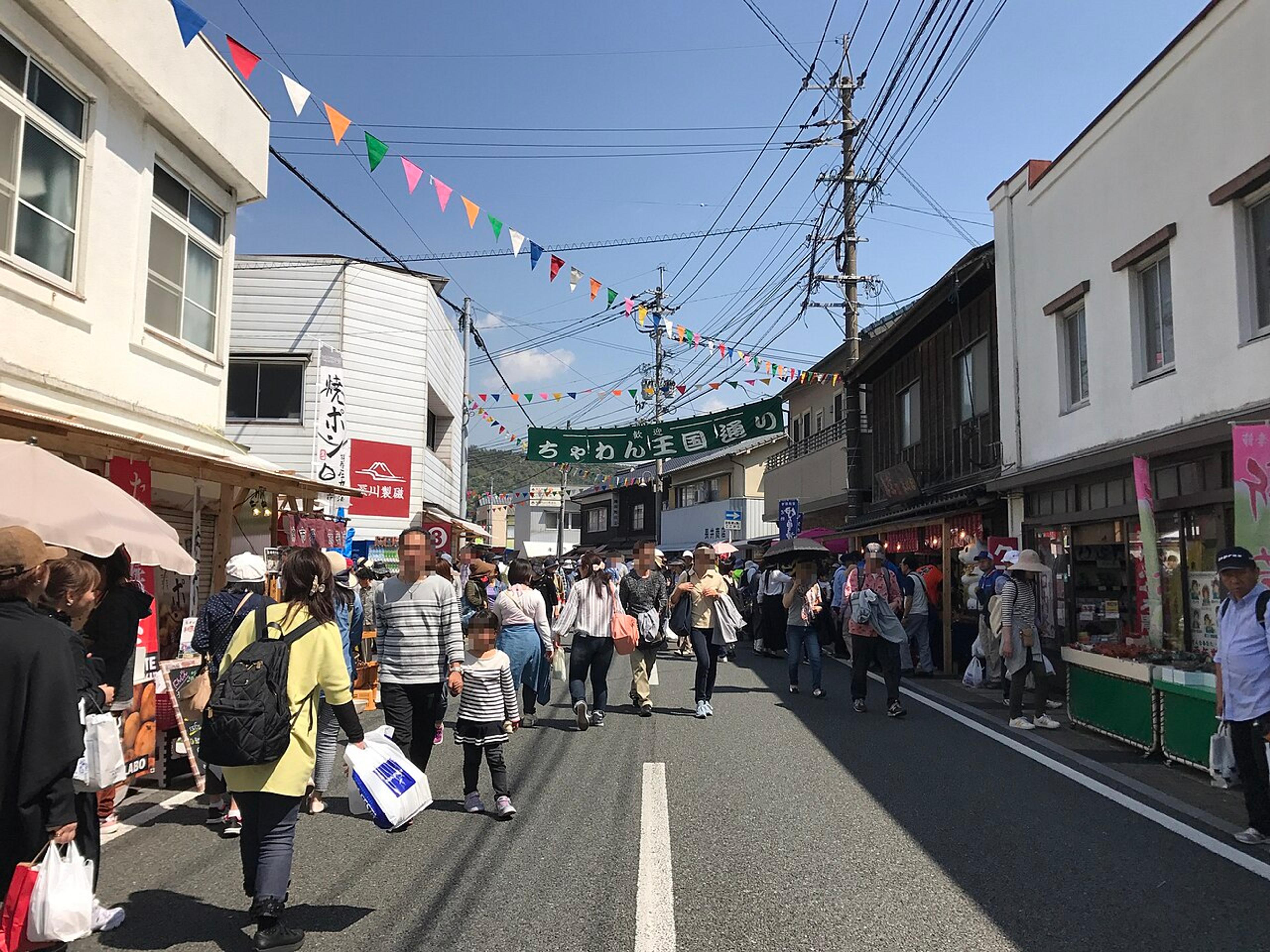
The Arita Toki Ichi (Pottery Fair), held annually from April 29 to May 5 during Golden Week, is the largest ceramics market in Japan. Over 500 stalls line 4 kilometers of street, selling everything from ¥100 bargain bowls to ¥500,000 art pieces. The fair draws over a million visitors across the week. Every kiln and workshop in Arita and the surrounding region participates, and many use the fair to sell seconds, test pieces, and discontinued designs at dramatic discounts.
The fair transforms Arita from a sleepy pottery town into a chaotic, exhilarating marketplace. Serious collectors arrive at dawn on the first day. Stalls selling the most sought-after kiln's seconds develop queues before opening. The atmosphere is competitive but friendly, buyers and sellers share a genuine enthusiasm for ceramics that transcends the transaction. Street food stalls line the route, and the entire town takes on a festival energy that is completely absent the other 51 weeks of the year.
The Arita Pottery Fair (April 29 - May 5) coincides with Golden Week, Japan's busiest holiday period. Accommodation within 30 kilometers sells out months ahead. Book by January for any hotel in the Arita-Imari-Takeo area. The best strategy is to stay in Saga or Nagasaki city and drive in early. Arrive before 8 AM on the first day for the best selection. Bring cash, many stalls do not accept cards.

Turn this guide into a trip
We'll prioritize these 6 places when building your itinerary.