Deep Yakushima: Beyond Jomon Sugi
Itinerary · yakushima · 9 min
Everyone hikes to Jomon Sugi and goes home. This guide maps the rest of Yakushima: Mononoke forests, sea turtles, mountain huts, river kayaking, and coastal hot springs.
Yuku Japan · February 16, 2026
8 places in this guide
The Island Beyond the Famous Tree
Yakushima has a marketing problem. The island's most famous resident, Jomon Sugi, an ancient cedar estimated at 2,000-7,000 years old, dominates every guide, every brochure, every Instagram post. Visitors fly in, endure the 10-hour round-trip hike, and fly out the next day, exhausted and satisfied that they have 'done' Yakushima. They have not. The Jomon Sugi trail, for all its drama, is a single-track trudge along an old logging railway into the island's interior. The real Yakushima, the mossy ravines, the sea turtle beaches, the coastal onsen, the mountain hut circuits, the river kayaking, remains largely untouched by the Jomon Sugi pilgrims.
This itinerary assumes four to five days on the island and deliberately avoids Jomon Sugi. Not because the tree is not worth seeing, it is magnificent, but because every other guide covers it extensively, and the rest of Yakushima deserves equal attention. If you have a sixth day, add Jomon Sugi. But do the rest first.
Day One: Shiratani Unsuikyo, The Mononoke Forest
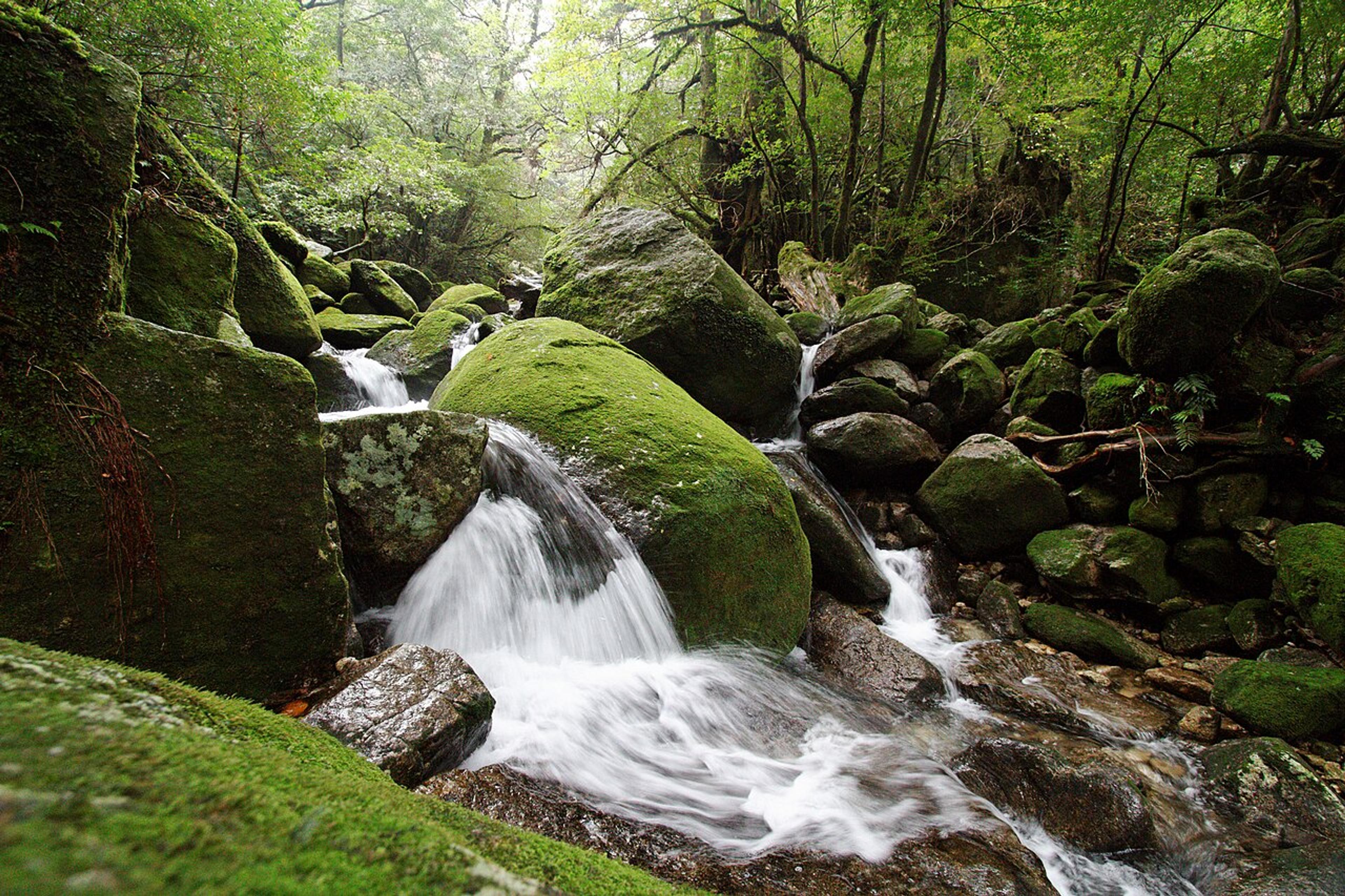
Shiratani Unsuikyo is a ravine on Yakushima's northeastern slope that inspired the forest landscapes in Miyazaki's Princess Mononoke. The resemblance is not subtle, every surface is covered in moss, massive cedars rise from boulder fields wrapped in green velvet, and the light filters through a canopy so dense it creates a permanent twilight. The ravine offers three trail loops: a 1-hour course to the suspension bridge, a 2-hour course through the heart of the moss forest, and a 4-hour course that climbs to the Taikoiwa viewpoint.
The 4-hour Taikoiwa course is the essential Yakushima hike. The trail climbs through progressively older forest, second-growth cedar gives way to ancient trees, the undergrowth becomes a continuous carpet of moss, and the silence deepens. Taikoiwa (Drum Rock) is a granite outcrop at 1,050 meters that provides a panoramic view over the forest canopy to the Pacific. On clear days, the island of Tanegashima is visible to the northeast. The descent returns through the Mononoke forest, and by the second passage the extraordinary density of green feels less alien and more like the natural state of a forest left entirely alone.
Enter Shiratani Unsuikyo at opening (7 AM, entry fee ¥500) to have the moss forest nearly to yourself. Tour buses arrive from 9 AM and the trails become crowded by 10 AM. The 4-hour Taikoiwa course is moderately strenuous with some scrambling over boulders and exposed root systems, hiking boots are essential. Bring rain gear regardless of the forecast; Yakushima receives 300+ days of rain per year.
Day Two: Yakusugi Land and the Shorter Trails
Yakusugi Land is an accessible yakusugi (ancient cedar) forest at 1,000 meters elevation, reached by a 40-minute drive from the coastal towns. Four trail courses (30, 50, 80, and 150 minutes) loop through a forest of named ancient cedars, each with its own character: Buddhasugi, with a trunk formation resembling a seated Buddha; Sennen-sugi (Thousand-Year Cedar), with a girth that requires ten people to encircle; and Futago-sugi (Twin Cedar), where two massive trunks have fused into a single canopy.
The 80-minute course hits the best trees without the endurance demands of the longer trails. The wooden boardwalks that cover much of the route make it accessible to hikers of all fitness levels, and the forest environment, cool, damp, fragrant with cedar resin, is deeply calming. Unlike Shiratani Unsuikyo, where the moss dominates, Yakusugi Land is about the trees themselves: their size, their age, their stubborn persistence on an island battered by typhoons and saturated with rain.
Yakusugi Land entry is ¥500. The Yakushima bus pass (¥2,000/day or ¥3,000/2 days) covers the route from Anbo and Miyanoura to Yakusugi Land and Shiratani Unsuikyo, eliminating the need for a rental car for the forest hikes. However, the bus schedule is limited, check departure times carefully to avoid being stranded at the trailhead.
Day Three: Sea Turtles and Coastal Onsen
Yakushima's western and southern beaches are major nesting sites for loggerhead sea turtles. Nagata Inakahama, on the northwest coast, is the largest loggerhead nesting beach in the North Pacific, up to 300 turtles come ashore to lay eggs between May and July. Organized night tours (¥1,500, advance booking required through the Yakushima Umigame-kan turtle museum) allow small groups to observe nesting under red-light conditions that do not disturb the turtles. Watching a 100-kilogram turtle laboriously dig a nest in the moonlit sand and deposit over 100 eggs is a wildlife encounter that matches anything on the island.
Yakushima's coastal onsen are scattered around the island's shoreline, several of them literally carved into the tidal rocks. Hirauchi Kaichu Onsen, on the southern coast, is a natural rock pool that is submerged at high tide and exposed at low tide, you bathe in hot volcanic water with the Pacific surf breaking meters away. Yudomari Onsen, slightly east, is a more developed facility with changing rooms, but the outdoor pools still face the open ocean. Both are free or accept voluntary donations (¥100-200).
Sea turtle nesting season runs from May through July, with peak activity in June. Hatchlings emerge from August through September. Nesting observation tours operate nightly during the season and must be booked through the Umigame-kan (Turtle Museum) in Nagata. Outside of nesting season, the museum (¥300) screens footage and maintains educational exhibits about Yakushima's turtle population.
Days Four and Five: Mountain Huts and River Kayaking
Yakushima's interior mountain hut circuit offers overnight hiking that avoids the Jomon Sugi corridor entirely. The Miyanoura-dake circuit, a two-day hike to Kyushu's highest peak (1,936 meters) via the Yodogawa mountain hut, climbs through distinct vegetation zones: coastal broadleaf forest, yakusugi cedar forest, rhododendron thickets, and finally alpine moorland with dwarf bamboo and exposed granite. The Yodogawa hut is basic (bunks, no meals, ¥2,000/night) but clean, and the sunset from the hut clearing, across a sea of mountain ridges fading into the Pacific, is one of Yakushima's great unreported views.
For a less strenuous final day, the Anbo River offers guided kayaking through the island's lowland forest. The river is calm and clear, flowing through a corridor of camphor trees, ferns, and banyan roots that trail into the water. Several operators run half-day trips (¥6,000-8,000) that include instruction, equipment, and a riverside break at a natural swimming hole. The perspective from the water, looking up into the canopy, watching freshwater crabs scuttle across boulders, floating past granite walls draped in moss, is a different Yakushima from the mountain trails, and a perfect counterpoint to four days of forest hiking.
Yakushima's mountains are serious terrain. Weather changes rapidly, clear skies can become whiteout fog within 30 minutes. Carry rain gear, warm layers, headlamp, and extra food even for day hikes above 1,000 meters. Register your hiking plan at the Yakushima Mountain Sports Center or any trailhead registration box. Mobile phone coverage is unreliable above 800 meters. The mountain huts do not provide blankets, bring a sleeping bag rated to 5°C minimum.
Featured in this guide
Places to Visit

Turn this guide into a trip
We'll prioritize these 8 places when building your itinerary.