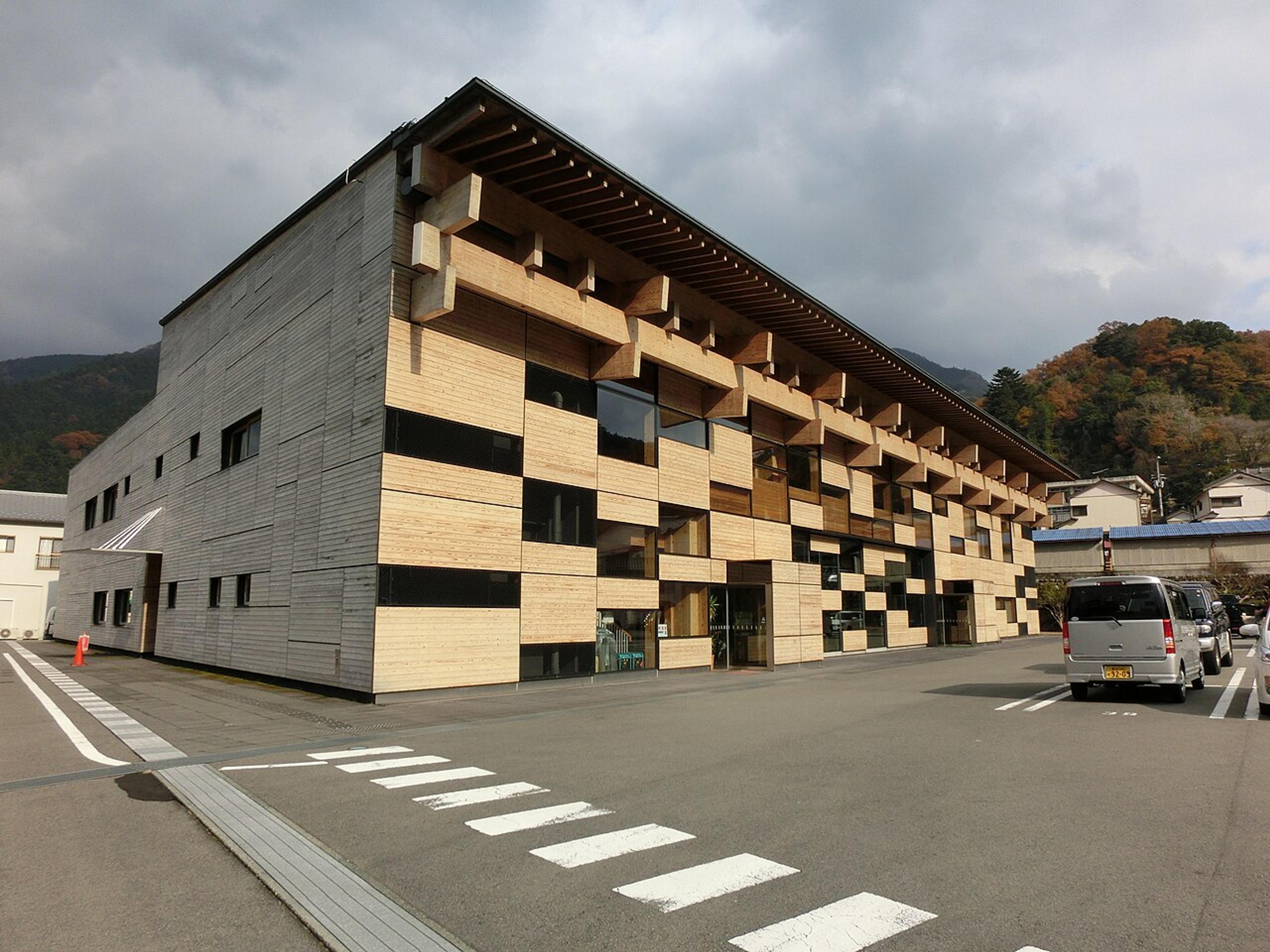
Layered cedar, slatted light, buildings that sit with the forest. Where to see Kengo Kuma's timber architecture, starting with the six-building town of Yusuhara.
Koku Editorial · May 25, 2026
7 places in this guide
Kengo Kuma builds with wood, layered and louvered, against the heavy concrete of the generation before him. The architect of Tokyo's new National Stadium has scattered work across Japan, and one mountain town holds six of his buildings at once. Here is where to see Kuma's timber architecture, starting with that town.
How to read a Kuma building
Look for small pieces of wood doing structural work: stacked cedar, slatted screens that filter light, and facades that read as woven rather than stacked. Kuma talks about making big buildings feel light and dissolving the line between inside and the forest. The work sits with its landscape rather than against it.
Yusuhara: a town of six Kuma buildings
Yusuhara, a town at altitude in the Kochi mountains, holds six Kuma buildings. The Yusuhara Wooden Bridge Museum spans a road on a stack of cantilevered cedar beams. The Community Library, the Library Above the Clouds, lines its hall with cedar shelving that climbs like a canopy. The Marché combines a hotel and market clad in thick straw thatch, and the town office and a welfare hall complete the set. Yusuhara is remote, deep in forested Kochi, and it is the single best concentration of his work in the country.
Tokyo: the Starbucks Reserve Roastery
In Nakameguro, the Starbucks Reserve Roastery is a four-story Kuma building wrapping a working coffee roaster in his signature wood and a cherry-tree terrace over the Meguro River. It reads as a public building that happens to sell coffee, and the riverside frontage peaks in cherry-blossom season.
Toyama: the Toyama Glass Art Museum
The Toyama Glass Art Museum sits inside a downtown complex Kuma wrapped in an undulating facade of layered wood and glass, with a soaring atrium of angled cedar. The glass collection suits the material; the atrium is the reason to look up.
Imabari: Kirosan Observatory
On Oshima Island in the Seto Inland Sea, Kirosan Observatory, completed in 1994, is an early Kuma move: rather than place a tower on the hill, he cut the structure into it, so the building nearly disappears and the view does the work. It looks out over the Kurushima Strait and the bridges of the Shimanami Kaido.
Kanazawa: the Ohi Museum
The Ohi Museum in Kanazawa holds the work of the Ohi family, who have made raku-style tea ware in the city for more than three centuries; Kuma shaped the museum and gallery around the collection. It pairs with the city's tea and craft district.
Planning a Kuma route
Yusuhara is the pilgrimage, and it takes commitment to reach, but it rewards the trip with six buildings in a single walkable town. The others drop into existing stops: the roastery into a Nakameguro day, the Toyama museum into a Hokuriku route, Kirosan into a Shimanami Kaido cycle, the Ohi Museum into Kanazawa. Confirm museum closed days before you go.
Featured in this guide
Places to Visit

Turn this guide into a trip
We'll prioritize these 7 places when building your itinerary.