Tokyo's best neighborhoods are the ones tourists miss: Yanaka's temple district, Kiyosumi's coffee scene, Todoroki's ravine, Shibamata's retro shotengai, and Shimokitazawa's lanes.
Yuku Japan · February 16, 2026
9 places in this guide
The Tokyo Nobody Photographs
Every first-time visitor to Tokyo walks the same circuit: Shibuya Crossing, Senso-ji, Meiji Shrine, Akihabara, Shinjuku at night. These places are famous for good reason. But Tokyo is a city of 23 wards and over 100 distinct neighborhoods, and the ones that reveal the city's actual character, the way people live, eat, create, and occupy space, are rarely the ones that appear on postcards. The walks below cross neighborhoods where Tokyo relaxes, where the pace drops, and where the details reward slow attention.
Each route is two to four hours on foot, connected by subway or JR lines. They can be combined into a full day (pick two that are geographically close) or savored individually on separate afternoons. None requires a reservation, a ticket, or a plan beyond comfortable shoes and curiosity.
Yanaka: The Temple Cemetery District
Yanaka, in Taito Ward, is the neighborhood that survived. While most of central Tokyo was destroyed in the 1945 firebombing, Yanaka's dense cluster of temples, over 70 in a few square blocks, acted as a firebreak, and the wooden houses, narrow lanes, and neighborhood fabric survived intact. Walking Yanaka today is walking through a streetscape that echoes pre-war Tokyo: low wooden buildings, ceramic-tile roofs, cat-filled alleys, and the constant background presence of temple bells.
Start at Nippori Station and walk through Yanaka Cemetery, which doubles as the neighborhood's park, locals jog through the rows of gravestones, children play among the cherry trees (the cemetery is one of Tokyo's best hanami spots), and cats sunbathe on warm stone. Descend Yuyake Dandan, a staircase that faces west and is named for its sunset view, into Yanaka Ginza, a short, lively shopping street of butchers, pickle shops, craft stores, and snack stalls. The croquettes from Suzuki Meat Shop (¥80) are the street's legendary cheap eat. Continue through to Nezu, where Nezu Shrine's tunnel of vermilion torii gates rivals Fushimi Inari without the crowds.
Visit Yanaka on a weekday morning for the quietest experience. The SCAI The Bathhouse gallery, a contemporary art space in a converted Edo-period public bathhouse, is one of Tokyo's most unusual gallery settings. The Asakura Museum of Sculpture (¥500) is a former artist's home with a rooftop terrace offering 360-degree views over the neighborhood's low-rise roofscape.
Kiyosumi-Shirakawa: The Coffee District
Kiyosumi-Shirakawa, in Koto Ward, was a quiet residential neighborhood of no particular distinction until Blue Bottle Coffee opened its first Japan roastery here in 2015. The choice was strategic, rents were low, the neighborhood had character, and the proximity to the Kiyosumi Garden (one of Tokyo's finest stroll gardens, ¥150 entry) gave it a destination anchor. Blue Bottle's success triggered a wave of specialty coffee shops, and the neighborhood now has one of the highest concentrations of third-wave coffee per square meter in the world.
The coffee walk threads through residential streets between the Kiyosumi-Shirakawa and Morishita subway stations. Allpress Espresso (New Zealand roaster), The Cream of the Crop Coffee (single-origin pourover in a converted warehouse), Iki Espresso (Australian-style), and ARiSE Coffee Roasters (a tiny shop with superb filter coffee at ¥350) are all within a 15-minute walk. Between cafes, the Tokyo Museum of Contemporary Art (¥500) offers a serious collection in a building that contrasts strikingly with the neighborhood's modest scale. Kiyosumi Garden's pine-framed stone bridges and koi ponds provide the walk's meditative center point.
A self-guided Kiyosumi coffee crawl costs remarkably little: ¥350-500 per shop for excellent single-origin filter coffee or espresso drinks. Four stops plus Kiyosumi Garden entry and a museum visit totals under ¥3,000 for a full afternoon, less than two drinks at a Ginza hotel lounge.
Todoroki Valley: The Urban Ravine
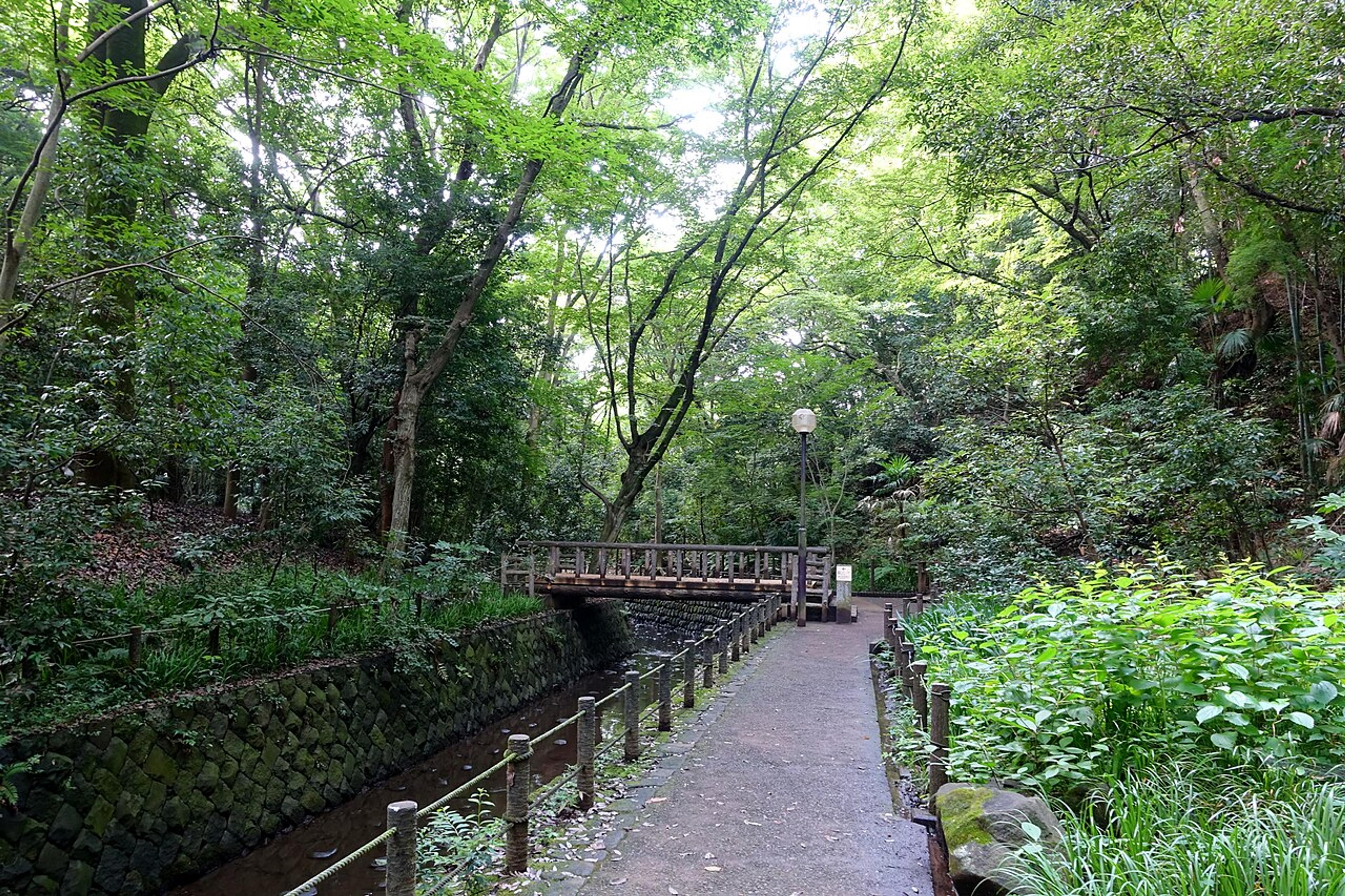
Todoroki Valley is the only ravine valley in Tokyo's 23 wards, a one-kilometer stretch of wooded gorge carved by the Yazawa River, hidden between residential streets in Setagaya Ward. The entrance, just steps from Todoroki Station on the Oimachi Line, drops from street level into a corridor of bamboo, zelkova, and Japanese maple canopy so dense that the city above disappears. A boardwalk follows the stream past moss-covered stone walls, small waterfalls, and a Shinto shrine (Todoroki Fudoson) set in a clearing above the gorge.
The walk takes about 30 minutes end to end, emerging at Todoroki Fudoson's upper gate near a park and children's playground. The transition is jarring, from subtropical ravine to suburban park in a single staircase. In summer, the gorge is noticeably cooler than the streets above, and the cicada noise creates an acoustic wall that blocks traffic sounds. In autumn, the maple canopy turns the gorge into a tunnel of red. The ravine's existence, genuine wilderness maintained in one of the world's densest cities, is Tokyo's most improbable secret.
Combine Todoroki Valley with a walk through adjacent Futako-Tamagawa, one stop away on the Oimachi Line. The Tamagawa riverbank park offers wide-open sky views and is a counterpoint to the ravine's enclosed canopy. The Futako-Tamagawa Rise shopping complex has a rooftop garden with river views, a good lunch spot before or after the gorge walk.
Shibamata: The Retro Film Set
Shibamata, in Katsushika Ward at the far eastern edge of Tokyo, is famous as the setting for 'Otoko wa Tsurai yo' (It's Tough Being a Man), the longest-running film series in history, with 50 installments between 1969 and 2019. The Tora-san films followed a lovable traveling salesman through small-town Japan, and Shibamata was his home base. The neighborhood has preserved the atmosphere that the films celebrated: a temple approach street (sandou) lined with traditional sweet shops, senbei crackers grilled over charcoal, and dango dumplings dipped in soy glaze.
The walk runs from Shibamata Station (look for the Tora-san statue outside) along the sandou to Taishakuten temple, a wooden temple whose exterior carvings, 10 massive panels depicting scenes from the Lotus Sutra, are among the most elaborate in Tokyo. The Yamamoto-tei garden, a Taisho-era merchant's villa with a stroll garden overlooking the Edogawa River, charges just ¥100 and offers matcha service (¥400) in a tatami room with garden views. The entire neighborhood feels like a film set because, essentially, it is one, but the shops and the temple predate the films by centuries.
The Tora-san Museum (¥500) near Taishakuten temple is surprisingly moving, even for visitors unfamiliar with the films. The recreation of the Kurumaya shop set and the exhibition on actor Atsumi Kiyoshi's dedication to the role convey something essential about Japanese popular culture's relationship with nostalgia, hometown identity, and gentle comedy. The films are available on streaming services, watching one before visiting transforms the walk.
Shimokitazawa: The Backstreet Village
Shimokitazawa, Shimokita to locals, is a maze of narrow lanes southwest of Shinjuku that functions as Tokyo's bohemian quarter. The neighborhood has no grid, no main street, and no obvious center. Instead, it has a density of small-scale culture: vintage clothing shops in converted apartments, live music venues seating 30, independent bookstores, curry shops operated by musicians, and theaters the size of living rooms. The vibe is young, creative, and resistant to Tokyo's usual corporate polish.
The recent Shimokita Senrogai development, a series of low-rise mixed-use buildings built along the former Odakyu railway trench after the line went underground, has added a curated layer of cafes, restaurants, and shops without displacing the older backstreet character. The combination of old Shimokita (vintage shops, hole-in-the-wall izakaya, live houses) and new Shimokita (design-conscious cafes, natural wine bars, independent record stores) creates a neighborhood that evolves without losing its identity. There is no itinerary for Shimokitazawa, just walk, turn into alleys that look interesting, and follow the smell of curry or the sound of guitars.
Shimokitazawa's vintage clothing shops are among the best-value in Tokyo: curated secondhand denim from ¥2,000, vintage band tees from ¥1,500, and retro Japanese workwear from ¥3,000. New York Joe Exchange and Flamingo are the most famous, but the tiny unnamed shops on the back lanes often have better prices and more eccentric stock.
Featured in this guide
Places to Visit



Turn this guide into a trip
We'll prioritize these 9 places when building your itinerary.