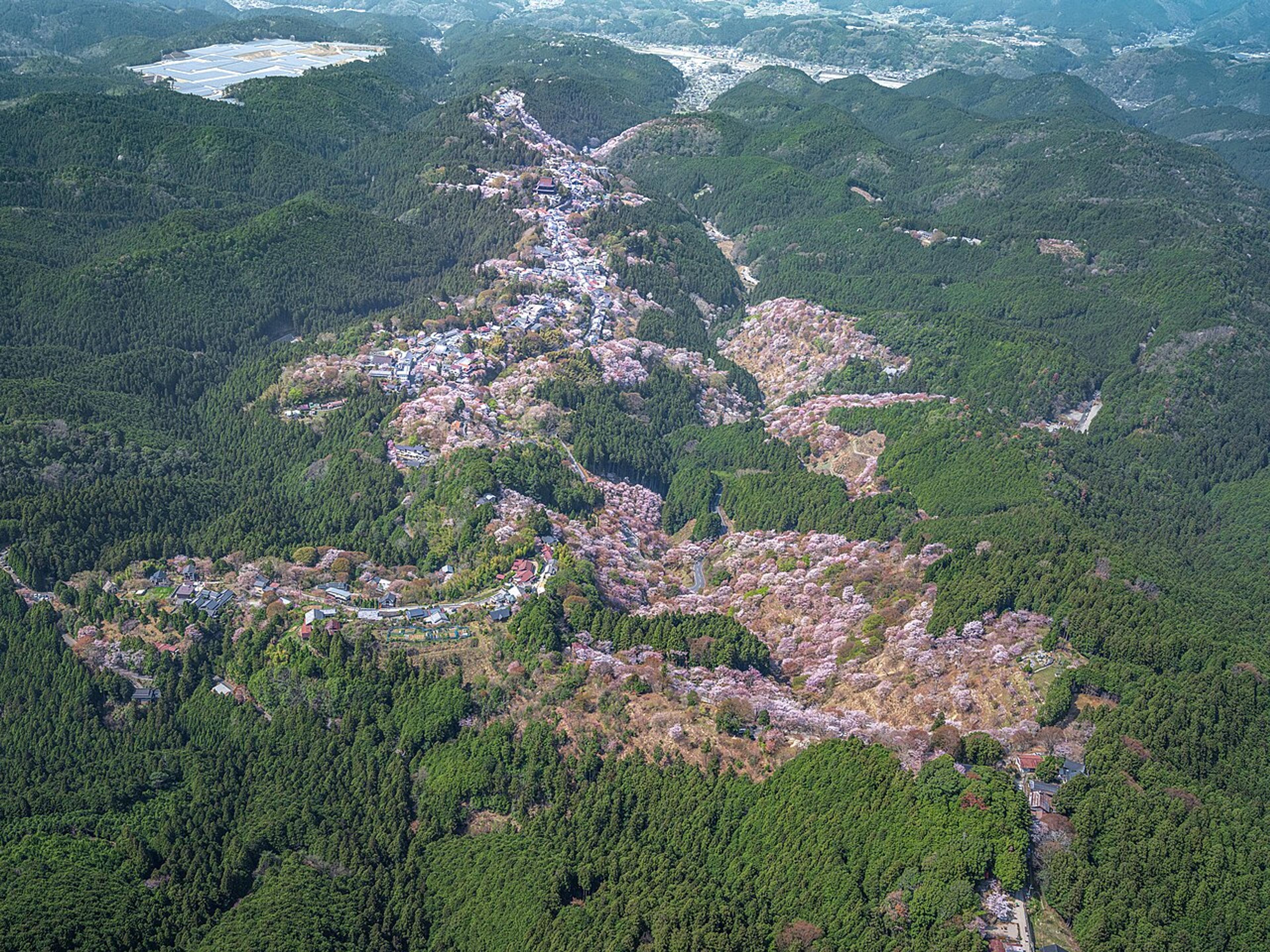
Yoshino: A Mountain of Cherry Trees
Seasonal · yoshino · 8 min
Yoshino holds 30,000 cherry trees across four zones that bloom in sequence up the mountain, Japan's most sacred hanami, rooted in temple culture and yamabushi practice.
Yuku Japan · February 16, 2026
7 places in this guide
The Sacred Mountain of Blossoms
Yoshino is not a park. It is an entire mountain covered in cherry trees, approximately 30,000 of them, planted over 1,300 years not for picnics but as sacred offerings to the mountain deity. The trees are shiro-yamazakura (white mountain cherry), a wild species that blooms white to pale pink with copper-colored new leaves, more subtle than the cultivated somei-yoshino that fills urban parks across Japan. Yoshino's blossoms are older, wilder, and woven into a religious tradition that predates the modern idea of hanami by centuries.
The mountain is divided into four zones by elevation: Shimo Senbon (lower thousand trees), Naka Senbon (middle thousand), Kami Senbon (upper thousand), and Oku Senbon (inner thousand). Because of the altitude difference, roughly 200 to 600 meters, the zones bloom in sequence over about two weeks, from lower to upper. This staggered bloom means Yoshino's cherry season lasts longer than anywhere else in Japan, and visitors can chase the bloom uphill as the days pass.
Peak bloom at Shimo Senbon typically falls in the first week of April, with Oku Senbon reaching full bloom around April 15-20. These dates shift by a week depending on the year. The Yoshino Town tourism office publishes daily bloom reports from late March. Weekday visits are strongly recommended, weekend crowds in peak bloom are significant, with traffic controls and bus delays of 60-90 minutes.
Shimo Senbon and Kinpusen-ji
The ropeway from Yoshino Station (¥450 one way, 3 minutes) deposits visitors at the base of Shimo Senbon, where the approach to Kinpusen-ji temple begins. The path climbs through the town's main street, a narrow lane of ryokan, sweet shops, and restaurants selling kuzumochi and kuzu udon (both made from the local kudzu starch that Yoshino is famous for). The sweet shops have been here for generations, some since the Edo period, and the smell of freshly made sakura mochi fills the air during bloom season.
Kinpusen-ji is the spiritual heart of Yoshino and the headquarters of Shugendo, a syncretic religion that blends mountain asceticism, esoteric Buddhism, and Shinto nature worship. The Zao-do main hall is the second largest wooden building in Japan after Todai-ji in Nara, and it houses three imposing Zao Gongen statues, fierce, blue-skinned deities with raised fists and flaming halos. These statues are normally hidden and revealed only during special openings (typically spring and autumn, ¥1,600 admission). The hall's massive pillars and the incense-darkened interior create an atmosphere of genuine power.
The cherry trees at Yoshino were originally planted as offerings to the Zao Gongen deity, each tree a prayer made physical. This is why cutting a Yoshino cherry tree was historically considered sacrilege. The yamabushi mountain monks who practice Shugendo still walk the mountain trails in their distinctive white robes and conch-shell horns, and their presence connects the cherry viewing to a living religious practice rather than pure aesthetics.
Naka Senbon and Kami Senbon
Above Kinpusen-ji, the path continues uphill through Naka Senbon, where the cherry trees grow denser and the crowds thin. The Yoshimizu Shrine here, originally a monk's residence, is where the fugitive Emperor Go-Daigo held court in the 14th century during the split between the Northern and Southern Imperial Courts. The view from the shrine veranda across Naka Senbon's cherry canopy is considered one of the three great cherry blossom views in Japan. Toyotomi Hideyoshi, the warlord who unified Japan, staged a legendary flower-viewing party at this exact spot in 1594, bringing 5,000 retainers for a day of poetry and feasting.
Kami Senbon, the upper zone, requires a steeper climb but rewards with solitude and broader views. The cherry trees here are older and more gnarled, growing from rocky slopes where the soil is thin. On clear days, the vista stretches across layers of mountain ridges fading to blue in the distance, with rivers of pale cherry blossom flowing down every valley. The Hanayagura viewpoint at Kami Senbon is the best single panorama on the mountain, arrive early morning for soft light and empty trails.
The community bus runs from Kinpusen-ji to Kami Senbon (¥400, 20 min) during bloom season, allowing you to start high and walk downhill. This is the smarter strategy, the uphill walk is tiring and the views are better looking down through the cherry canopy. Walking from Kami Senbon to Shimo Senbon takes about 90 minutes at a leisurely pace.
Oku Senbon and the Mountain Interior
Oku Senbon (inner thousand) is the highest and most remote zone, reached by a further 40-minute walk beyond Kami Senbon on a trail that enters deep forest. The cherry trees here are scattered rather than massed, growing wild among cedar and cypress. The atmosphere shifts from spectacle to solitude, this is the zone where yamabushi monks train, and the trail passes small shrines and meditation platforms perched on mountain ledges.
Kinpu Shrine, at the edge of Oku Senbon, marks the beginning of the Omine Okugake trail, a 170-kilometer mountain route that connects Yoshino to Kumano, used by Shugendo practitioners for over a millennium. The shrine itself is a modest wooden structure, but its setting, dense forest, mountain silence, the faint sound of wind through cherry blossoms, is Yoshino at its most contemplative. Most visitors turn back at Kami Senbon, so Oku Senbon in bloom is a rare and private experience.
The trail to Oku Senbon is unpaved mountain path with some steep sections. Proper walking shoes are essential, the trail surface is root-covered and muddy after rain. There are no shops or vending machines beyond Kami Senbon. Carry water and a snack. Cell phone coverage is intermittent in the Oku Senbon area.
Kuzu and the Flavors of Yoshino
Yoshino kuzu (kudzu starch) is one of Japan's most refined traditional ingredients. The roots of the kudzu plant are harvested in winter, washed repeatedly in cold mountain water over 30-40 days, and the resulting white starch is prized for its silky texture and translucence. Genuine Yoshino kuzu is expensive (¥1,500-3,000 for a small package) because the process is labor-intensive and the yield is low, roughly one kilogram of starch from twenty kilograms of root.
Along Yoshino's main street, shops serve kuzumochi (starch cakes dusted with kinako soybean powder), kuzu-kiri (starch noodles in brown sugar syrup), and sakura-flavored kuzu confections during cherry season. The texture is unlike anything else in Japanese sweets, cool, yielding, and almost liquid on the tongue. Nakanishi Yoshino, a kuzu producer operating since the Edo period, runs a small tasting shop where you can try freshly made kuzu-kiri for ¥600 and watch the starch being worked in the kitchen.
A full day at Yoshino costs surprisingly little. The ropeway is ¥450, Kinpusen-ji entry is free (special openings ¥1,600), kuzu sweets run ¥400-800 per portion, and a lunch of kuzu udon or kakinoha-zushi (persimmon leaf sushi, a Yoshino specialty, ¥800-1,200) is filling and local. The Kintetsu train from Osaka-Abenobashi to Yoshino is ¥970 one way (75 minutes).
Turn this guide into a trip
We'll prioritize these 7 places when building your itinerary.