Sakai forged Japan's swords, invented its tea ceremony, and guards the world's largest tomb. A craft city hiding in plain sight 15 minutes south of Osaka.
Yuku Japan · February 16, 2026
3 places in this guide
The City That Forged Japan
Sakai sits on the southern edge of Osaka, a 15-minute train ride from Namba that most travelers make only by accident. This is a mistake. Sakai was, for centuries, one of the wealthiest and most independent cities in Japan, a free trading port governed by its own merchant council, the Detroit and Sheffield of the pre-modern world rolled into one. It forged the swords that armed the samurai, the guns that ended the samurai era, and the knives that now fill the kitchens of every serious chef in Japan. It was the birthplace of Sen no Rikyu, the man who codified the tea ceremony. And at its northern edge stands the largest tomb on earth.
Modern Sakai is an industrial city that makes no effort to charm tourists. The streets are functional, the architecture is postwar concrete, and the signage is almost entirely in Japanese. This lack of tourist polish is precisely the point, Sakai's craft traditions are not performances for visitors but active industries serving professional markets. The knife forges, the tea houses, and the konbu processors operate as they have for generations, and encountering them requires engagement rather than spectatorship.
The Nankai Line from Namba to Sakai Station takes 15 minutes (¥310). The Sakai City Loop Bus (¥220 per ride, ¥500 day pass) connects all major sites. The Sakai Tourism Promotion Association at Sakai Station has English maps and can arrange knife forge visits, some forges require advance booking through the association rather than accepting walk-ins.
The Blade Quarter
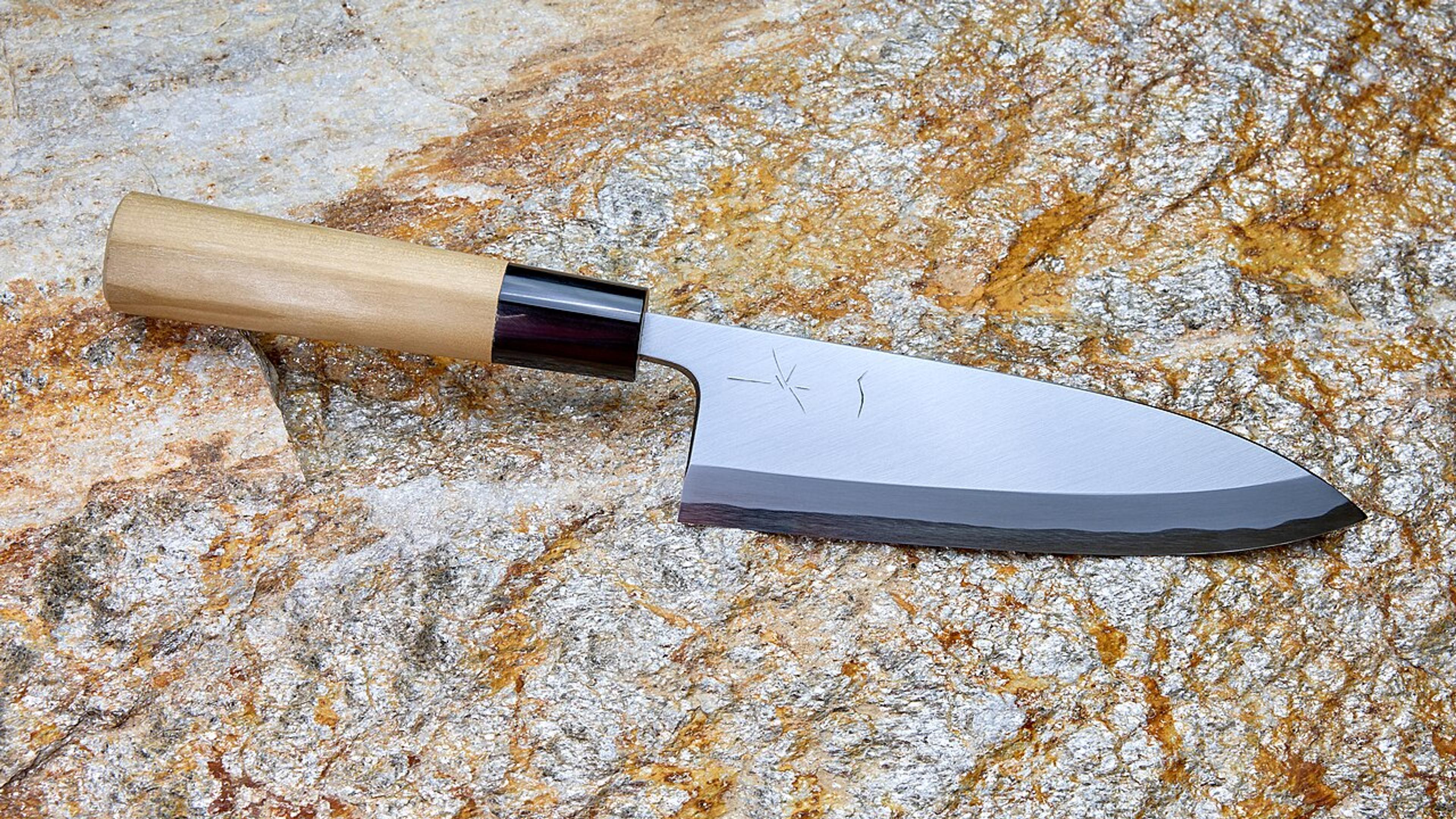
Sakai produces over 90% of Japan's professional kitchen knives. The industry descended directly from the city's sword-making tradition: when Tokugawa banned swords in the 17th century, Sakai's smiths pivoted to kitchen blades, applying the same techniques, differential hardening, laminated steel construction, hand-forging, that had made their swords legendary. Today, Sakai knives are the standard in Japanese professional kitchens and increasingly prized by chefs worldwide.
The knife-making process in Sakai is divided between three specialists: the blacksmith (who forges and shapes the blade), the sharpener (who grinds and hones the edge), and the handle maker. Each specialist is a separate workshop, and a single knife passes through all three before completion. The Sakai Knife Museum (Sakai Hamono Museum, free entry) explains this division of labor with displays, videos, and a working demonstration area where craftsmen shape blades in real time. The attached shop sells knives at factory-direct prices, a professional-grade yanagiba (sashimi knife) runs ¥15,000-40,000, roughly 40% less than the same blade at a Tokyo knife shop.
Japanese knife etiquette: a knife is considered a deeply personal tool, and gifting a knife carries the superstition of 'cutting' the relationship. The traditional workaround is for the recipient to give a small coin (¥5 or ¥10) in return, symbolically transforming the gift into a purchase. Many Sakai shops include a small coin with purchase for exactly this purpose.
Sen no Rikyu and the Way of Tea
Sen no Rikyu (1522-1591) was born in Sakai and is revered as the greatest tea master in history, the person who transformed the tea ceremony from an aristocratic display of Chinese ceramics into the austere, philosophical practice of wabi-cha that defines Japanese tea culture to this day. Rikyu stripped the ceremony to its essentials: a small room, a simple bowl, seasonal flowers, and a quality of attention that finds beauty in imperfection and transience.
The Sen no Rikyu Memorial (Rikyu no Furusato, ¥100) marks the site of his family residence with a small museum displaying his aesthetic philosophy. More rewarding is the Nanshu-ji temple, a Zen temple where Rikyu studied and which preserves a tea room attributed to his design. The garden here, raked gravel, moss, and a few carefully placed stones, embodies the restrained aesthetic that Rikyu elevated to an art form. Tea ceremony sessions in Sakai (¥1,000-2,000 at various venues including the Sakai Plaza of Rikyu and Akiko) tend to be quieter and more focused than the tourist-oriented ceremonies in Kyoto.
Rikyu's most radical teaching was that true tea exists in the ordinary, a cracked bowl is more beautiful than a perfect one, a single flower outweighs an arrangement, and the highest skill is invisible. His seven rules of tea (make a satisfying bowl, lay the charcoal so the water boils, arrange flowers as they are in the field, be ready ahead of time, prepare for rain, give attention to each guest, keep to the allotted time) apply far beyond the tea room.
Daisen Kofun: The World's Largest Tomb
The Mozu-Furuichi Kofun Group, designated a UNESCO World Heritage Site in 2019, is a cluster of 49 ancient burial mounds in the Sakai area, dating from the 4th to 6th centuries. The largest, Daisen Kofun, is attributed to Emperor Nintoku and is the biggest tomb on earth by area, 486 meters long, surrounded by three moats, covering more ground than the Great Pyramid of Giza or the Mausoleum of Qin Shi Huang.
The paradox of Daisen Kofun is that you cannot see it whole from the ground. The keyhole shape, a circular rear mound connected to a triangular front platform, is visible only from the air. At ground level, it appears as a forested hill surrounded by a wide moat, impressive in scale but difficult to comprehend. The Sakai City Hall observation deck (21st floor, free entry) offers a partial aerial view, and the Mozu Kofun Visitor Center (¥200) provides excellent context with models, videos, and archaeological displays that bring the mounds to life.
Rent a bicycle from the Sakai Station rental shop (¥300/day) and ride the 2.5-kilometer perimeter path around Daisen Kofun's outer moat. The full circuit takes about 20 minutes and gives you a sense of the tomb's enormous scale that static viewpoints cannot. The surrounding smaller kofun are visible from the cycling path and are less restricted, you can walk up the grassy slopes of some for elevated views.
Konbu and the Flavors of Sakai
Sakai has been Japan's primary konbu (kelp) processing center since the Edo period. Kelp harvested in Hokkaido was shipped south on the kitamae-bune trade route, arriving in Sakai where it was processed into the various forms used in Japanese cuisine: shaved konbu, tororo konbu (fine-shaved sheets), oboro konbu (hand-shaved translucent layers), and the dashi konbu that forms the foundation of Japanese cooking. The konbu trade made Sakai's merchants fabulously wealthy and established the city as the center of Japan's umami industry.
Konbu-processing workshops still operate in the Sakai area, though their numbers have declined. Okui Kaiseido, a konbu shop founded in 1848, operates a small factory and shop where you can watch artisans shave konbu by hand, a skill that takes ten years to master, producing sheets so thin they are translucent. The shop sells products ranging from everyday cooking konbu (¥500) to premium hand-shaved oboro konbu (¥2,000+) that dissolves on the tongue in a burst of umami.
A full Sakai day works well as a self-guided food tour: knife museum (free), Rikyu memorial (¥100), kofun visitor center (¥200), konbu shop tasting (free samples at most shops), and lunch at one of Sakai's old-school udon or tempura restaurants (¥800-1,200). Total spend excluding transport: under ¥2,000 for a day that covers forging, philosophy, archaeology, and flavor.
Featured in this guide
Places to Visit
Turn this guide into a trip
We'll prioritize these 3 places when building your itinerary.