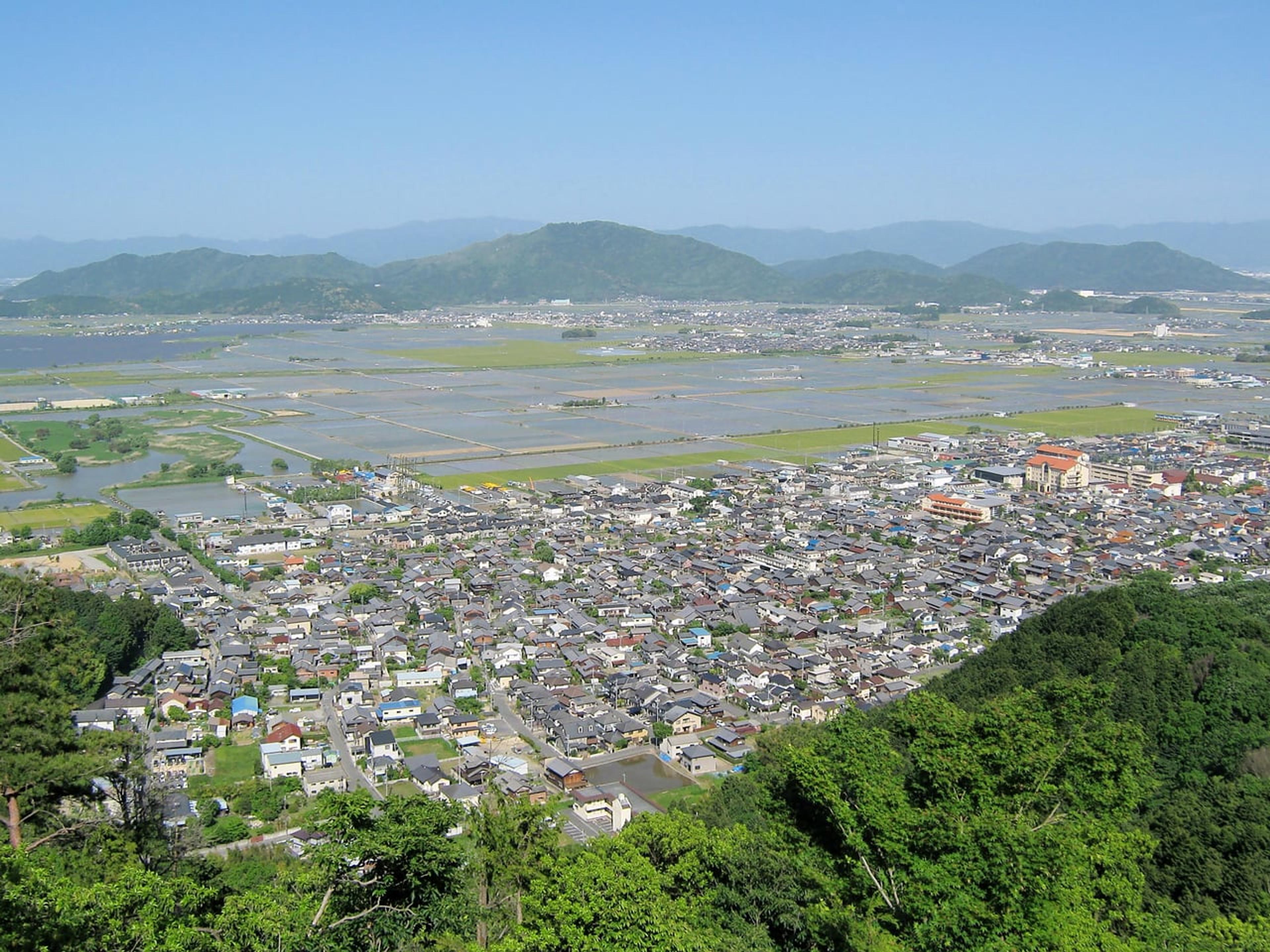
The eastern shore of Japan's largest lake hides Omihachiman's canals, Hikone Castle, Nagahama's glass studios, Chikubu-shima's island shrine, and funazushi traditions.
Koku Travel · February 16, 2026
7 places in this guide
The Inland Sea of Kansai
Lake Biwa is the largest freshwater lake in Japan, 670 square kilometers of water surrounded by mountains in Shiga Prefecture, just 15 minutes by train from Kyoto. Despite this proximity, most Kyoto visitors never see it. The lake's eastern shore, running from Omihachiman in the south to Nagahama in the north, preserves a landscape of merchant towns, feudal castles, and fishing villages that has been shaped by the lake's commerce and ecology for over a thousand years.
The JR Biwako Line hugs the eastern shore, making it easy to hop between towns. From Kyoto Station, Omihachiman is 35 minutes (¥680), Hikone is 50 minutes (¥1,170), and Nagahama is 70 minutes (¥1,340). A single day can cover two towns comfortably; three days lets you work the full shore with time to linger.
The JR Kansai Area Pass (roughly ¥2,800 for 1 day, ¥4,800 for 2 days at recent prices) covers unlimited rides on the Biwako Line and typically pays for itself with a single Kyoto-Nagahama round trip. The pass also works on JR buses and includes access to the Kansai Airport express, making it useful for the first or last day of a Kansai trip. Check JR West for current pricing before you buy.
Omihachiman: The Merchant Canals
Omihachiman was built around a network of canals that connected Lake Biwa to inland trade routes. The Omi merchants (Omi shonin) who operated from here were among the most successful traders in pre-modern Japan, with a business philosophy summarized as sanpo yoshi, 'good for the seller, good for the buyer, good for society.' Their legacy is visible in the town's architecture: grand merchant houses with whitewashed walls, tile roofs, and inner gardens that speak of wealth accumulated over centuries.
The Hachiman-bori canal is the town's centerpiece, a 6-kilometer waterway flanked by willows and old storehouses that reflects the sky in its still surface. Boat tours (¥1,000, 35 minutes) glide along the canal past the merchant district and out toward the reed beds at the lake's edge. The warehouses along the canal have been converted into galleries, cafes, and a sake brewery. Climb Hachiman-yama, the hill at the canal's head, via the ropeway (¥890 round trip) for a panoramic view of the canal grid, the lake, and the surrounding mountains.
The Omi merchants' sanpo yoshi philosophy is considered a precursor to modern corporate social responsibility. Several of the merchant houses are now museums documenting their trade networks, which stretched from Hokkaido to Kyushu, and their practice of reinvesting profits in community infrastructure. The Kyuichiro Merchant House (free entry) is the most atmospheric, with its original furnishings and a garden visible from the main trading room.
Hikone Castle: The Survivor
Hikone Castle is one of only five castles in Japan designated as a National Treasure, and one of only twelve that retain their original keep (tenshu). Built between 1604 and 1622 by the Ii clan, the castle survived the Meiji-era demolition orders that destroyed most of Japan's feudal castles only because an imperial inspection delayed the demolition long enough for a preservation order to be issued.
The castle is compact but exquisite. The three-story keep combines architectural elements borrowed from several destroyed castles, the Ii lords essentially assembled a greatest-hits compilation of castle design. The steep wooden stairs inside lead to an observation floor with views across the lake to the mountains beyond. The Genkyu-en garden at the castle's base, modeled after the Eight Views of Omi (a classical catalog of Lake Biwa views), is one of the finest daimyo gardens in Japan, with a teahouse (matcha and wagashi ¥500) overlooking a pond that frames the castle keep.
Hikone Castle admission is ¥800 (includes the castle museum and Genkyu-en garden). The castle's mascot, Hikonyan, a white cat wearing a samurai helmet, performs daily at 10:30 AM and 1:30 PM on the castle grounds. The mascot is surprisingly charming even for adults and has become one of the most popular yuru-kyara (local mascot characters) in Japan.
Nagahama and Chikubu-shima
Nagahama, at the northeastern corner of the lake, was a castle town of Toyotomi Hideyoshi before he moved to Osaka. The town's Kurokabe Square district, named for the black-walled Meiji-era bank building at its center, has reinvented itself as a glass-art district, with over thirty studios, galleries, and workshops producing and selling blown glass, fused glass, and stained glass. The Kurokabe Glass Studio (free entry, glass-blowing sessions from ¥3,300) demonstrates techniques in an open workshop setting.
From Nagahama Port, ferries (¥3,130 round trip, 30 minutes each way) cross to Chikubu-shima, a small island in the northern lake that has been a sacred site since antiquity. The island holds both a Buddhist temple (Hogonji, founded in 724) and a Shinto shrine (Tsukubusuma Shrine), their buildings clinging to the steep wooded hillside above the water. The approach by boat, the island rising from the lake like a green jewel, is one of the finest arrivals in Kansai. Visitors are asked to leave within two hours; the island has no shops, no restaurants, and no overnight accommodation.
Chikubu-shima ferries run only from late March through early December, with reduced schedules in spring and autumn shoulder seasons. Check the Ohmi Marine website for current timetables. The island's steep stone stairs are not accessible for wheelchairs or strollers. Weather can cancel crossings, the northern lake is exposed to wind, and waves build quickly.
Funazushi: The Ancient Fermentation
Funazushi is the oldest form of sushi in Japan, and a direct ancestor of the nigiri sushi we know today. Nigorobuna (a crucian carp species endemic to Lake Biwa) is packed in salt for a year, then fermented in cooked rice for another one to three years. The result is intensely pungent, deeply umami, and divisive: locals consider it a delicacy, while many visitors find the fermented aroma overwhelming on first encounter.
Understanding funazushi as a living ancestor of all sushi transforms the experience from strange to revelatory. The fermentation process, lactic acid bacteria breaking down the fish proteins over years, produces flavors closer to aged cheese than to raw fish. The best funazushi is layered and complex: sour, salty, savory, with a finish that lingers for minutes. Kitashina, a funazushi producer in Takashima (west shore, accessible by JR), sells directly from their workshop and offers tastings with explanation. A small tasting portion is ¥500; a whole fish runs ¥3,000-8,000 depending on age.
If funazushi intimidates you, start with the rice that surrounds the fish rather than the fish itself. The fermented rice has a milder, pleasantly sour flavor that introduces the taste profile gently. Pair with local Shiga sake, the prefecture has over 30 breweries, which cuts through the fermentation and creates a pairing that locals have perfected over centuries.
Featured in this guide
Places to Visit

Turn this guide into a trip
We'll prioritize these 7 places when building your itinerary.