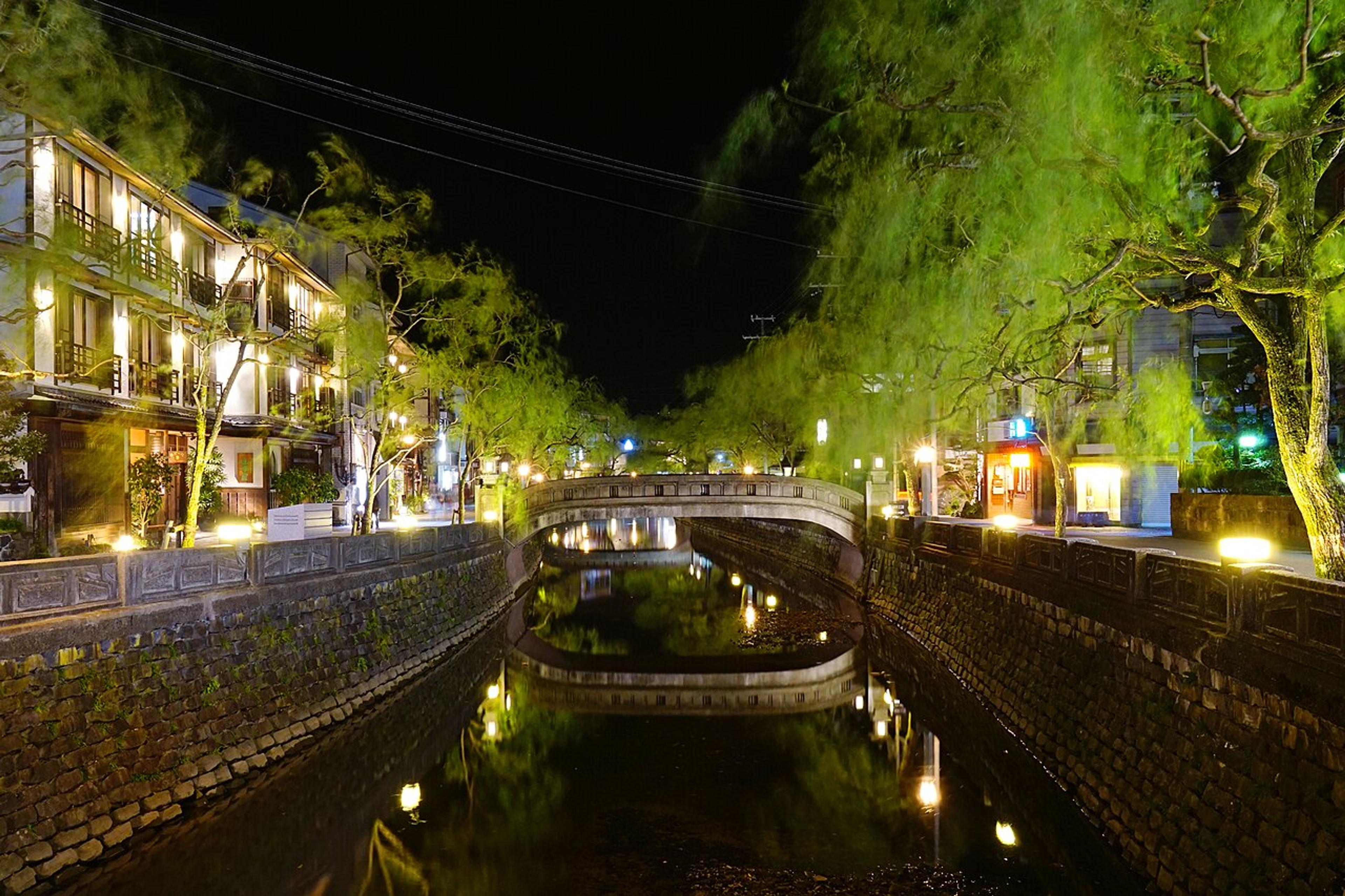
Kinosaki is Japan's most walkable onsen town: seven bathhouses, willow-lined canals, yukata strolling. Add Genbudo's basalt caves, matsuba crab, and Izushi's soba quarter.
Yuku Japan · February 16, 2026
5 places in this guide
The Town Built for Bathing
Kinosaki Onsen is a small hot spring town on the Sea of Japan coast in northern Hyogo Prefecture, and it may be the most perfectly designed onsen destination in Japan. The town is built around a single canal lined with willow trees, stone bridges, and wooden ryokan. Seven public bathhouses (sotoyu) are spaced along the canal and surrounding streets, each with a different architectural style and water quality. The tradition is to check into your ryokan, change into a yukata and wooden geta sandals, and spend the evening walking between bathhouses, bathing, cooling off, walking, bathing again.
This practice of sotoyu meguri (bathhouse hopping) defines Kinosaki's character. The town exists to facilitate it: every ryokan provides a yukata and a towel bag, the streets are designed for geta-clad strolling, and the bathhouses are spaced at comfortable walking intervals. In the evening, the canal is lit by lanterns, and the sound of wooden geta clacking on stone fills the air. It is, without irony, one of the most civilized ways to spend an evening in Japan.
Most ryokan include a sotoyu meguri pass (free entry to all seven bathhouses) with your stay. If visiting as a day-tripper, buy the Yumepa pass (¥1,500 for adults) at any bathhouse. The pass is valid all day. Each bathhouse has its own opening hours and weekly closing day, check the schedule posted at the Kinosaki Onsen Tourism Office near the station to plan your route efficiently.
The Seven Bathhouses
Each of Kinosaki's seven bathhouses has distinct character. Ichino-yu, nearest the station, features a cave-themed interior with a Persian-influenced domed ceiling. Gosho-no-yu, at the town's south end, has an imperial palace aesthetic with a grand entrance and outdoor bath overlooking the mountains. Mandara-yu, the most remote, is set in a forested area and is the quietest of the seven. Satono-yu, the largest and newest, offers a rooftop terrace bath with panoramic views, the only bathhouse with an elevator, making it accessible for those with mobility issues.
The ritual matters as much as the water. The sotoyu meguri is structured, warm up in a small bath, graduate to a larger one, rest between baths with a stroll and perhaps a snack from one of the canal-side vendors (hot spring tamago eggs at ¥100, soft-serve ice cream at ¥350, or onsen manju steamed buns at ¥120). The alternation of hot water and cool evening air, repeated across several bathhouses, produces a deep, cumulative relaxation that a single bath cannot match.
Onsen etiquette applies at all seven bathhouses: wash thoroughly at the shower stations before entering the bath, tie long hair up so it does not touch the water, do not put your towel in the bath (fold it on your head), and enter quietly. Tattoos are accepted at all seven Kinosaki bathhouses, one of the few traditional onsen towns in Japan with a universal tattoo-friendly policy.
Genbudo Basalt Caves
Five kilometers south of Kinosaki, the Genbudo caves are a geological formation of columnar basalt created by volcanic eruptions 1.6 million years ago. The hexagonal basalt columns, perfectly geometric, stacked like giant organ pipes, line the walls and ceilings of four interconnected caves along the Maruyama River. The site was designated a National Natural Monument in 1931 and is where the reversal of Earth's magnetic polarity was first conclusively demonstrated by geologist Motonori Matuyama in 1929.
The caves are free to enter and take about 30 minutes to walk. The Genbudo Museum (¥500) at the entrance explains the geological significance with displays, rock samples, and a model showing how columnar basalt forms as lava cools and contracts. A rowing boat service (¥300, 20 minutes) crosses the river to the main cave entrance, an approach worth taking by water. In autumn the surrounding maple trees flame red against the gray basalt.
Rent a bicycle from Kinosaki Station (¥600/day) and ride to Genbudo, the route follows a flat riverside path and takes about 20 minutes. The caves themselves are free. Combined with the museum (¥500) and boat crossing (¥300), the entire excursion costs ¥1,400 including the bike. Return via the riverside path for views of the stork nesting platforms, Kinosaki is a key habitat for the Oriental white stork reintroduction program.
Matsuba Crab Season
From November through March, Kinosaki transforms into a crab town. Matsuba-gani (male snow crab) is hauled from the Sea of Japan and served at every ryokan, restaurant, and market stall in preparations that range from sashimi (raw, sweet, and slippery) to kani-suki (hot pot), grilled over charcoal, and steamed in its shell. A tagged matsuba crab, bearing the colored tag of its fishing port, is the premium grade, indicating the crab was landed locally and meets strict size and quality standards.
The crab experience at a Kinosaki ryokan is the definitive way to eat matsuba. A typical crab kaiseki dinner includes seven or eight courses built around a single crab: sashimi legs, grilled shell with miso, hot pot with vegetables, vinegared crab, deep-fried crab, crab rice porridge to finish. The meal unfolds over two hours, each course demonstrating a different quality of the same ingredient. Ryokan rates during crab season increase significantly (¥25,000-45,000 per person including crab dinner and breakfast), but the meal alone is worth ¥15,000-20,000 at a standalone restaurant.
Matsuba crab season opens November 6 and closes March 20. The sweetest, meatiest crabs are typically caught in late November and December. By February, quality remains high but availability narrows. Book crab-season ryokan at least six weeks ahead, popular properties sell out by early October. For a budget alternative, the crab stalls at Kinosaki's morning market sell boiled crab legs for ¥1,000-2,000.
Izushi: The Soba Castle Town
Izushi is a small castle town 30 minutes inland from Kinosaki by car (or 50 minutes by Zentan Bus, ¥600), known for a distinctive soba tradition: sara soba (plate soba), where buckwheat noodles are served in small portions on five stacked dishes. You eat through the stack, adding toppings, grated yam, raw egg, wasabi, green onion, ground daikon, and pouring dashi-based sauce from a ceramic vessel. When you finish the five plates, you can order more (¥200 per additional plate). Local pride demands finishing at least fifteen plates; the current record, displayed in several shops, exceeds fifty.
The town itself is a well-preserved Edo-period grid with a ruined castle on the hill above, a kabuki theater (Eiraku-za, one of the oldest in Kansai, free to enter), and about fifty soba shops competing for customers along the main street. Izushi produces its own buckwheat locally, milled fresh daily at most shops. The soba is thin, firm, and nutty, closer to the refined tradition of Nagano soba than the rustic Tohoku style. A standard five-plate set costs ¥850-950, making it one of the best-value specialty meals in Kansai.
Visit Izushi on a weekday morning before 11:30 AM, when the best shops are freshly open and the noodles are at their peak. Tanbaya and Kogetsu are consistently ranked among the top shops. After eating, walk up to the Izushi Castle ruins for a view over the tile rooftops and the surrounding mountains. The Izushi Clock Tower (Shinkorou), a Meiji-era drum tower that still keeps time, is the town's photographic landmark.
Turn this guide into a trip
We'll prioritize these 5 places when building your itinerary.