Hidden Gems of Shikoku: Pilgrimage, Art, and River Valleys
Blog · Shikoku · 9 min
Japan's smallest main island has 58 hidden gems, from contemporary art museums to vine bridges over gorges. Shikoku is Japan distilled.
Koku Editorial · March 7, 2026
12 places in this guide
The Island People Forget
Shikoku is the smallest and least-visited of Japan's four main islands. This is starting to change, the Setouchi art islands (Naoshima, Teshima) have brought international attention, and the 88-temple pilgrimage has always drawn the devoted. But between the art and the pilgrimage, there's an entire island of gorges, indigo workshops, cliff-top villages, and some of the best udon in Japan.
Teshima Art Museum (Tonosho)
On Teshima, a small island in the Seto Inland Sea, the Teshima Art Museum is a single concrete shell, no walls, no columns, just a low-slung dome with two openings to the sky. Inside, water springs from the polished floor and forms droplets that move and merge in unpredictable patterns.
The building was designed by Ryue Nishizawa (of SANAA) and the water art is by Rei Naito. It's one room and one artwork, and it takes about 30 minutes. People cry here. It sounds like hyperbole until you're standing in the space, watching water move on a white floor while wind passes through the opening and clouds drift overhead. ¥1,570 entry. Book in advance during Setouchi Triennale years.
Oboke and Koboke Gorges (Miyoshi)
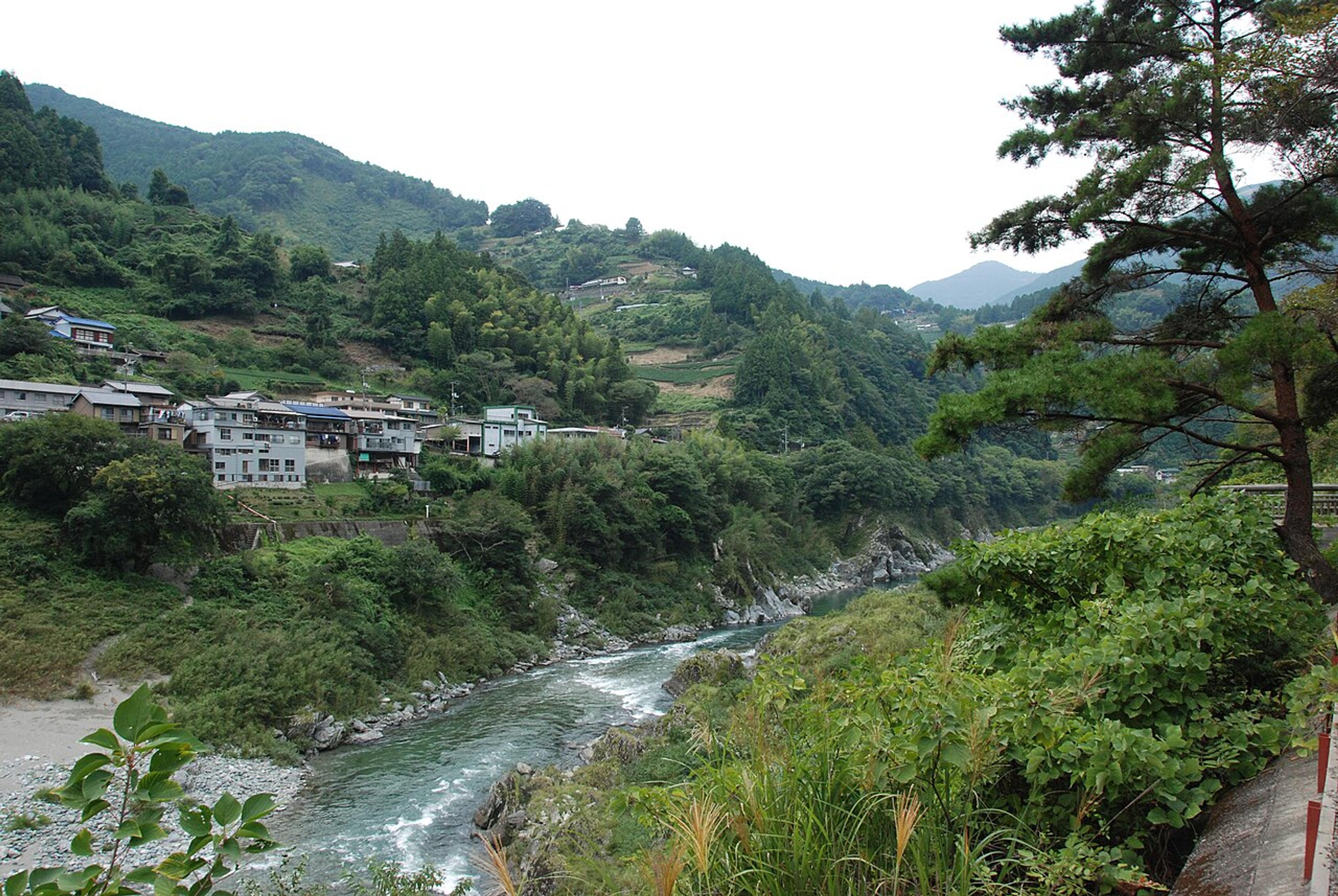
In western Tokushima, the Yoshino River has carved two dramatic gorges through crystalline schist rock. Oboke (big danger) and Koboke (small danger) earned their names from the treacherous rapids that once made river travel deadly. Today, you can ride a sightseeing boat through the gorges (¥1,200) or, for the adventurous, go whitewater rafting on the Class III-IV rapids above.
The rock formations are extraordinary: green and blue schist striations tilted at sharp angles, carved into smooth curves by millennia of river erosion. The gorges are most spectacular in autumn when the forested cliffs turn color, but they're beautiful year-round. Accessible by JR Dosan Line from Takamatsu.
Tokushima Indigo (Aizumi)
Tokushima was historically Japan's indigo capital. The Yoshino River's fertile floodplain was ideal for growing ai (Japanese indigo), and by the Edo period, Tokushima controlled most of the country's indigo trade. The craft survives, barely, but genuinely.
The Ai no Yakata Indigo Museum in Aizumi town explains the history, and several farms offer hands-on dyeing workshops (¥1,500-3,000) where you tie, fold, and dip fabric in traditional indigo vats. The blue you produce, Japan Blue, as it came to be known, is deeper and more complex than synthetic indigo. You'll understand why it became a national color.
Real Japanese indigo (sukumo) is fermented for months and has a distinctive smell. Synthetic indigo is odorless and chemical-bright. At workshops, ask if they use sukumo, the traditional farms do, and the difference in the final color is visible.
Garyu Sanso Villa (Ozu)
In the small castle town of Ozu (Ehime Prefecture), Garyu Sanso is a late-Meiji villa perched on a cliff above the Hijikawa River. Built in 1907 by a wealthy merchant, it is rustic-style architecture with enormous windows framing the river and mountains, moon-viewing platforms, and gardens that cascade down the hillside.
The villa is a masterclass in Japanese residential architecture: every room is oriented toward a different natural feature (the river, the mountains, the moon's path). ¥550 entry. Ozu itself is a compact town with a reconstructed castle and well-preserved Edo-period streets.
Shodoshima Olive Park
Shodoshima, an island in the Seto Inland Sea, has been growing olives since 1908, the first place in Japan to successfully cultivate them. Olive Park sits on a hilltop with views across the inland sea, a Greek-style windmill (incongruous but photogenic), and an olive grove you can walk through.
The island also has soy sauce breweries (Shodoshima produces a significant portion of Japan's soy sauce), a dramatic mountain gorge (Kankakei, accessible by cable car), and one of the outdoor Setouchi Triennale art sites. It's reachable by ferry from Takamatsu (60 minutes) and makes an excellent day trip.
Ioki Cave (Aki)
On the eastern coast of Kochi Prefecture, Ioki Cave is a sea cave accessible only at low tide. You walk along the rocky shoreline, duck through a narrow opening, and enter a cavern where sunlight filters through cracks in the ceiling, illuminating a natural Shinto shrine inside. The cave has been a sacred site for centuries.
Timing is everything, check tide tables and aim for a low tide with calm seas. The approach involves some rock scrambling. When conditions align, the light inside the cave is extraordinary. Free access. About 30 minutes from Aki city by car.
Do not enter Ioki Cave at mid or high tide. The entrance floods completely. Check tide tables at the tourist information office in Aki. Go with a local guide if this is your first visit.
Shikoku's Scale
Shikoku is small enough to circle in a week, diverse enough to fill three. The island's four prefectures each have a distinct character, Kagawa (udon, art islands), Tokushima (indigo, gorges, pilgrimage start), Ehime (castles, onsen, citrus), Kochi (coast, rivers, free-spirited culture). A rental car is helpful but not essential, the JR Shikoku railway covers the coast, and local buses reach most inland sites.
Featured in this guide
Places to Visit

Turn this guide into a trip
We'll prioritize these 12 places when building your itinerary.