Yamaguchi Prefecture hides Japan's largest limestone cave, a karst plateau of unearthly beauty, the fox-gate shrine of Motonosumi, and a five-story pagoda of perfect proportions.
Yuku Japan · February 16, 2026
6 places in this guide
The Western Edge
Yamaguchi Prefecture occupies the western tip of Honshu, the last stretch of the main island before the Kanmon Strait separates it from Kyushu. It is bypassed by most visitors, a transit zone between Hiroshima and the Kyushu Shinkansen. The prefecture's tourist board, in a moment of admirable honesty, once promoted it as 'Japan's most underrated prefecture.' The self-assessment is accurate. Yamaguchi holds geological formations, coastal shrines, and architectural treasures that would anchor tourism campaigns in any other region but here exist in relative solitude.
This itinerary loops through Yamaguchi's highlights over three to four days: the karst landscape in the center, the coastal shrines in the north, and the cultural capital in the south. The route works by car (essential, public transport is sparse) and rewards a pace that matches the prefecture's own: deliberate, unhurried, and open to surprise.
Akiyoshido: Japan's Cathedral Cave
Akiyoshido is the longest limestone cave in Japan, surveyed at over 10 kilometers, with approximately 1 kilometer open to visitors on a paved, lit walkway. The scale is immense. The main chamber, called the Hundred Dishes, features a series of rimstone pools (terraced limestone basins filled with clear water) that descend like a giant natural staircase. The ceiling soars 30 meters overhead in places, and the stalactites and stalagmites have been growing for 300,000 years, creating columns and curtains of stone that glow amber and gold under the installed lighting.
The cave maintains a constant temperature of 17°C year-round, making it a cool refuge in summer and a comparatively warm shelter in winter. The underground river that carved the cave still flows through the lower passages, its water remarkably clear. The walkway follows this river for much of its length, and the sound of flowing water, amplified by the cave acoustics, provides a constant auditory backdrop. At the far end of the tourist route, an elevator shaft rises 80 meters through the limestone to emerge on the karst plateau above, a transition from underground darkness to open sky that is genuinely dramatic.
Enter the cave from the lower entrance (Akiyoshido Bus Stop side) and exit via the elevator to the karst plateau. This direction gives you the full 1-kilometer cave walk with the Hundred Dishes as a climactic feature, and deposits you on the plateau for the second half of your visit. Admission is ¥1,300 (includes both cave and elevator). Allow 60-90 minutes for the cave walk.
Akiyoshidai: The Karst Plateau
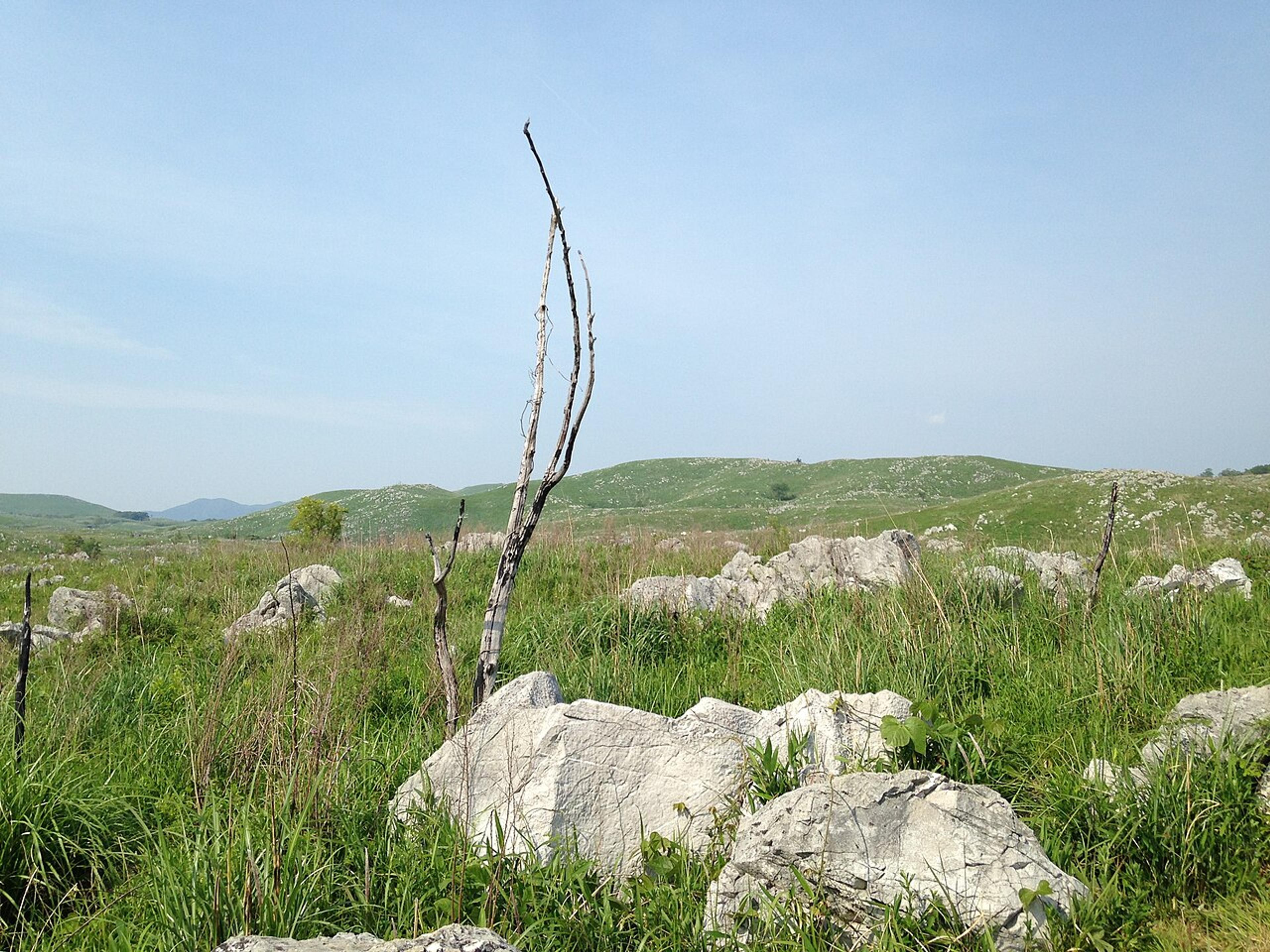
Emerging from the elevator onto Akiyoshidai is like stepping onto another planet. The plateau stretches 130 square kilometers, the largest karst landscape in Japan, and its surface is a rolling grassland punctuated by thousands of white limestone pinnacles that protrude from the green turf like teeth from a jaw. In every direction, the terrain undulates in smooth waves, the stone outcrops creating patterns that are simultaneously geological and sculptural.
Walking trails cross the plateau, connecting observation points and passing through landscapes that shift with the seasons. In spring and summer, the grass is vivid green against the white stone. In autumn, controlled burns turn the plateau amber and gold, the annual yaki (prescribed burning) in February maintains the grassland and prevents forest encroachment, creating a brief, spectacular landscape of black earth and white stone before the spring growth returns. The Karst Observatory provides a 360-degree panorama, and on clear days the views extend to the Sea of Japan coast.
The controlled burn (yaki) of Akiyoshidai typically occurs in mid-February. For approximately one week after the burn, the plateau is a stark landscape of charred grass and exposed limestone, hauntingly beautiful in its desolation. By late March, fresh green shoots emerge through the black earth. Summer brings wildflowers. Autumn grasses turn the plateau golden. Each season presents a fundamentally different landscape.
Motonosumi Shrine: Fox Gates on the Sea Cliff
Motonosumi Shrine, on the Sea of Japan coast near Nagato, is one of Japan's most visually dramatic shrines, and one of its most recently famous. A tunnel of 123 vermilion torii gates snakes down a grassy clifftop to the edge of the ocean, where waves crash against volcanic rock and sea spray reaches the lowest gates. The shrine was unknown outside Yamaguchi until CNN included it in a 2015 list of Japan's 31 most beautiful places, after which it went from near-zero visitors to a major destination.
The shrine is dedicated to Inari, the fox deity, and was founded in 1955 after a local fisherman received a divine vision. The torii gates were donated over subsequent decades, creating the crimson corridor that now defines the site. At the top of the gate tunnel, the offering box is deliberately placed five meters above ground level, on top of the final torii, throwing a coin into it successfully is said to guarantee a wish. The combination of red gates, green grass, blue sea, and white spray creates a color composition that justifies every cliche about Japan's photogenic shrines.
Visit Motonosumi before 9 AM or after 3 PM to avoid tour bus crowds. The shrine has a large parking lot (¥300) but limited space on the cliff path, and midday congestion can make the torii walk feel like a queue rather than a pilgrimage. Morning light from the east illuminates the gates against the dark sea; afternoon light from the west turns them incandescent. Both are excellent.
Tsunoshima Bridge and the Cobalt Coast
Tsunoshima Bridge is a 1,780-meter road bridge connecting the mainland to Tsunoshima island, and driving across it is one of the great small pleasures of Yamaguchi travel. The bridge is low-slung, just above wave height, and the water on either side is an improbable shade of cobalt blue that intensifies on sunny days. The bridge has appeared in enough car commercials and Instagram posts to qualify as a destination in its own right.
Tsunoshima itself is a small, quiet island with a 19th-century granite lighthouse (one of the oldest Western-style lighthouses in Japan), a few beaches with remarkably clear water, and a community of about 700 people. The island can be circled by car in 30 minutes or by bicycle in about two hours. Cobalt Blue Beach, near the bridge landing, has water clear enough to see the sandy bottom at three meters depth. The Tsunoshima Lighthouse Park offers views back across the bridge to the mainland, the low white arc of concrete against blue water is Yamaguchi's most recognizable image.
Tsunoshima Bridge is free to cross. The lighthouse park is ¥300. The island has a handful of small restaurants serving local seafood, uni (sea urchin) is a Tsunoshima specialty, available from April through August at prices (¥1,500-2,500 for a bowl) significantly lower than Tokyo or Osaka. Pack a picnic from the Nagato Aeon supermarket for a beach lunch if restaurant options are limited.
Rurikoji: The Perfect Pagoda
Yamaguchi City, the prefectural capital, was known in the 15th and 16th centuries as the 'Kyoto of the West', the Ouchi clan lords modeled their capital on the imperial city, attracting artisans, poets, and Jesuit missionaries (Francis Xavier preached here in 1551). Most of the historical city was destroyed in the wars that followed the Ouchi clan's fall, but one building survived: the five-story pagoda of Rurikoji temple, built in 1442.
The Rurikoji pagoda is considered one of the three finest pagodas in Japan, alongside those at Horyuji in Nara and Daigoji in Kyoto. Its proportions are exceptional, each story diminishes in size with mathematical precision, creating a visual rhythm of ascending lightness. The pagoda stands in a garden beside a pond that provides a mirror reflection, and the composition of pagoda, water, and surrounding maples is deliberately designed for contemplation. In autumn, the maples turn crimson around the white pagoda. In spring, cherry blossoms frame the dark wooden eaves. At any season, the Rurikoji pagoda justifies Yamaguchi City as a destination.
The pagoda grounds are always open and free to enter. The adjacent Rurikoji Archive Museum (¥200) displays artifacts from the Ouchi clan period, including painted screens and ceramics that illustrate Yamaguchi's former cultural ambitions. Francis Xavier Memorial Cathedral, a modern church built on the site where Xavier preached in 1551, is a 10-minute walk away and provides an unexpected counterpoint, Western and Japanese architectural traditions in the same small city.
Turn this guide into a trip
We'll prioritize these 6 places when building your itinerary.