Walk Japan's newest long-distance trail: 1,025 km of Pacific coastline from Aomori to Fukushima, through fishing villages, tsunami-recovery towns, and wild headlands.
Yuku Japan · February 16, 2026
8 places in this guide
Japan's Newest Long-Distance Trail
The Michinoku Coastal Trail (Michinoku Shiokaze Trail) opened in 2019 as Japan's newest long-distance walking route, 1,025 kilometers from Hachinohe in Aomori Prefecture to Soma in Fukushima Prefecture, following the Pacific coastline through four prefectures. The trail was conceived as both a hiking route and a memorial pathway, connecting communities along the Sanriku coast that were devastated by the 2011 tsunami and rebuilt with extraordinary determination.
The full thru-hike takes 40 to 50 days, a commitment that few will make. But the trail is designed for section hiking, and its 28 officially mapped segments range from gentle coastal walks to challenging headland crossings. A carefully chosen week of sections can deliver the trail's essence: wild Pacific coastline, intimate fishing villages, tsunami memorials, coastal camping, and the particular rhythm of walking through a landscape that is simultaneously ancient and newly remade.
The Northern Sections: Hachinohe to Kuji
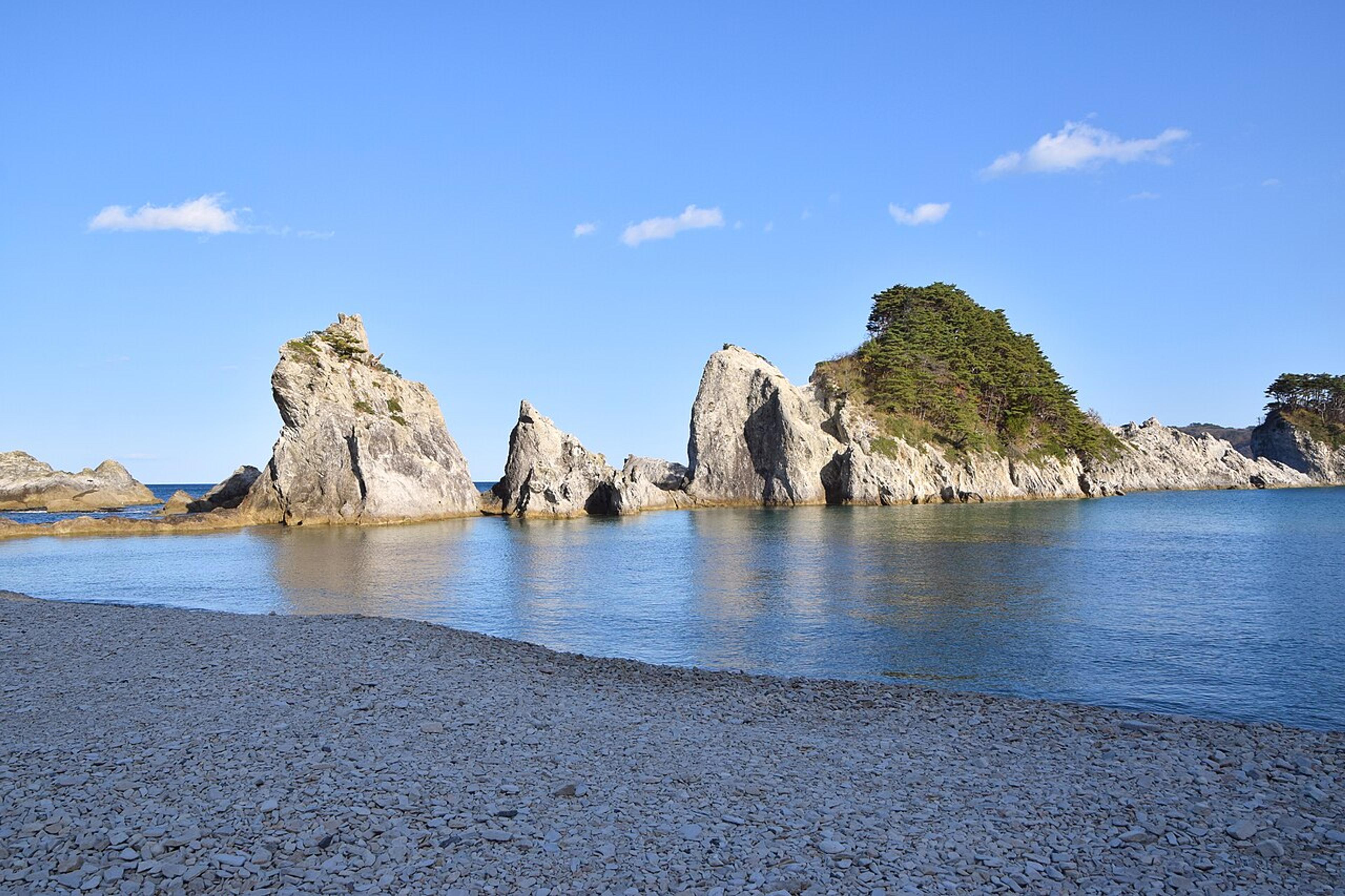
The trail begins at the Kabushima Shrine in Hachinohe, a rocky headland covered by 40,000 nesting black-tailed gulls in summer. From here, the route follows the Tanesashi coast south, a stretch of natural grassland and rock formations that is one of the finest coastal walks in northern Japan. The Tanesashi section (about 12 km) is flat, well-maintained, and runs along low cliffs above a shoreline of weathered rock and tide pools. In early summer, the grassland blooms with wildflowers; in autumn, the grass turns golden against the blue Pacific.
Continuing south, the trail enters the dramatic Kitayamazaki cliffs, 200-meter sea cliffs that are among the tallest in Japan. A network of trail sections and observation platforms provides views down to the churning ocean below. The cliffs are carved with sea caves and natural arches accessible at low tide. Between Hachinohe and Kuji (about 70 km of trail), the route alternates between coastal grassland, cliff-top paths, fishing ports, and stretches of quiet forest. This northern section sees the fewest hikers and retains the wildest character.
The Tanesashi coast section is the best single-day introduction to the trail. Start at Tanesashi Kaigan Station (JR Hachinohe Line) and walk south to Same Station, about 12 km along the coast. The path is well-marked with blue trail signs and navigable without GPS. Pack a lunch, there are no shops on the route, but the grassy headlands above the ocean provide spectacular picnic spots.
The Central Sections: Tanohata to Miyako
The central trail sections along the Iwate coast offer the most varied terrain and some of the trail's most memorable moments. The Tanohata section crosses rugged headlands where the trail climbs through forest to cliff-top viewpoints before descending to small fishing ports tucked into narrow inlets. The geography here is intensely vertical, the trail gains and loses hundreds of meters as it navigates the ria coastline.
Between Tanohata and Miyako, the trail passes through several communities that were severely damaged in 2011 and have since rebuilt. New seawalls, relocated neighborhoods, and memorial parks are visible alongside the trail. Walking through these towns provides a ground-level perspective on recovery that driving through cannot offer, the new buildings, the repaired fishing infrastructure, the gardens planted in what were once debris fields. Conversations with local residents (many of whom are enthusiastic about the trail and its role in bringing visitors back to the coast) add a human dimension that no guidebook can capture.
Many fishing villages along the trail welcome hikers warmly. In small ports, you may be offered tea or fish by locals who appreciate the trail bringing visitors to their communities. This hospitality, called settai in the Shikoku pilgrimage tradition, has its own coastal version here. Accept graciously, your presence is part of the coast's recovery.
The Southern Sections: Rikuzentakata to Kesennuma
The southern Iwate and northern Miyagi sections carry the heaviest weight of the 2011 disaster. Rikuzentakata, one of the most severely affected towns, has been rebuilt around the Miracle Pine, a single tree that survived the tsunami out of a forest of 70,000. The tree eventually died from saltwater damage but was preserved as a monument, reinforced with a carbon fiber core. The trail passes through the memorial park and the rebuilt town center.
South of Rikuzentakata, the trail reaches Kesennuma, a fishing city famous for shark fin processing and bonito (katsuo) fisheries. Kesennuma's fish market has been rebuilt and expanded, and the morning tuna auction (visible from a public gallery) rivals Tsukiji in intensity if not scale. The trail section south of Kesennuma follows Oshima Island, the largest island in Tohoku's Pacific coast, which is now connected to the mainland by a bridge completed in 2019. Oshima's coastal trail loops the island in about six hours, passing beaches, viewpoints, and a forest of camellia trees that bloom in February.
Kesennuma's revitalized Uminoichi market is the best single food stop on the trail. The kaisendon (seafood bowl) stalls offer massive portions of fresh tuna, salmon roe, and uni for ¥1,800-2,500. The town's specialty is katsuo no tataki, bonito seared over straw flame and served with garlic and ponzu. Have it at the market for ¥1,200, or at the renowned Fukuyoshi restaurant for the full multi-course katsuo experience (¥3,500).
Practical Trail Logistics
The Michinoku Coastal Trail is a developing route, and logistics require more planning than established trails like the Kumano Kodo. Accommodation along the trail is a mix of minshuku (family-run inns, ¥5,000-8,000 with meals), business hotels in larger towns, and a growing number of hiker-friendly guesthouses. Camping is possible at designated sites, about 15 official campgrounds along the route, but wild camping is generally not permitted. Resupply points (convenience stores, supermarkets) are spaced every 15 to 30 km in most sections.
The trail is marked with blue MCT signs, but not all sections are equally well-maintained. The official trail app (available in English and Japanese) provides GPS tracks, elevation profiles, and accommodation listings. Some sections follow roads rather than dedicated trails, particularly through rebuilt towns where the original coastal paths were destroyed. This is not necessarily a drawback, the road sections pass through the communities and their daily life, which is part of the trail's purpose.
The best hiking months are May-June and September-October. Summer (July-August) is hot and humid, with occasional typhoons. Winter sections above sea level may have snow and ice. The northern sections (Aomori) are hikeable from late April; the southern sections (Miyagi, Fukushima) open earlier. Spring brings wildflowers on the coastal grasslands; autumn turns the inland forest sections gold and red.
Featured in this guide
Places to Visit

Turn this guide into a trip
We'll prioritize these 8 places when building your itinerary.