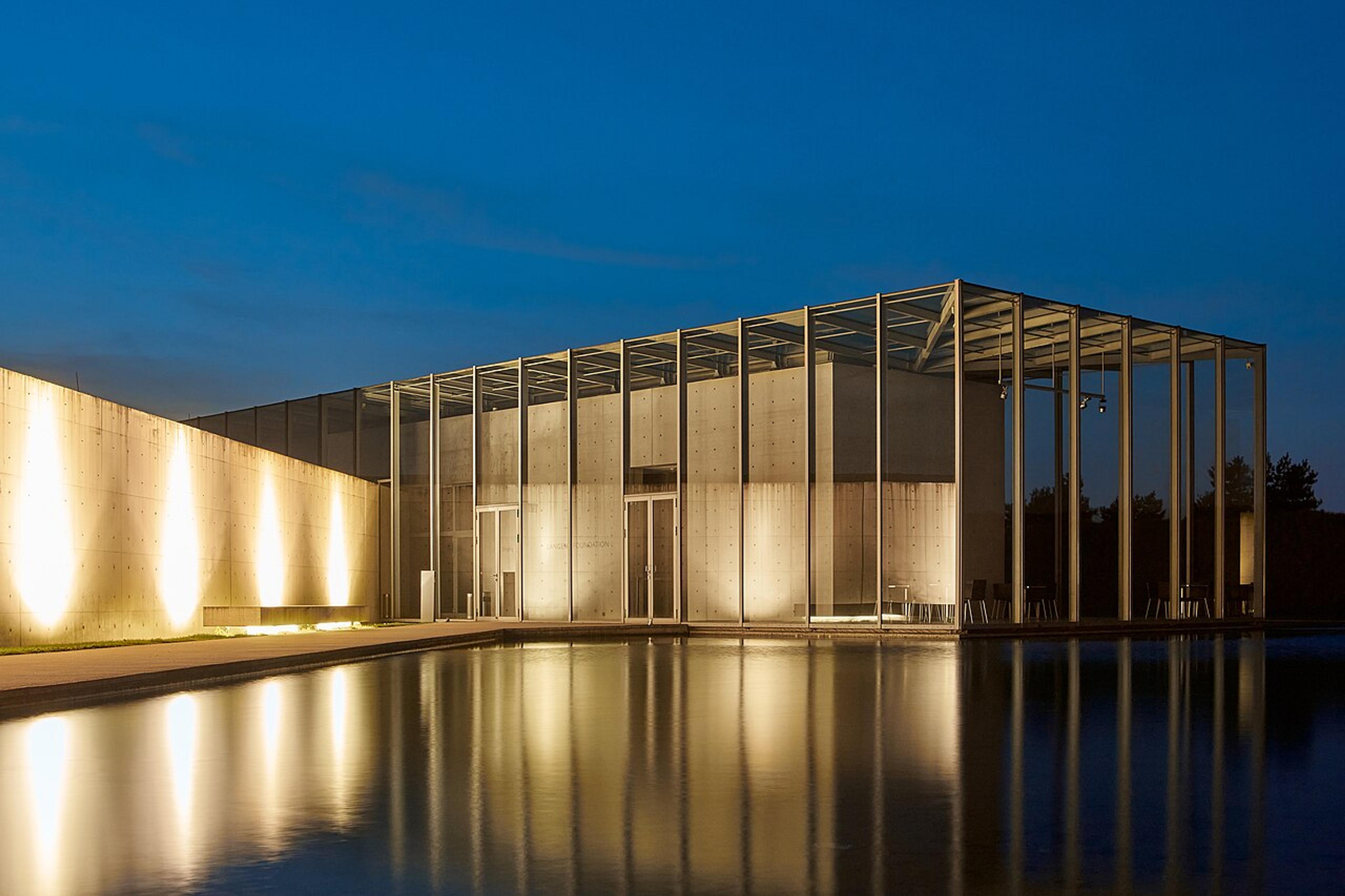
Board-marked concrete, controlled light, and water. A route through the Tadao Ando buildings open to visitors, from Awaji's Water Temple to Naoshima, and how to read them.
Koku Editorial · May 25, 2026
6 places in this guide
Tadao Ando builds in board-marked concrete, controlled light, and water. The self-taught Osaka architect, a Pritzker laureate, has left work the length of Japan, and several pieces are open to visitors without an appointment. Here is a route through the Ando buildings you can walk into, and how to read them.
How to read an Ando building
The vocabulary repeats: smooth in-situ concrete with its formwork tie-holes left visible, long approach ramps and walls that hide the destination until you arrive, and daylight used as a material. Expect to be made to walk before you are shown the view. Photography is often restricted inside; the buildings reward time over speed.
Awaji: Honpukuji, the Water Temple
Honpukuji on Awaji Island is a Shingon temple Ando reimagined in 1991. The main hall sits beneath an oval lotus pond; you descend a stair that splits the water to reach a vermilion-lit chamber below. It is one of his most quietly radical religious works. Pair it with a day on Awaji, between Kobe and Tokushima.
Kobe: Hyogo Prefectural Museum of Art
The Hyogo Prefectural Museum of Art stands on the Kobe waterfront, exposed concrete and geometric volumes with reflecting water, the largest museum of its kind in western Japan. Ando added a green apple sculpture and an open-air gallery; the building itself is the headline. It pairs with a walk along the rebuilt Kobe shore.
Sapporo: Hill of the Buddha
At Makomanai Takino Cemetery south of Sapporo, Ando set a 13.5-meter stone Buddha inside an artificial hill planted with lavender. From outside only the head shows; you walk a long tunnel to reach the statue and look up to a ring of open sky. The lavender peaks in summer, when the approach is at its strongest.
Akita: Akita Museum of Art
The Akita Museum of Art is worth the visit for the building alone: dramatic concrete volumes, a triangular pool, and a top-floor view across Senshu Park framed without a single window mullion in the way. It holds the Tsuguharu Foujita collection, including his vast mural of an Akita festival.
Matsuyama: Saka no Ue no Kumo Museum
In Matsuyama, the Saka no Ue no Kumo Museum is an angular Ando work whose cafe and galleries look out over Matsuyama Castle. The museum draws on Shiba Ryotaro's novel of Meiji Japan; the building's ramps and concrete carry the same forward tilt. The adjacent Bansui-so villa makes a natural pairing.
Naoshima: the Benesse Art Site
Ando's largest concentration is on Naoshima, where the Benesse Art Site set his concrete museums into the Seto Inland Sea hillside. The buried Chichu Art Museum, lit only by daylight, is the masterpiece; Benesse House combines a museum and a hotel. Naoshima earns its own day, reachable by ferry from Uno or Takamatsu, and the island is the through-line into a Setouchi art trip.
Planning an Ando route
These do not sit on one line. Honpukuji and the Hyogo museum pair on a Kobe-Awaji swing; Naoshima anchors a Setouchi trip; Akita and Sapporo are northern detours for the committed. Check each building's closed days (museums usually shut one weekday), and allow the approach time the buildings are designed around.
Turn this guide into a trip
We'll prioritize these 6 places when building your itinerary.