Mount Tsurugi and the Lost Valley
Deep Dive · miyoshi · 9 min
The Iya Valley's deep interior: hike Mount Tsurugi, cross the Oku-Iya vine bridges, sleep in Ochiai hamlet, and meet the scarecrows of Nagoro.
Yuku Japan · February 16, 2026
11 places in this guide
Into the Interior
The Iya Valley is Shikoku's most famous remote area, but most visitors see only the main vine bridge and the river gorge near Oboke. The deeper interior, the Oku-Iya (inner Iya), is where the valley's true character emerges. Here the roads narrow to single lanes cut into mountainsides. Villages cling to slopes so steep that houses are terraced like rice paddies. The silence, broken only by river sound and birdsong, has a physical quality, it settles over you like weather.
At the center of this landscape stands Mount Tsurugi (Tsurugisan), Shikoku's second-highest peak at 1,955 meters. To its north, the Oku-Iya double vine bridges span a tributary gorge in a setting wilder than the tourist-circuit main bridge. The hamlet of Ochiai climbs an impossible mountainside. And in the village of Nagoro, a population of handmade scarecrows outnumbers the living residents ten to one. This is a Japan that exists nowhere else, ancient, vertical, and slowly emptying.
Climbing Mount Tsurugi
Mount Tsurugi is sacred to Shugendo mountain ascetics and was historically off-limits to women until the Meiji period. The main trail from Minokoshi (the trailhead at 1,420 meters, accessible by car or the seasonal Tsurugi Lift chairlift) reaches the summit in about 60-90 minutes via a well-maintained but steep path through dwarf bamboo grassland and subalpine forest. The lift (¥1,050 one way, ¥1,870 round trip, operates April-November) eliminates 500 meters of elevation gain and reduces the hike to a manageable 40-minute walk.
The summit is a broad, grassy ridge with 360-degree views that encompass most of Shikoku on clear days, the Inland Sea to the north, the Pacific to the south, and the jagged spine of the Shikoku mountains in every direction. A small shrine marks the peak. On autumn mornings, the valleys below fill with cloud inversions that turn the view into an archipelago of mountain peaks floating above a white sea. The phenomenon is most common in October and early November, when cold overnight air pools in the valleys.
Start from the Minokoshi trailhead by 7 AM to catch the cloud inversion before it burns off (usually by 9-10 AM). The mountain hut at See (also called Tsurugi Sancho Hutte) near the summit offers basic accommodation (¥6,500 with two meals, reservation required) for those who want to catch sunrise from the peak. Weather changes rapidly above 1,800 meters, bring a windproof layer even in summer.
Oku-Iya Double Vine Bridges
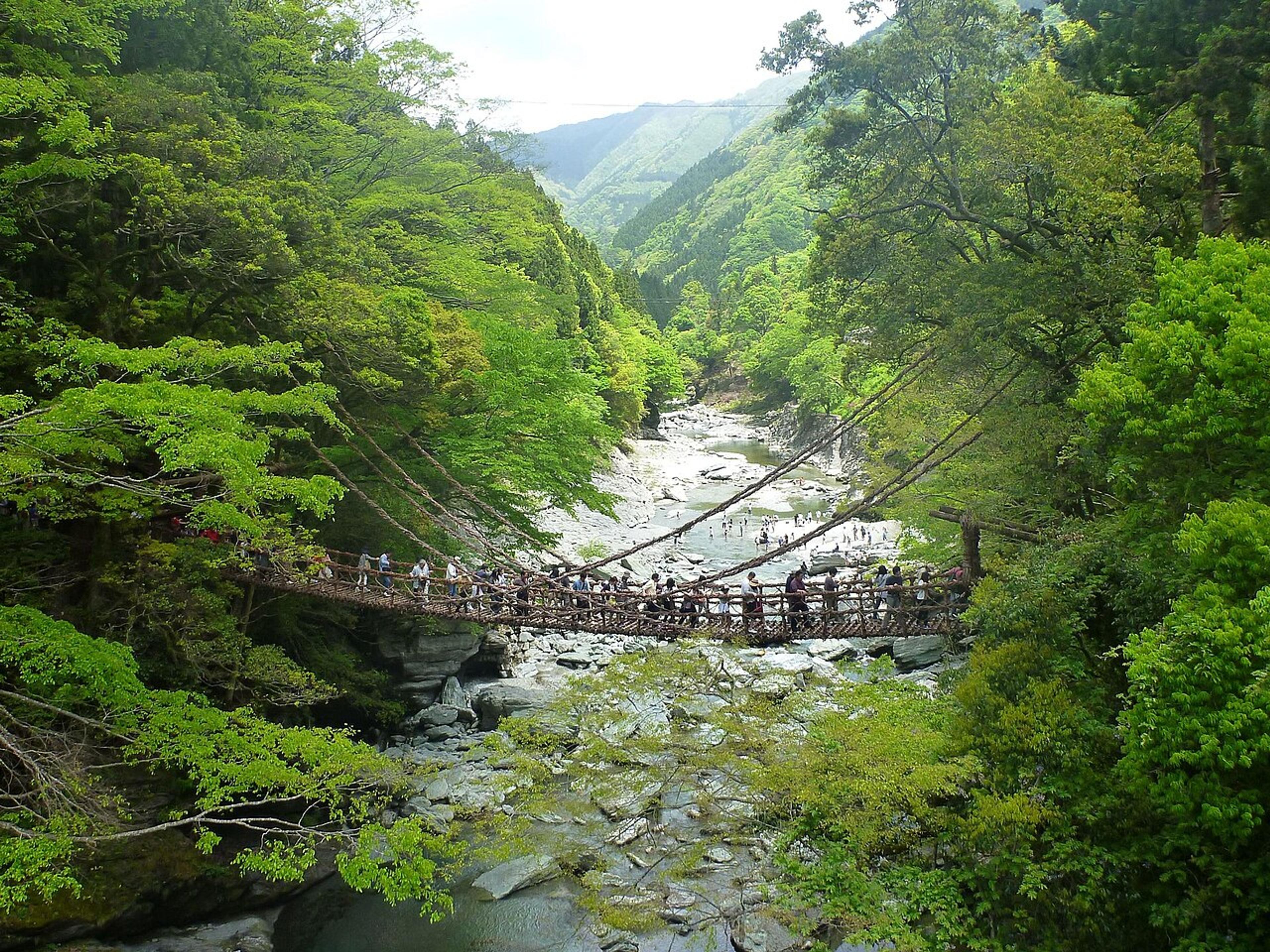
While the main Iya Kazurabashi vine bridge is a well-known Shikoku attraction, the Oku-Iya Niju Kazurabashi (double vine bridges) are deeper in the valley and far less visited. Two bridges span the river here, the 'husband bridge' (42 meters long) and the 'wife bridge' (22 meters), plus a manually-operated cable car called the 'wild monkey bridge' (yaenotoko) that you pull yourself across the river in a small wooden cart suspended from a wire.
The setting is substantially wilder than the main bridge. The gorge is narrower, the forest denser, and on weekday mornings you may have both bridges entirely to yourself. The vine bridges sway and creak with each step, the gaps between the wooden planks revealing the river 14 meters below. Both bridges are rebuilt every three years using shirakuchi kazura (Actinidia arguta) vines harvested from the surrounding mountains, a tradition attributed to Heike clan fugitives who allegedly designed the bridges to be cut quickly if pursued.
The road to Oku-Iya is narrow, steep, and winding, single-lane with blind corners and occasional rock falls. It takes roughly 45 minutes from the main Iya Valley road. Do not attempt it in a large vehicle. In winter (December-March), the road may be closed due to snow or ice. Entry to the bridges is ¥550. The wild monkey cable car is an additional ¥200.
Ochiai Hamlet: Living on the Vertical
Ochiai is a hamlet of approximately 20 thatched-roof farmhouses built on a mountainside so steep that the village spans a 390-meter elevation difference from bottom to top. The stone-walled paths that connect the houses climb at angles that would qualify as staircases elsewhere. The village is designated an Important Preservation District, and several of the farmhouses have been restored as overnight accommodations through the Chiiori Alliance, a nonprofit founded by American author Alex Kerr.
Staying overnight in one of the Ochiai houses is an experience of radical simplicity. The buildings have irori (sunken hearths) but no central heating. Futons are laid on tatami floors. The bathroom may be a composting toilet. The kitchen is stocked with local ingredients for self-catering. At night, with no streetlights and no ambient noise beyond insects and the distant river, the darkness and silence are absolute. Morning brings mist rising from the valley, the sound of the village's last few roosters, and a view down the mountainside that compresses a thousand years of Japanese rural life into a single frame.
The Chiiori Alliance houses in Ochiai rent for ¥8,000-12,000 per person per night, with discounts for groups. This is comparable to a mid-range business hotel but the experience is incomparably different. Book through the Chiiori Trust website at least two weeks ahead. The nearest convenience store is 30 minutes away by car, bring provisions or arrange a local dinner set (¥3,000 per person, features river fish and mountain vegetables).
Nagoro: The Scarecrow Village
Nagoro is a tiny village in the eastern Iya Valley where artist Tsukimi Ayano began making life-sized scarecrow figures to replace the neighbors who had died or moved away. There are now over 300 scarecrows positioned throughout the village, sitting on benches, working in fields, attending the now-closed school, waiting at the bus stop. The living population is approximately 30.
The effect is simultaneously endearing and deeply unsettling. The scarecrows wear real clothes, often the actual garments of the person they represent. Their postures are naturalistic, a fisherman holds a rod at the river, schoolchildren sit at desks, a group of farmers takes a tea break. From a distance, the village appears populated. Up close, the cloth faces and button eyes create an uncanny valley effect that has drawn documentary filmmakers and anthropologists studying Japan's rural depopulation crisis.
Nagoro represents a phenomenon affecting thousands of Japanese villages. Japan has over 800 settlements classified as 'marginal communities' where more than half the population is over 65. Ayano-san's scarecrows began as a personal art project but have become an internationally recognized symbol of inaka (rural Japan) decline. She welcomes visitors warmly and will explain each scarecrow's story if you ask. There is no entry fee.
The Heike Fugitive Legend
The deep Iya Valley's cultural identity is built on the legend that defeated Heike clan warriors fled here after losing the Genpei War at the Battle of Yashima in 1185. Whether the story is historical fact or foundational myth, the valley's isolation made it a plausible refuge. The vine bridges, the remote hamlets, the terraced fields carved into impossible slopes, all are attributed to the ingenuity of fugitives building a hidden civilization.
The Heike Yashiki (Heike House Museum) near the main Iya bridge displays armor, documents, and household items attributed to the Heike refugees. The collection's provenance is debated by historians, but the museum conveys the valley's deep attachment to its origin story. Throughout the Iya area, family names, shrine dedications, and local festival traditions trace (or claim to trace) lineage back to the defeated warriors who chose this vertical wilderness over surrender.
The full Oku-Iya circuit, Mount Tsurugi, double vine bridges, Ochiai hamlet, Nagoro, requires a car and at least two days. Base yourself in the Iya Valley (Hotel Iya Onsen or the Kazurabashi area) and make day trips to each site. The mountain roads are spectacular but slow, budget 30-40 minutes for what looks like a 15-kilometer drive on the map.
Featured in this guide
Places to Visit



Turn this guide into a trip
We'll prioritize these 11 places when building your itinerary.