Ishigaki Beyond the Beach
Itinerary · ishigaki · 8 min
Ishigaki is more than a beach resort: Kabira Bay's turquoise lagoon, Mount Omoto's jungle summit, Shiraho's blue coral reef, and some of the darkest skies in Japan.
Yuku Japan · February 16, 2026
10 places in this guide
The Other Side of the Island
Ishigaki has become Okinawa's most popular outer island, with direct flights from Tokyo, Osaka, and Taipei feeding a steady stream of visitors to its beach resorts. Most come for the sand and the sea, and they are not wrong to, the beaches here are genuinely extraordinary. But Ishigaki is a volcanic island with a mountainous interior, the largest coral reef system in the Northern Hemisphere, and night skies so dark they have been designated a protected stargazing zone. The beach is just the introduction.
This three-day itinerary moves from coast to summit to reef to sky, covering the island's full range. A rental car is essential, public transit on Ishigaki is limited to a few bus routes along the coast, and the best sites are accessible only by car or on foot.
Day One: Kabira Bay and the Western Coast
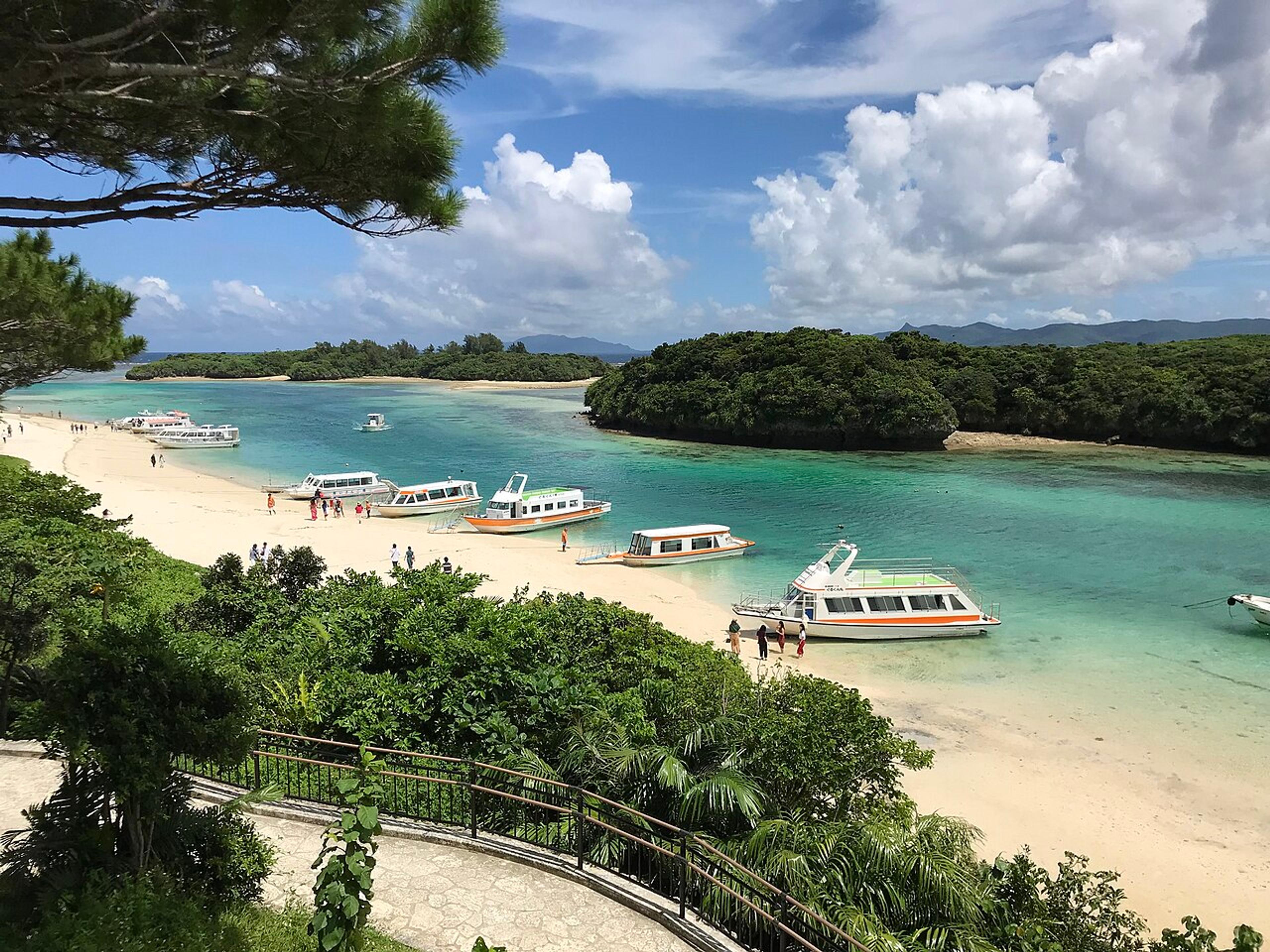
Kabira Bay is Ishigaki's postcard image, a sheltered lagoon where turquoise water laps against a white sand beach backed by jungle-covered hills. The bay's beauty is matched by its ecological sensitivity: swimming is prohibited to protect the pearl oyster farms and coral beds that line the seafloor. Instead, glass-bottom boats (¥1,030, departures every 15 minutes) glide across the lagoon, the hull windows revealing coral gardens, giant clams, tropical fish, and the occasional sea turtle passing through.
After Kabira, drive the western coast road south to Oganzaki Cape, where limestone cliffs drop into the deep blue channel between Ishigaki and Iriomote. The cape is famous for its sunset views, the sun drops into the sea directly ahead, turning the sky from gold to crimson. On the drive south, stop at Yonehara Beach for shore-entry snorkeling: the reef here begins in waist-deep water and teems with clownfish, butterflyfish, and blue-green chromis. Snorkel sets rent for ¥1,000 from the beachside shack.
Glass-bottom boat tours at Kabira Bay are identical regardless of operator, all run the same 30-minute route. The first departure (9 AM) has the calmest water and best visibility. By midday, wind chop reduces clarity. Parking is free at the main lot, but it fills by 10 AM on weekends, arrive early or park along the access road and walk.
Day Two: Mount Omoto and Shiraho Reef
Mount Omoto (Omoto-dake) is Ishigaki's highest point at 526 meters, and the highest point in Okinawa Prefecture. The hiking trail from the Omoto parking area is 2.5 kilometers to the summit, climbing steeply through subtropical forest thick with tree ferns, pandanus palms, and the Yaeyama palm (Satakentia liukiuensis), found only in the Yaeyama Islands. The trail is well-marked but rugged, exposed roots, muddy sections, and steep rock scrambles near the top require sturdy footwear.
The summit panorama justifies every step: the entire Yaeyama archipelago spreads out below, Iriomote Island filling the western horizon, and on clear days, the mountains of Taiwan are visible 270 kilometers to the southwest. Allow two hours up and 90 minutes down. Afterward, drive to Shiraho on the southeast coast, where the world's largest blue coral (Heliopora coerulea) colony extends across 30 hectares of shallow reef. The WWF-managed Shiraho Reef Research Station offers guided snorkel tours (¥5,000 including equipment) that explain the reef's biology while you float above it.
Shiraho's blue coral is extremely fragile. Do not stand on, touch, or rest on the coral, even light contact can damage colonies that took centuries to grow. Wear a buoyancy vest (provided on guided tours) to maintain distance from the reef. Fins must be used carefully in the shallow sections. The guided tour is strongly recommended over independent snorkeling, both for safety and to avoid accidental damage.
Day Three: Yaeyama Palm Grove and Night Stargazing
The Yonehara Yaeyama Palm Grove is a national natural monument, a dense stand of Yaeyama palms growing in their natural forest habitat, the only place on earth where this species grows wild. The grove rewards a slow walk: a boardwalk trail winds through the palms, their smooth gray trunks rising 15-20 meters before exploding in feathery crowns. The light filtering through the canopy is soft and green, and the air is thick with the sound of birdsong, Ryukyu robins, Ishigaki flycatchers, and the ubiquitous Ryukyu scops owl.
After dark, Ishigaki transforms. The Yaeyama Islands were designated Japan's first International Dark Sky Park (Iriomote-Ishigaki National Park) in 2018. Light pollution is minimal outside the main town, and on clear nights, the Milky Way is visible with the naked eye, a dense river of light arcing from horizon to horizon. From the southern coast near the Tamatorizaki Observatory, all 84 of the 88 officially recognized constellations are visible, more than from any other point in Japan.
The best stargazing months are June through September, when the Milky Way core is overhead and the southern constellations, including the Southern Cross, visible from Ishigaki, are at their highest. Guided stargazing tours (¥3,000-5,000) run from several operators using telescopes and laser pointers to identify constellations. New moon nights offer the darkest skies; avoid full moon periods.
Getting Around and Practical Notes
Ishigaki's new airport (opened 2013) receives direct flights from Tokyo Narita and Haneda (3 hours, ¥15,000-35,000), Osaka Kansai (2.5 hours), and Naha (1 hour, ¥6,000-10,000). Rental cars start at ¥4,000 per day from airport agencies. Book in advance during summer and Golden Week, availability runs out quickly. Fuel stations are limited outside the main town, so fill up when you see one.
Ishigaki town has excellent restaurants serving Yaeyama soba (lighter and straighter than Okinawan soba), Ishigaki beef (a wagyu variety raised on the island, genuinely world-class), and fresh sashimi from the morning fish market. Dinner at a quality izakaya with Ishigaki beef and local awamori runs ¥3,000-5,000 per person. The covered market in the town center sells island-made crafts, chili oil (Ishigaki's signature condiment), and fresh tropical fruit.
The Ishigaki public bus system covers the main coastal route and Kabira Bay for ¥200-700 per ride. A one-day bus pass (¥1,000) is available but only useful if you are staying near the route. For a group of two or more, a rental car is cheaper per person and infinitely more flexible. Avoid the expensive resort restaurants and eat in town, quality is higher and prices are half.
Featured in this guide
Places to Visit


Turn this guide into a trip
We'll prioritize these 10 places when building your itinerary.