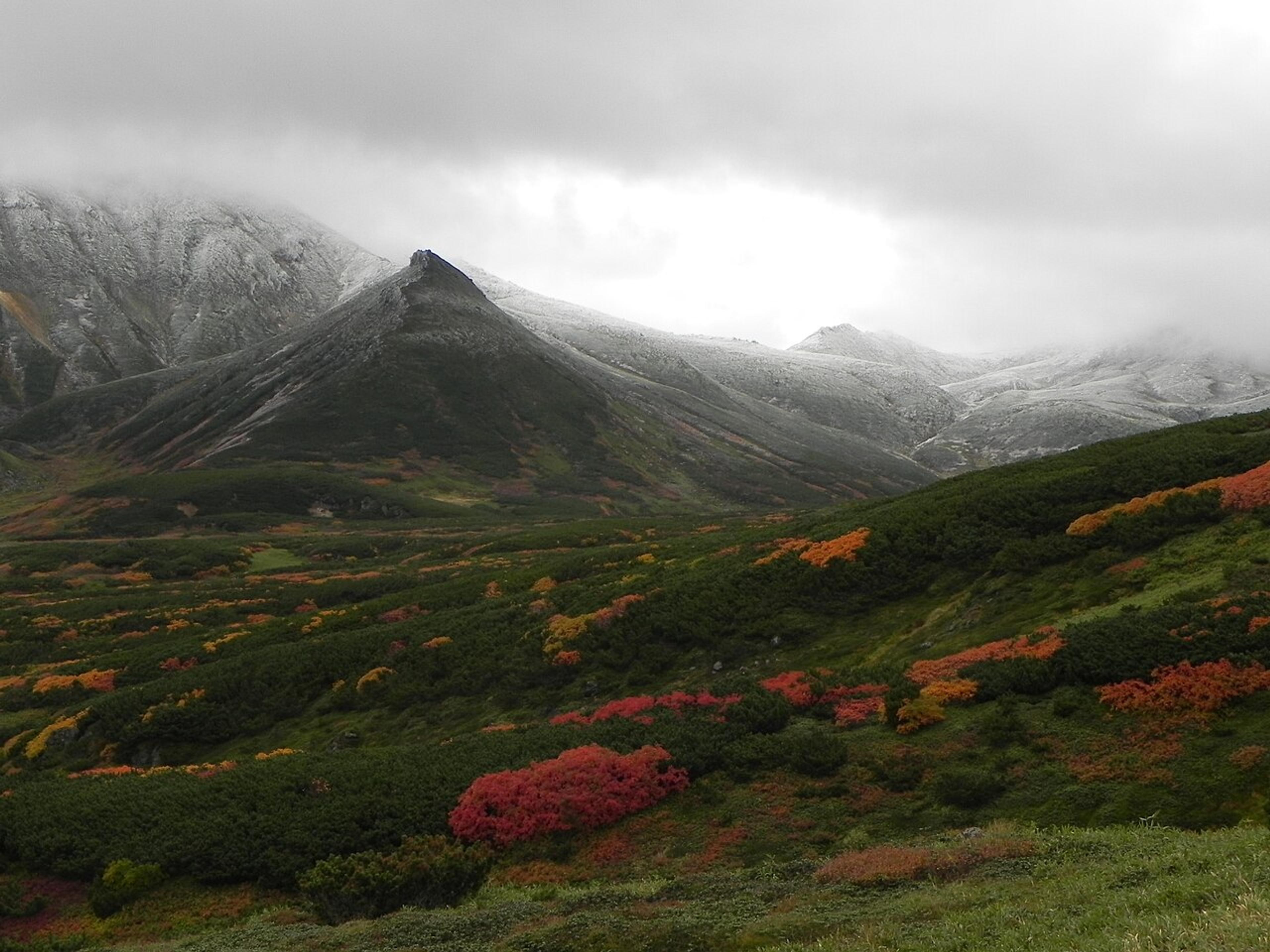
Drive Hokkaido's autumn corridor: Biei's patchwork hills, Daisetsuzan's early colors, Tokachi wine country, and farm stays in Japan's most spacious landscape.
Yuku Japan · February 16, 2026
10 places in this guide
Autumn Arrives First in Hokkaido
Hokkaido's autumn starts in September, a full month before Honshu's famous koyo season, and the island's landscape amplifies the color change in ways the south cannot match. The scale is different here: Hokkaido's interior is a continuous sweep of farmland, forest, and volcanic highland, and when the colors turn, they turn across an entire visible horizon. There are no urban interruptions, no temple walls constraining the view. The color simply runs from mountain to plain in unbroken waves of crimson, gold, and amber.
A road trip is the only way to properly experience Hokkaido's autumn. The trains follow limited corridors, and the most spectacular color is found on mountain roads and rural routes that no bus serves. The driving itself is a pleasure, Hokkaido's roads are wide, traffic-free by mainland standards, and lined with birch, larch, and rowan trees that turn every drive into a color tunnel. This route runs from Furano through Biei, up to the Daisetsuzan mountains, and south through the Tokachi wine region, a four-to-five-day circuit through the island's autumn heartland.
Furano and the Patchwork Road
Furano is famous for summer lavender, but autumn reveals a different kind of beauty. The rolling farmland between Furano and Biei, known as the Patchwork Road and Panorama Road, transforms as crops are harvested and the soil exposed. Fields of golden wheat stubble alternate with dark turned earth, green cover crops, and the occasional stand of brilliant orange larch. The hills roll gently, and the light in September is lower and warmer than summer, casting long shadows across the patchwork.
The named trees along the Patchwork Road, Ken and Mary's Tree, the Christmas Tree, the Seven Stars Tree, are famous from Japanese TV commercials shot here in the 1970s. They are undeniably photogenic: solitary trees standing in vast fields against a mountain backdrop. But the real magic of the Furano-Biei landscape is in the unnamed moments, a dirt road disappearing over a hill, a single farmhouse trailing smoke, the light catching a row of birches at the edge of a harvested field. Drive slowly, stop often, and let the landscape unfold.
The best light on the Patchwork Road is in the first and last hours of daylight, when the low sun rakes across the hills and every contour casts a shadow. The midday light flattens the landscape. Base yourself in Furano or Kamifurano and drive the hill roads at sunrise, you will have them to yourself.
Biei and the Blue Pond
Biei sits at the intersection of the Patchwork Road and the route up to the Daisetsuzan mountains. The town's Blue Pond (Shirogane Aoi Ike) is a year-round attraction, but autumn adds a dimension that other seasons lack. The birch trees surrounding the pond turn gold in late September, and their reflection in the cobalt water, gold on blue, is one of the most photographed scenes in Hokkaido. Arrive before 8 AM to beat the tour buses and catch the morning light filtering through the forest.
From the Blue Pond, the Shirogane road climbs toward the Tokachidake mountains through a forest of birch and Yezo spruce that transitions from green to gold to bare with every hundred meters of elevation gain. The Shirogane Falls, a curtain of groundwater spilling over volcanic rock into the Biei River, sits alongside the road. The water is the same aluminum-rich volcanic seepage that creates the Blue Pond's color, and the falls have an ethereal blue-white tint against the autumn forest backdrop.
Biei and Furano's autumn colors peak in early to mid-October for the lowland farmland, but the higher-elevation larch forests along the Tokachidake road peak two weeks earlier (late September). The Blue Pond birches typically turn gold in the last week of September. The Tokachidake mountain road closes by late October due to early snow.
Daisetsuzan Mountain Colors
The Daisetsuzan range holds Japan's earliest autumn colors. The alpine zone above the treeline turns in mid-September, the creeping pine and alpine bearberry shift to a deep crimson that contrasts with the grey volcanic rock. By late September, the color has descended to the birch and rowan forests at the mountain base, and the Sounkyo Gorge becomes a corridor of flame: vertical basalt columns draped in red and gold maple, with waterfalls threading silver through the color.
The Asahidake Ropeway (¥2,200 return) provides aerial views of the color transition, from green conifers at the base through the golden birch zone to the crimson alpine tundra at the upper station. On foot, the Sugatami Pond trail offers a two-hour loop through the volcanic landscape where autumn foliage meets active fumaroles, steam rising through red-leafed bushes in a combination unique to this mountain. The Kurodake Ropeway from Sounkyo offers similar aerial perspectives from the eastern side of the range.
For the most dramatic Daisetsuzan autumn experience, drive the mountain road from Sounkyo to Obihiro via the Mikuni Pass (Route 273). The 80-kilometer route crosses through the heart of the range, climbing to 1,139 meters through forest that burns with color in late September. The road is narrow and winding but well-maintained. Allow 3 hours for the drive with photo stops.
Tokachi Wine Country and Farm Stays
South of the Daisetsuzan mountains, the Tokachi Plain spreads toward the Pacific, Hokkaido's agricultural heartland, producing dairy, wheat, potatoes, beets, and increasingly, wine. The Tokachi wine region, centered on the town of Ikeda, has been producing wine since 1963, when the municipal government planted experimental vineyards as an economic development project. The gamble paid off: Tokachi wines, particularly the Kiyosato and Ikeda labels, now compete in Japanese wine competitions.
The Ikeda Wine Castle, a chateau-style building overlooking the Tokachi Plain, offers tastings (¥300 for a flight of five wines) and tours of the underground aging cellars. The wines are cool-climate styles, crisp whites from Kerner and Muller-Thurgau grapes, light reds from Zweigelt and mountain grape blends. Paired with Tokachi's farm cuisine, raclette from local dairy, Tokachi beef, fresh-pulled mozzarella, the wines shine in a way that international competition cannot capture. The agricultural co-ops in Obihiro and Kamishihoro run farm stay programs where guests stay in working farmhouses, help with harvest, and eat meals made from ingredients picked that morning. Stays run ¥7,000-9,000 per night with two meals.
Tokachi's farm culture is distinctly Hokkaido, it traces back to the Meiji-era settlers who cleared the wilderness in the late 1800s. The farmhouses are large, Western-influenced buildings (unlike the compact farmhouses of Honshu), and the food reflects frontier abundance: massive portions, dairy-heavy dishes, and a directness that feels more Montana than Miyagi. The Obihiro Butadon (pork rice bowl) is the regional signature, grilled pork glazed with sweet soy over rice. ¥900 at the original Pancho restaurant.
Driving Logistics
The full circuit covers roughly 400 kilometers: Furano → Biei → Asahidake/Sounkyo → Mikuni Pass → Obihiro → Ikeda → Furano. Four days is comfortable; five allows for farm stays and unhurried exploration. Rent from Asahikawa Airport (direct flights from Tokyo Haneda, 1 hour 45 minutes, from ¥12,000 one way) to avoid Sapporo traffic. Hokkaido rental cars in September are still on summer tires, snow is unlikely below 1,500 meters until mid-October, but the mountain passes can frost overnight.
Fuel stations are spaced at 30-50 kilometer intervals on the main roads but can be 80+ kilometers apart on mountain routes. Fill up before entering the Daisetsuzan section. Most stations close by 7 PM in rural areas. Road conditions are excellent, Hokkaido's national routes are well-maintained and lightly trafficked. Speed limits are 60 km/h on national routes and 70 km/h on expressways, and Hokkaido police enforce them with unmarked cars.
Hokkaido has a serious deer collision risk, especially at dawn and dusk in autumn. Ezo deer are large (up to 150 kg) and can total a car. Drive cautiously during the golden hours, watch for deer warning signs, and use high beams when safe. Insurance that covers wildlife collision damage is available at most rental agencies for an additional ¥500-1,000/day.
Featured in this guide
Places to Visit
Turn this guide into a trip
We'll prioritize these 10 places when building your itinerary.