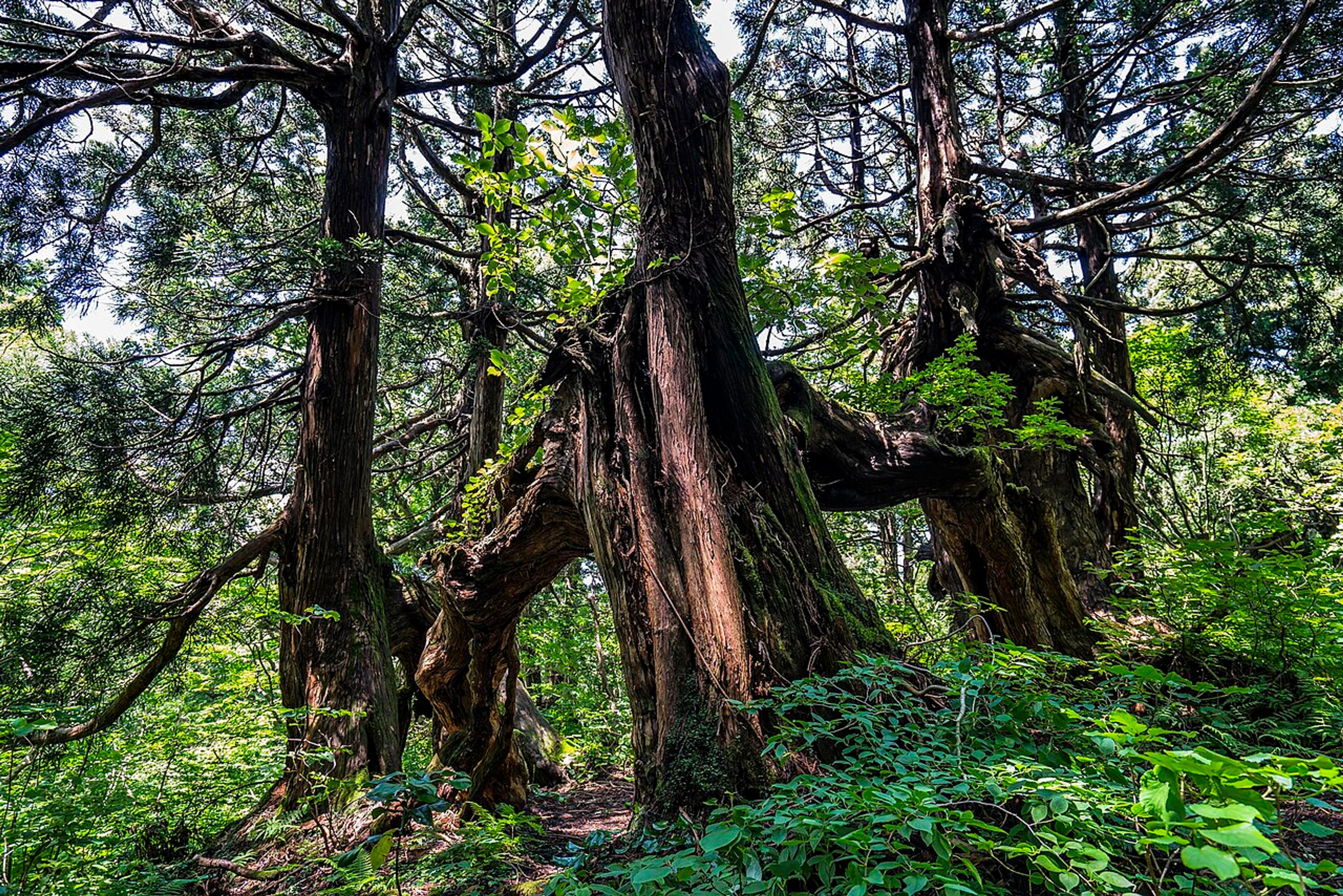
Sado Island distills centuries of exile, gold rush ambition, and artistic reinvention into one remote island off Niigata's coast.
Koku Travel · February 16, 2026
7 places in this guide
An Island Built by Outcasts
Sado Island sits 35 kilometers off the coast of Niigata in the Sea of Japan, large enough to have its own mountain range, its own rice paddies, its own distinct culture. For most of Japanese history, Sado was a place of exile, emperors, aristocrats, intellectuals, and monks were banished here when they fell from political favor. The exiles brought Kyoto court culture to a fishing island, and the collision produced something unique: Noh theater performed in rice paddies, imperial poetry traditions maintained by farmers, and a cultural depth wildly disproportionate to the island's size.
Then gold was discovered. The Sado Kinzan gold mine, operational from 1601 to 1989, was once the largest in Japan and funded the Tokugawa shogunate's entire monetary system. Thousands of miners were shipped to the island, many forcibly, and their labor hollowed out an entire mountain. Today the mine tunnels are a UNESCO World Heritage Site, the exile culture survives in over 30 active Noh stages, and the island's newest identity centers on Kodo, the taiko drumming troupe that has made Sado synonymous with percussive art worldwide.
Sado Kinzan: The Gold Mountain
The Sado gold and silver mine complex stretches across the Aikawa district on the island's western coast. The most dramatic feature is the Doyu no Warito, a mountain literally split in half by mining, its two halves standing like broken teeth against the sky. The open-cut scar is visible from kilometers away and remains the most visceral evidence of the scale of extraction that occurred here over four centuries.
Two main tunnel routes are open to visitors. The Sodayu tunnel (¥900) follows an Edo-period hand-dug shaft and uses life-sized mechanical figures to recreate the brutal conditions of pre-industrial mining, men crouched in tunnels barely a meter high, hauling ore in baskets by candlelight. The Dohyu tunnel (¥900) traces the Meiji-era industrial route, where Western mining technology transformed production. A combination ticket (¥1,400) covers both routes and takes about 90 minutes. The underground temperature is a constant 10°C year-round, bring a jacket even in August.
The mine's UNESCO inscription in 2024 was controversial. Korean and Chinese forced laborers worked the mine during World War II under brutal conditions. The interpretive displays now acknowledge this history alongside the Edo-period heritage, but the presentation remains a subject of international debate. Understanding both layers of history enriches the visit.
Kodo and the Earth Celebration
Kodo is a professional taiko drumming ensemble based on Sado since 1981. The group's members live communally on the island, training with a rigor that blurs the line between musical practice and athletic discipline. Their signature piece, O-Daiko, features a single drummer on a drum so massive it requires a specially built cart, the performer strikes it with full-body force, and the sound is felt in the chest before it reaches the ears.
Every August, Kodo hosts the Earth Celebration, a three-day outdoor music festival on Sado's Shiroyama Park overlooking the sea. The festival brings international musicians to collaborate with Kodo, and the evening performances under open sky, with the Sea of Japan behind the stage, create an atmosphere that is part concert, part ritual. Tickets for the main stage performances sell for ¥5,000-8,000, but fringe events, workshops, and the general festival atmosphere are free. The island's population roughly doubles during the festival weekend.
Outside the Earth Celebration, Kodo performs at the Sado Island Taiko Centre in Ogi village. Drop-in taiko workshops (¥2,000, 60 minutes) let you strike the drums yourself under instruction from Kodo apprentices. The physical sensation of hitting an odaiko, the reverberation through your arms and torso, cannot be replicated by watching a performance.
Exiled Emperors and Living Noh
Emperor Juntoku was exiled to Sado in 1221 after a failed attempt to overthrow the Kamakura shogunate. He spent 21 years on the island before dying in exile, and his tomb (Mano Goryo) remains a solemn pilgrimage site on the central plain. The monk Nichiren, founder of one of Japan's major Buddhist sects, was also exiled here in 1271, and his temple sites dot the southern coast. The exiles' cultural influence persists most visibly in Noh theater, Sado has over 30 Noh stages, more per capita than anywhere in Japan, including Kyoto.
Many of the stages are outdoors, set against rice paddies or forest clearings, and the takigi Noh performances, lit by bonfires, held at shrines from June through August are Sado's most striking cultural events. The performers are not professionals but local farmers and fishermen who have learned the art through generations of community transmission. The quality varies, but the context, ancient drama performed under firelight by the people of the place, is irreplaceable. Most performances are free or accept a small donation.
Takigi Noh performances are concentrated from June to August, with the Sado Noh no Sato festival in late June being the highlight. Check the Sado Tourism site for the annual Noh schedule, performances happen at different shrines on different nights, and attending two or three across a stay reveals the range of stages and settings.
Tub Boats and the Southern Coast
The tarai-bune, circular wooden tub boats, of Ogi port on Sado's southern tip are the island's most photographed attraction. Originally designed for harvesting seaweed and abalone in the rocky coves where conventional boats could not maneuver, the tubs are now paddled by women in traditional dress who ferry tourists around the harbor. A ride costs ¥500 for about 10 minutes and is more stable than it looks, though the rocking motion takes a moment to trust.
The southern coast beyond Ogi is Sado's quietest stretch, fishing villages tucked into coves, rocky headlands with sea caves, and the Senkakuwan bay, where glass-bottomed boats cruise over coral formations unusual at this latitude. The coastal road from Ogi to Akadomari passes through a landscape that feels Mediterranean in summer, terraced hillsides, blue water, stone walls, an improbable counterpoint to the island's northern mining heritage. The Shukunegi district, a 20-minute walk from Ogi port, preserves a shipbuilding village of narrow lanes and 100-year-old wooden houses that once produced the kitamaebune trading ships.
The Jetfoil from Niigata Port to Ryotsu takes 67 minutes and costs ¥6,880 one way. The car ferry takes 2.5 hours but costs only ¥2,550 for a second-class seat. If you are not bringing a car, the Jetfoil saves enough time to justify the cost. Island buses run infrequently, renting a car (¥5,000-7,000/day) or e-bike (¥3,000/day) is essential for the southern coast.

Turn this guide into a trip
We'll prioritize these 7 places when building your itinerary.