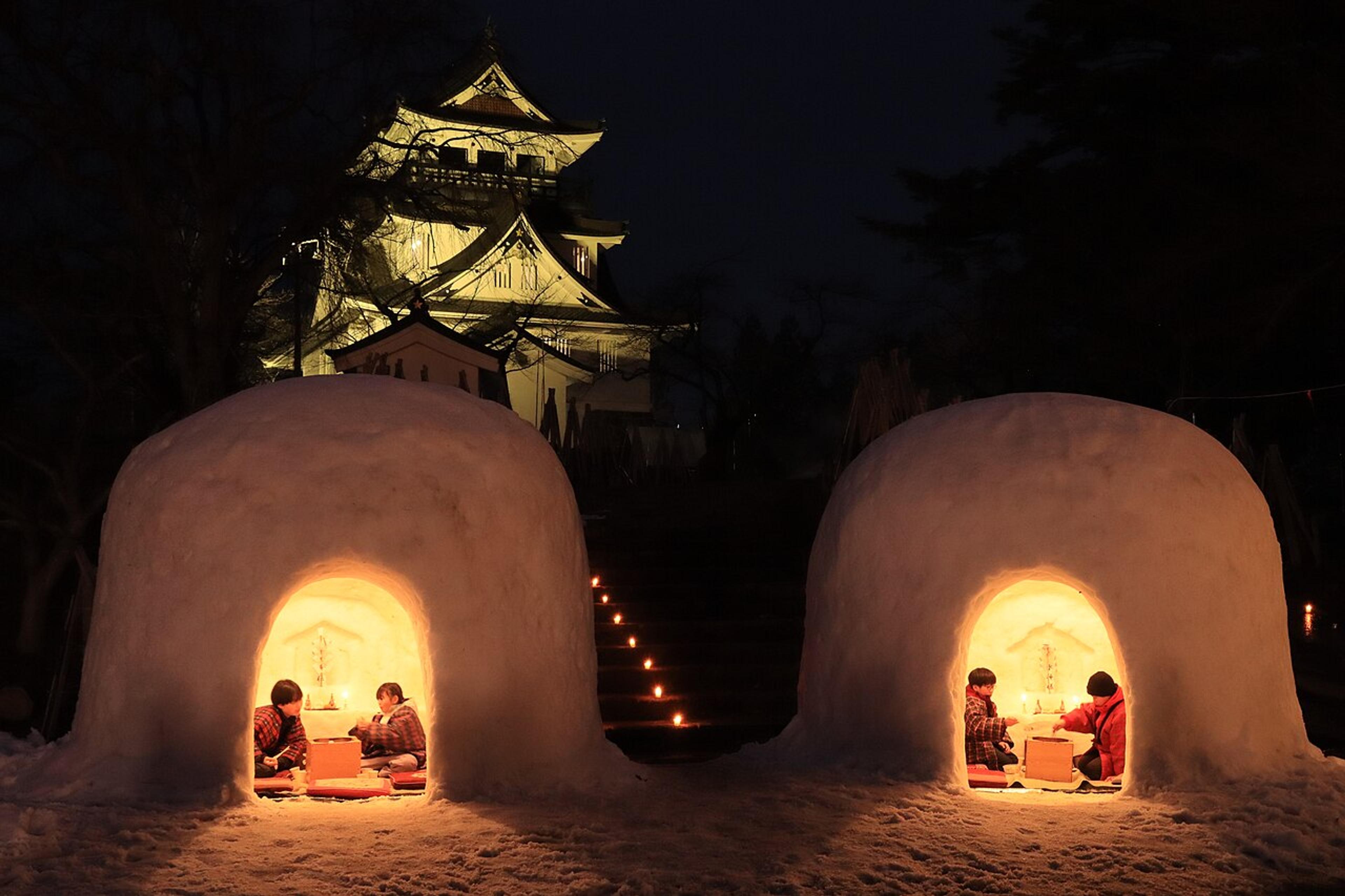
Tohoku's winter festivals transform heavy snowfall into art: Yokote's glowing kamakura, Hirosaki's snow lanterns, and onsen retreats between celebrations.
Koku Travel · February 16, 2026
5 places in this guide
Celebrating the Snow
Tohoku receives more snow than almost any other inhabited region on earth. The Sea of Japan effect, moisture-laden air from the warm Tsushima Current rising over the mountain spine of northern Honshu, dumps meters of snow on the western prefectures every winter. Cities like Yokote, Hirosaki, and Daisen routinely see two to three meters of accumulated snowfall. Rather than merely enduring it, these communities have developed winter festivals that transform the burden of snow into art, ritual, and communal celebration.
The major Tohoku winter festivals cluster in February, when snow coverage is deepest and the evenings are long. A well-planned circuit can link three or four festivals in a single week, with onsen retreats filling the gaps between celebrations. This guide covers the essential festivals and the practical logistics of traveling through deep-snow country.
Yokote Kamakura Festival
The Yokote Kamakura Festival, held February 15-16 each year, is the most iconic winter event in Akita Prefecture. Kamakura are snow huts, domed structures about 3 meters wide and 2 meters tall, hollowed from packed snow blocks. Each kamakura contains a small altar to the water deity Suijin, and children sit inside offering amazake (sweet rice drink) and mochi (rice cakes) to visitors who stop to pray. The tradition dates to the Edo period and was originally a children's festival associated with the lunar new year.
On festival nights, about 100 kamakura line the streets and riverbanks of Yokote, each lit from within by candles. The effect is magical, warm amber light glowing through translucent snow walls, the sound of children's voices calling 'haitte tanshe' (come in, please) from inside. On the hillside above the Yokote River, hundreds of miniature kamakura (about 30 centimeters tall) are arranged in rows, each containing a single candle, creating a field of flickering lights against the snow.
Arrive in Yokote by 4 PM to see the kamakura being constructed and lit, the transition from daylight construction to evening illumination is the most atmospheric period. The miniature kamakura on the Yokote River hillside are the most photographed scene; position yourself across the river for the best angle. Yokote is 50 minutes from Omagari Station on the JR Ou Main Line.
Hirosaki Castle Snow Lantern Festival
Hirosaki Castle, famous for its cherry blossoms in spring, transforms in winter into the venue for the Hirosaki Castle Snow Lantern Festival (Hirosaki-jo Yuki Toro Matsuri), held over four days in early February. The castle park fills with snow sculptures, ice carvings, and hundreds of snow lanterns arranged along the moat paths and around the castle tower. The centerpiece is usually a large-scale snow replica of a famous building, sculpted by local teams and illuminated with colored lights.
What distinguishes Hirosaki from Sapporo's more famous snow festival is scale and intimacy. Hirosaki's event is smaller, less commercial, and set within the historic castle grounds, where ancient cherry trees (bare in winter) frame the snow sculptures against the castle walls. The moat, partially frozen, reflects the lantern light. Food stalls sell regional winter specialties: nabe (hot pot), nikumiso-den (miso-grilled rice patties), and hot apple cider made from Aomori's celebrated apples.
The Hirosaki Snow Lantern Festival is free to enter. Food stall items run ¥300-600. Hirosaki is 35 minutes from Shin-Aomori Station (Tohoku Shinkansen) by JR Limited Express, ¥680. Accommodation in Hirosaki is plentiful and affordable, business hotels near the station offer rooms from ¥5,500 during the festival period.
Inukko Matsuri and Daisen
The Inukko Matsuri (Dog Festival) in Yuzawa, south of Yokote, is one of Tohoku's most endearing and least-known winter events. Held over two days in mid-February, the festival fills the town's shrine grounds with hundreds of small snow sculptures of dogs, sitting, running, sleeping, howling, each about 30 centimeters tall, carved by residents and school children. The dogs are placed on shelves of packed snow and lit by candles after dark.
The festival's origin is a 17th-century legend about a magistrate whose hunting dogs detected a plot against his life. The snow dogs are offerings of gratitude and protection. The atmosphere is local and familial, grandparents help children carve, hot sake is shared freely, and the scale is deliberately small. Nearby Daisen, in the mountains above Yokote, holds its own bonten matsuri (banner festival) in which teams carry massive, ornate banners through the snow to a hilltop shrine, competing in a chaotic, joyful scramble that is as much sport as ceremony.
The Daisen bonten matsuri (held at Taiheisan Miyoshi Shrine in January) is a physically intense event, teams of men race through deep snow carrying 5-meter bamboo poles topped with elaborate woven decorations. Spectators are often caught in the jostling as teams compete to be first to plant their banner at the shrine. It is exhilarating, occasionally chaotic, and entirely uncommercial, this is a community ritual, not a performance.
The Winter Onsen Circuit
Between festivals, the winter onsen towns of Tohoku provide the essential counterpoint, warmth, quiet, and rest after cold outdoor celebrations. Nyuto Onsenkyo, deep in the mountains of Akita, offers rustic baths in milky sulfur water surrounded by snow-laden beech forest. Ginzan Onsen in Yamagata turns its gas-lit streetscape into a winter postcard when snow banks reach head height. Takayu Onsen above Fukushima city has powerful sulfur baths and mountain views.
The logistics of combining festivals and onsen require some planning but are manageable. The Akita and Yamagata Shinkansen lines connect to local trains and buses that reach all the festival towns and most onsen destinations. A rental car offers more flexibility but requires winter tires (standard on all Tohoku rentals) and confidence driving in heavy snowfall. The key is to alternate: festival day, then onsen rest day. The cold, the crowds, and the walking take more energy than expected.
The JR East Pass (Tohoku Area, 5-day flexible, ¥30,000 for foreign visitors) covers all Shinkansen and local trains for the festival circuit and pays for itself by day two. Reserve seats on Shinkansen legs, unreserved cars on popular routes can fill up during festival weekends. Book onsen ryokan at least one month ahead for February stays.

Turn this guide into a trip
We'll prioritize these 5 places when building your itinerary.