The Forgotten Boso Peninsula
Itinerary · tateyama · 8 min
Chiba's Boso Peninsula hides in plain sight: Nokogiriyama's giant Buddha, Katsuura's morning market, early-blooming flowers, and uncrowded Pacific surf spots.
Yuku Japan · February 16, 2026
2 places in this guide
Tokyo's Overlooked Peninsula
The Boso Peninsula forms the eastern arm of Tokyo Bay, curving south into the Pacific like a crooked finger pointing at the Izu Islands. Most Tokyo residents think of Chiba Prefecture as Narita Airport and Disneyland, functional transit points, not destinations. The peninsula itself is ignored by international visitors entirely and undervisited even by locals. This is a mistake. Within 90 minutes of Tokyo Station, the Boso coast offers cliff temples, fishing port markets, the earliest spring flowers in the Kanto region, and surf breaks that face open ocean.
The peninsula divides into two distinct coasts. The western side faces Tokyo Bay, calmer water, sunset views, and the industrial fringe of Chiba City giving way to fishing villages. The southern and eastern coasts face the Pacific, rougher water, dramatic cliffs, and a maritime culture that feels more distant from Tokyo than the actual distance suggests. A two-to-three-day loop covers both sides comfortably by car, or you can focus on specific sections using the JR Uchibo and Sotobo railway lines.
Nokogiriyama and the Great Buddha
Nokogiriyama (Mount Sawtooth, 329m) sits at the northern tip of the inner Boso coast, accessible by a ropeway from Hamakanaya Station (¥950 round trip) or by a steep hiking trail from the base (40 minutes). The mountain was quarried for centuries, its distinctive serrated profile comes from stone removal, not erosion, and the abandoned quarry faces and tunnels have been incorporated into a temple complex of unexpected drama.
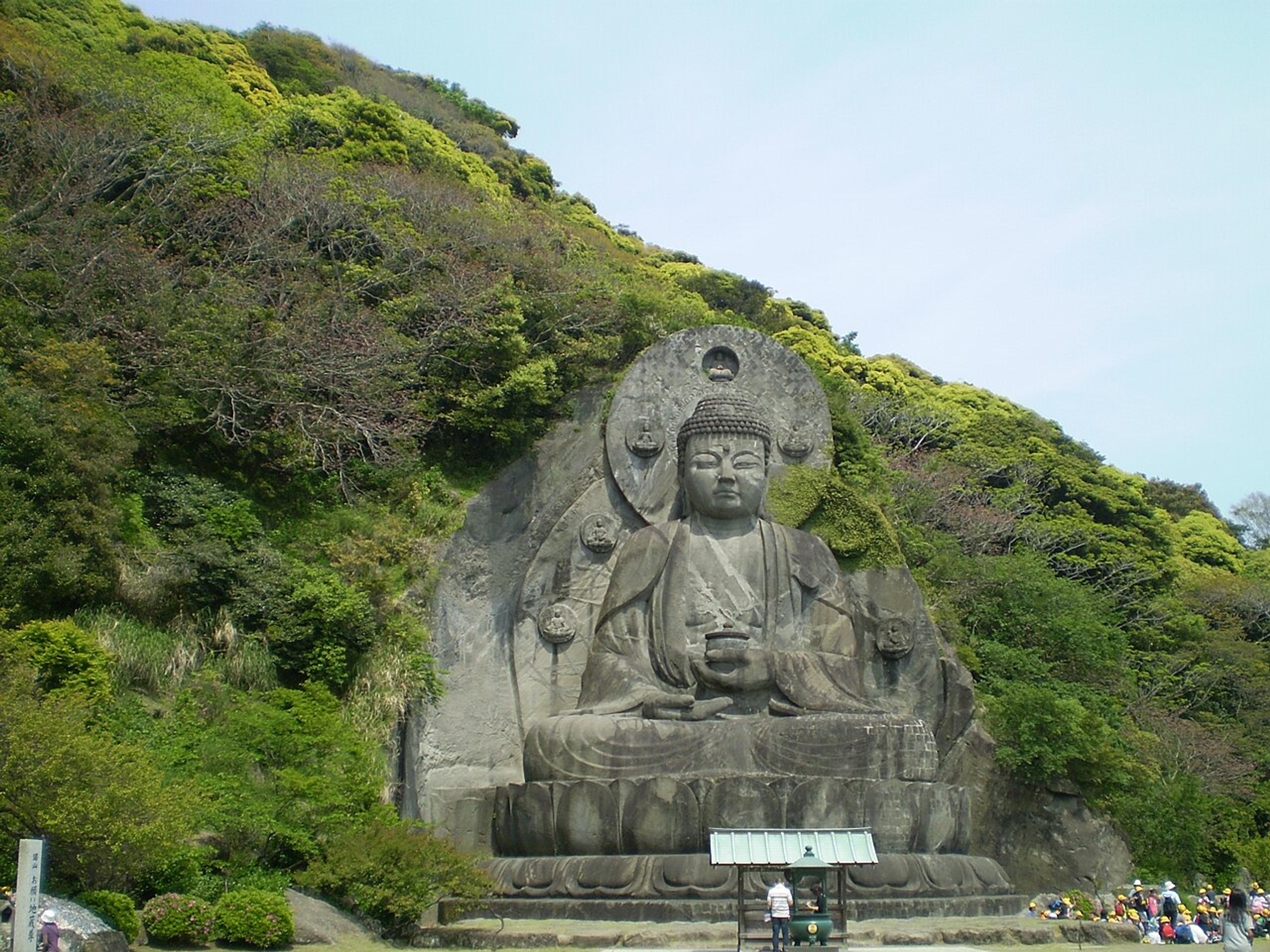
The Nihon-ji Temple complex spreads across the entire mountain. The centerpiece is the Daibutsu, a 31-meter seated Buddha carved directly into the cliff face in 1783, making it the largest pre-modern stone-carved Buddha in Japan (taller than Kamakura's bronze Daibutsu). The Jigoku Nozoki (Hell Viewpoint) is a protruding rock ledge at the cliff edge where visitors lean over a sheer drop to Tokyo Bay, the view is vertiginous, spanning the bay to the Miura Peninsula and, on clear days, Mount Fuji. The Thousand Five Hundred Rakan, 1,553 individually carved stone disciples lining the mountain paths, took 21 years to complete. Each face is unique. Entry to the temple complex is ¥700.
Take the ropeway up and hike down. The descent through the Rakan stone figures is the most atmospheric part of the complex, and walking downhill through the quarry trails is easier on the knees than climbing. Allow 2-3 hours for the full complex. Bring water, there are no vending machines once you enter the temple grounds.
Katsuura Morning Market and the Pacific Coast
Katsuura, on the outer (Pacific) Boso coast, hosts one of Japan's three great morning markets, operating continuously for over 400 years. The market sets up along a single street near the harbor every morning except Wednesdays, roughly 6 AM to 11 AM. The stalls sell fresh fish from the morning catch (bonito, squid, mackerel), local vegetables, pickles, dried seaweed, and homemade mochi. The atmosphere is unhurried and genuinely local, this is not a tourist market but a functioning supply chain for the town's restaurants and households.
The Katsuura coast south of town rewards exploration. Ubara Beach is a reliable surf spot with a sandy bottom and consistent Pacific swells. The Cape Katsuura lighthouse trail offers cliff-top walking above blue water. In February, the Katsuura Big Hina Matsuri (Doll Festival) displays over 30,000 hina dolls on the steps of Tomisaki Shrine, the cascade of tiny figures flowing down the stone staircase is a spectacle unique to this town.
At Katsuura's morning market, a grilled squid stick costs ¥300, a bag of fresh wakame seaweed ¥200, and a portion of local kinmedai (golden-eye snapper) sashimi ¥500. A full breakfast grazing the stalls costs under ¥1,000 and tastes better than most restaurant meals in Tokyo.
Early Spring Flowers
The southern Boso Peninsula benefits from the warm Kuroshio Current flowing offshore, creating a microclimate that blooms two to four weeks ahead of Tokyo. In January and February, when the rest of Kanto is still deep in winter, the Boso coast erupts in color. Chikura Hana no Sato (Chikura Flower Village) grows over a million stems of stock, poppy, and marigold in open fields along the coast, visitors pick their own bouquets for ¥500-800. The sight of flower fields against a blue Pacific backdrop while Tokyo shivers is genuinely surreal.
Cherry blossoms arrive early too. The Moto-Machi district of Tateyama has kawazu-zakura trees (the early-blooming variety native to Izu) that flower in late February, a full month before Tokyo's somei-yoshino peak. Kyonan-machi's Suisen (narcissus) Road blooms from December through February, three million narcissus flowers carpeting the hillsides above the coast. These early blooms mean Boso has a flower season when the rest of Kanto offers only gray skies and bare branches.
The Boso flower calendar: narcissus December-February, stock and poppy January-March, kawazu-zakura late February, rapeseed (nanohana) March, somei-yoshino cherry late March. The southern tip around Shirahama and Tateyama is consistently 2-3 weeks ahead of Tokyo. Plan accordingly and layer up, warm current or not, February sea wind is cold.
Surf Culture and the Kamogawa Coast
The outer Boso coast between Kamogawa and Ichinomiya is the closest legitimate surf zone to Tokyo. The beaches face southeast into the Pacific and catch swells from tropical storms, typhoons, and winter lows. Ichinomiya's Shidashita Beach hosted the surfing events at the 2021 Olympics and has the most developed surf infrastructure, board rentals (¥3,000-4,000 for a half day), surf schools (¥5,000-8,000 for a group lesson), and beachfront cafes.
Kamogawa, further south, is quieter and more characterful. The harbor area has fresh-fish restaurants where the set lunch (teishoku) features whatever came off the boats that morning, typically ¥1,200-1,800 for a generous plate of sashimi, rice, miso, and pickles. The town's Sea World aquarium is kitschy but the orca show draws families from across Kanto. Above the coast, the terraced rice paddies of Oyama Senmaida (Great Mountain Thousand Rice Paddies) cascade down a steep hillside to the sea, one of the most photographed landscapes in Chiba.
The Boso Peninsula is best explored by car. JR trains serve the coast but stations are far from many highlights. Rental cars from Kisarazu or Tateyama start at ¥5,000/day. The Tokyo Bay Aqua-Line expressway connects Kawasaki to Kisarazu in 15 minutes, making the peninsula surprisingly accessible from western Tokyo.
Featured in this guide
Places to Visit
Turn this guide into a trip
We'll prioritize these 2 places when building your itinerary.