Hokkaido's Backcountry Onsen
Itinerary · noboribetsu · 9 min
Beyond Noboribetsu and Jozankei lie Hokkaido's wildest onsen: sulfur pools at Tokachidake, milky baths beneath Asahidake, and riverside soaks in Niseko's backcountry.
Yuku Japan · February 16, 2026
2 places in this guide
Beyond the Tourist Onsen
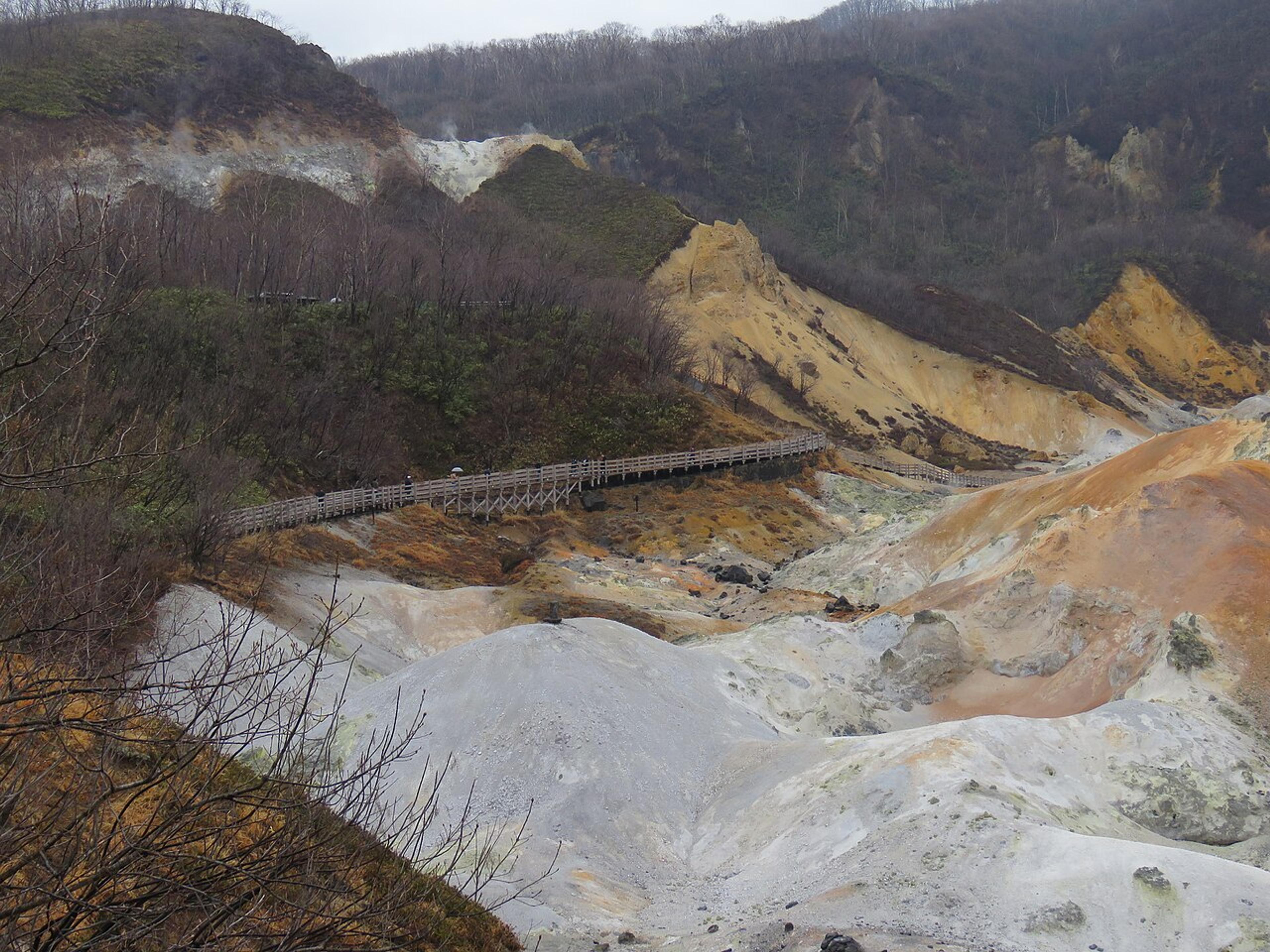
Noboribetsu is where most visitors experience Hokkaido hot springs, the Jigokudani (Hell Valley) boardwalk, the sulfur steam, the row of large-format ryokan with conveyor-belt kaiseki dinners. It is fine, and the water is genuinely excellent. But Noboribetsu is the surface layer. Hokkaido's volcanic geology runs deeper than any other region in Japan, and the most extraordinary bathing experiences sit at the end of gravel roads, up unmarked trailheads, and in valleys where the only sound is water hitting rock.
This guide traces a route through four of Hokkaido's hidden onsen areas, each one requiring more effort to reach than Noboribetsu, and each one repaying that effort with water, setting, and solitude that the big resort towns cannot match. The route runs roughly north from Niseko through the Daisetsuzan range, covering ground that most visitors never see.
Niseko Backcountry Onsen
Niseko is known for powder snow and Australian ski tourists, but the volcanic geology beneath the ski runs feeds a network of onsen that most skiers never find. Goshiki Onsen sits at the end of a narrow mountain road on the east face of Mount Niseko-Annupuri, at 750 meters elevation. The ryokan is a weathered wooden building surrounded by birch forest, and the outdoor rotenburo looks directly up at the mountain. The water is a deep, opaque green, iron-rich and acidic, with a mineral tang that you can taste on your lips hours later. A night here costs ¥8,500 with two meals.
Yukichichibu, further up the road toward Niseko's backcountry, is even more remote. The small inn has been run by the same family for three generations and receives almost no international visitors. The bath is a single stone tub fed by a pipe from the hillside, with water so hot at the source (72°C) that it must cool in a wooden channel before entering the pool. In winter, you sit in 43°C water while snow falls on your head and the birch trees creak under ice. It is one of the purest onsen in Hokkaido.
Goshiki Onsen's mountain road closes from November through late April due to snow. During the open season (May-October), drive from Niseko village in about 40 minutes. No public bus, rental car or taxi only. Call ahead to confirm the road is open, as late-season snowfall can close it unexpectedly.
Tokachidake: Sulfur and Steam
The Tokachi Mountains in central Hokkaido are among the most volcanically active in the range, and the onsen town of Tokachidake Onsen clings to the mountainside at 1,280 meters, one of the highest-elevation onsen settlements in Hokkaido. The area has just three inns and a public campground, all fed by springs that emerge from the volcanic rock at temperatures exceeding 60°C. The water is milky white with dissolved sulfur, and the smell of hydrogen sulfide hangs in the valley like fog.
Ryounkaku, the oldest inn (operating since 1897), has an outdoor bath perched on a ridge with an unobstructed view across the Tokachi Plain, on clear days, you can see 100 kilometers to the Pacific coast while sitting in sulfur water. The inn is basic: tatami rooms, shared bathrooms, communal meals of local venison and mountain vegetables. A night with two meals runs ¥7,000-9,000, making it one of the best-value ryokan stays in Hokkaido. The Fukiage Rotenburo, a free public outdoor bath 2 kilometers down the road, sits in a river gorge where hot spring water mixes with glacial runoff. You control your own temperature by moving between the hot spring source and the cold stream.
Fukiage Rotenburo is completely free, no entrance fee, no changing rooms, no staff. Bring your own towel, leave no trace, and respect the konyoku (mixed bathing) etiquette. The bath is accessible from late June through October. Parking is at a small pullout 200 meters from the trail.
Asahidake: The Highest Onsen
Asahidake is Hokkaido's tallest peak (2,291 meters) and the northern anchor of the Daisetsuzan range. The small onsen settlement at its base, Asahidake Onsen, sits at 1,100 meters and serves as a staging point for hikers heading into the alpine zone. But the onsen themselves justify the visit. The water here is different from Tokachidake, clear, slightly alkaline, with a silky texture that coats the skin like lotion. The volcanic source is deep, and the mineral profile is complex: sodium, calcium, sulfate, and traces of lithium that some bathers claim produce a subtle euphoria.
Yumoto Yukomanbetsu, a small lodge at the end of the access road, has an outdoor bath surrounded by dense Yezo spruce forest. In autumn, the Japanese rowan trees turn crimson against the dark conifers, and the steam from the bath drifts through the color like smoke. The lodge serves wild Hokkaido venison and foraged mushroom hotpot. In winter, the ropeway to the upper mountain operates for backcountry skiers, and the onsen becomes a recovery station for legs destroyed by waist-deep powder. A night with dinner and breakfast costs ¥10,000-12,000.
Asahidake's autumn colors peak in mid-September, the earliest in Japan, a full month before most of Honshu. The ropeway runs year-round (¥2,200 return) and offers aerial views of the color change. Winter access is reliable but the road requires studded tires or chains from November through April.
Kawayu Onsen: The Acid Bath
Kawayu Onsen, in the Akan-Mashu National Park near Teshikaga, is unlike any other onsen in Hokkaido. The water is strongly acidic, pH 1.8, comparable to lemon juice, and flows directly from the flanks of Mount Io (Sulfur Mountain), an active volcano that vents sulfurous gases from fumaroles visible from the town. The Kawayu River itself is a hot spring: the entire streambed is heated, and in summer, locals dig shallow pools in the riverbank and bathe in water that is naturally heated to bathing temperature.
The town's ryokan tap into this acid water, which is reputed to cure skin conditions and has a distinctive sharp, tingling sensation on the body. Kin-no-Yu, the public bathhouse (¥250), is the most no-frills of them, two pools of different temperatures and water so mineral-rich it has stained the tile work into abstract patterns over decades. The stronger ryokan baths have a pH low enough to dissolve a coin overnight. Guests with sensitive skin should test cautiously; for everyone else, the water produces an extraordinary smoothness that lasts for days.
Kawayu's acid water can irritate open cuts, sensitive skin, and eyes. Do not submerge your face. Remove all jewelry before bathing, the sulfur will tarnish silver and corrode base metals within minutes. Rinse thoroughly with fresh water after bathing to prevent skin irritation.
Planning the Onsen Route
The four onsen areas form a rough crescent across central Hokkaido. A practical route runs: Niseko (1 night) → Tokachidake (1 night) → Asahidake (1 night) → Kawayu (1 night), covering the circuit in four days with a rental car. Public transit is possible but slow, JR Hokkaido trains reach Kamikawa (for Asahidake) and Mashu Station (for Kawayu), but the mountain onsen require bus connections or taxi rides that add hours.
The best season for the full route is late September through mid-October, when autumn colors are at their peak in the Daisetsuzan range and the mountain roads are still open. Summer (July-August) offers the longest days and access to the free riverside baths. Winter limits access to Asahidake and Kawayu only, but the experience of soaking in an outdoor bath during a Hokkaido snowstorm, visibility reduced to the edge of the pool, snowflakes dissolving on the water's surface, is worth the restricted itinerary.
Rent a car from Asahikawa or Obihiro rather than Sapporo to avoid the congested expressway. Hokkaido rental cars come with studded winter tires from November through April at no extra charge. Budget ¥6,000-8,000 per day for a compact car with insurance.
Featured in this guide
Places to Visit
Turn this guide into a trip
We'll prioritize these 3 places when building your itinerary.