Hokkaido's wildest corners hold supernatural blue ponds, tide-dependent hot springs, and remote islands where alpine flowers bloom at sea level.
Koku Travel · February 15, 2026
11 places in this guide
Most visitors to Hokkaido follow a predictable arc: Sapporo beer, Furano lavender, Otaru canals. These are fine. But the island's real character lives in its margins, volcanic coastlines with no road access, ponds so clear that submerged trees refuse to decompose, and onsen where the Pacific Ocean is your cold plunge.
Hokkaido is roughly the size of Austria, with a population of about 5.2 million, most of it concentrated in Sapporo. The rest is open space on a scale that exists nowhere else in Japan. Here are five places that reward the extra effort to reach it.
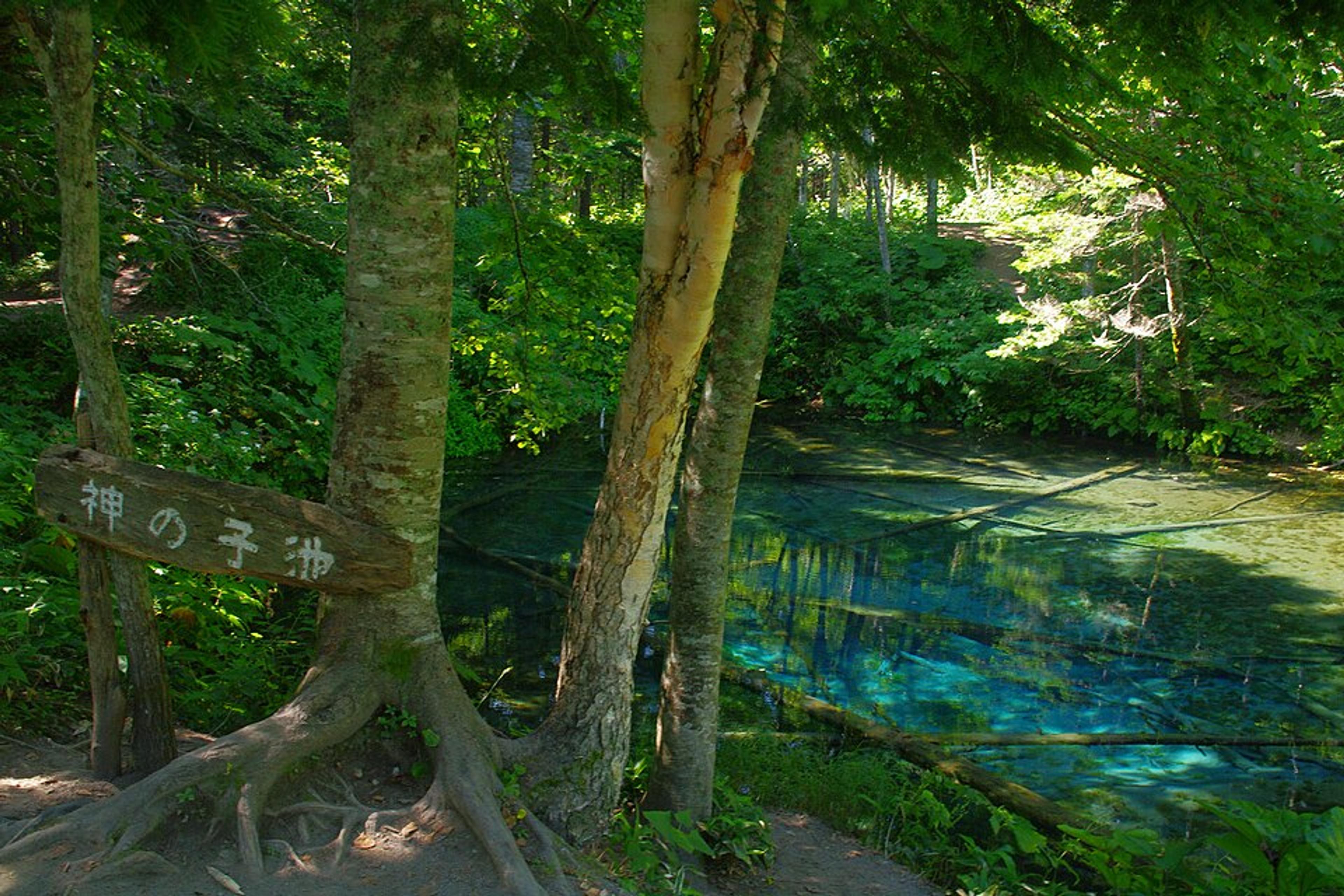
Kaminoko Pond
A tiny pond fed by underground springs from Lake Mashu, Kaminoko holds water at a constant 8 degrees Celsius year-round. The temperature is low enough that fallen trees submerged in the pond never decompose, they sit on the bottom like preserved specimens, perfectly visible through cobalt-blue water. The color shifts from deep indigo in winter to a brighter cobalt in summer, depending on how light hits the mineral content.
The pond is about 20 minutes by car from JR Mashu Station, down a gravel forest road. No facilities. No gift shop. The surrounding Akan-Mashu National Park holds Lake Mashu itself, one of the clearest lakes in the world, and the active volcanic landscape of Mount Io, where sulfur vents steam year-round. The region's Ainu heritage is preserved at the Ainu Kotan village near Lake Akan.
Cape Kamui
The Shakotan Peninsula juts into the Sea of Japan on Hokkaido's western coast, and Cape Kamui is its dramatic terminus. A narrow cliffside walking path, about 770 meters long, leads to the point, with sheer drops on both sides into waters so turquoise the locals call it "Shakotan Blue." The color comes from the water's extreme clarity over white volcanic rock. It looks more Caribbean than Japanese.
An Ainu legend designates the cape as sacred: a woman who waited for her lover threw herself from the cliffs, and her curse once prohibited all women from approaching. The ban was lifted in the Meiji era. The cape is about 2.5 hours from Sapporo by car, with no rail access. Go on a clear day or not at all, fog erases the color entirely.
Seseki Onsen
On the Shiretoko Peninsula's eastern coast, Seseki is a wild hot spring where 64-degree volcanic water flows directly from coastal rocks into the sea. The catch: it is only accessible at certain tide levels. At high tide, the ocean swallows it. At low tide, you sit in a rocky pool mixing scalding spring water with cold seawater to find a tolerable temperature. No changing facilities, no roof, no attendant.
The Shiretoko Peninsula is a UNESCO World Heritage site and one of the least accessible corners of Hokkaido, brown bears outnumber humans in many areas. Seseki embodies that character. The spring is open roughly from July through September, and even then, weather and tides dictate access. Check conditions locally before making the drive from Rausu, which itself is a 6-hour drive from Sapporo.
Shirogane Blue Pond
Near the town of Biei, volcanic runoff rich in aluminum hydroxide created an artificial pond with an otherworldly cobalt-blue surface. Dead larch trees stand in the water like ghostly sentinels. Apple used a photograph of it as a default macOS wallpaper in 2012, which made it famous overnight. The pond was actually created by accident in 1988 when a dam was built to prevent volcanic mudflows from nearby Mount Tokachi.
Despite the fame, it remains a simple boardwalk loop through forest, about 20 minutes of walking. The color is most vivid from May through June, when snowmelt increases the mineral concentration. Winter illuminations add another layer of surrealism when the snow-covered trees are lit against the frozen blue surface. The nearby town of Biei is worth exploring for its patchwork-quilt farmland and rolling hills.
Rebun Island
Japan's northernmost inhabited island sits off the coast of Wakkanai, reachable by a 2-hour ferry. Known as the "Island of Flowers," Rebun hosts over 300 species of alpine wildflowers that bloom at sea level, a quirk of the island's subarctic climate that compresses altitude zones. The 8-hour Rebun Island Trail in early summer (June through July) offers wildflower hiking found nowhere else in Japan, traversing coastal cliffs with views across the Soya Strait toward Sakhalin.
The island has a population of around 2,500, a handful of minshuku guesthouses, and no convenience stores. Fishing is the primary economy, Rebun sea urchin, harvested from cold northern waters, is considered among the finest in Japan. It is as far from urban Japan as you can get without leaving the country.
Getting Around
Hokkaido demands a rental car. Public transit connects major cities, Sapporo to Asahikawa, Hakodate, Kushiro, but the hidden gems sit between these corridors. Kaminoko Pond and Seseki Onsen require backcountry driving on narrow roads. Cape Kamui has a seasonal bus from Shakotan, but it is unreliable. Rebun requires the Wakkanai ferry. Budget at least a week to cover the distances. Summer (July to September) is the sweet spot for road access and wildflowers. Winter closes many mountain routes but opens up the Blue Pond illuminations and Seseki's dramatic ice coast. Sapporo's New Chitose Airport has direct flights from most Japanese cities and several international routes.
Featured in this guide
Places to Visit


Turn this guide into a trip
We'll prioritize these 12 places when building your itinerary.